



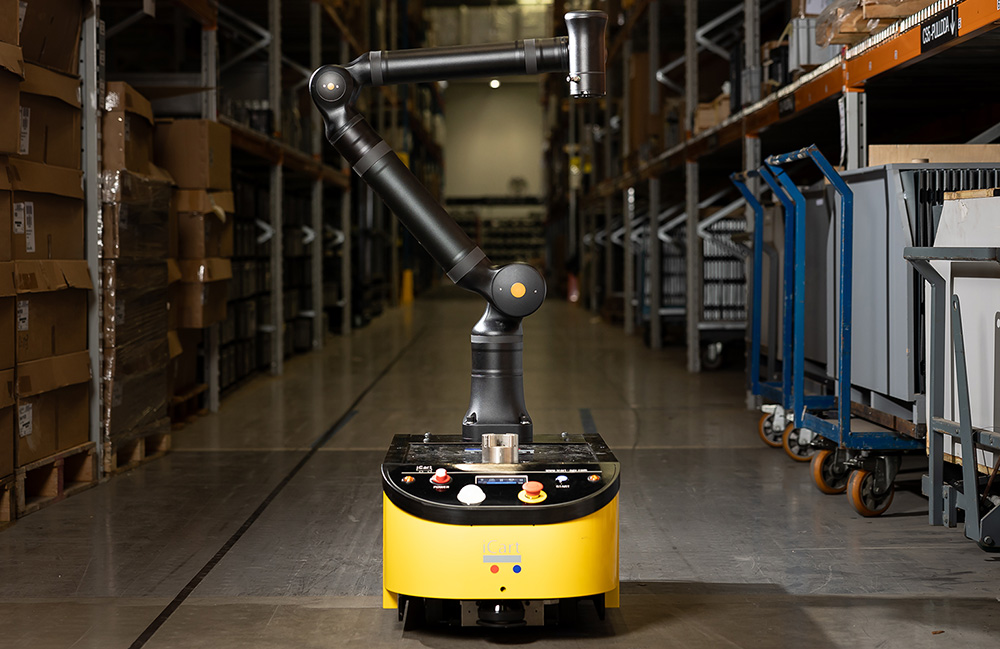
# Seven-Axis Cobots on AMRs Are Redefining Automation in Warehousing and Industrial Environments
The landscape of warehouse automation is evolving at an unprecedented pace. As facilities grapple with escalating productivity demands and persistent labor shortages, the adoption of autonomous mobile robots (AMRs) and collaborative robots—commonly known as cobots—is accelerating. These technologies are no longer confined to fixed stations; instead, they are being integrated into mobile manipulators capable of traversing entire facilities and performing a diverse array of tasks.
Cobot usage in industrial settings has surged tenfold between 2018 and 2025, signaling a fundamental shift in how warehouses and production floors operate. Among the most notable trends is the rise of seven-axis force- and power-limited robotic arms, which offer a greater range of motion compared to their six-axis predecessors. When mounted on AMRs, these advanced cobots can reach difficult-to-access areas, handle heavier objects, and execute demanding tasks with remarkable accuracy.
## Cobots Deliver Precision Across a Broad Range of Applications
Cobots are engineered to enhance precision in repetitive industrial tasks, including picking, assembly, screwing, labeling, and welding. Beyond individual workstation applications, integrating cobot capabilities onto mobile platforms extends these advantages across an entire facility. This approach streamlines workflows, improves operational precision, and significantly reduces the need for multiple dedicated cobot and industrial robot arm stations—ultimately minimizing manual and repetitive touchpoints for human workers.
The integration of cobots and AMRs also enables mobile manipulators to take on tasks such as loading and offloading materials and driving carts from station to station, functions that are performed far more efficiently by a mobile solution than by stationary equipment.
## Seven-Axis Design Provides Superior Flexibility and Workspace Optimization
A growing number of industrial operations are transitioning from traditional six-axis cobot arms to seven-axis models mounted on AMRs. The additional axis of motion allows these robots to reach under and around obstacles more effectively and to operate closer to the robot’s base—a zone where six-axis arms face inherent limitations. This expanded flexibility enables the system to complete more work with greater accuracy and in more orientations than previously possible.
One of the key challenges historically associated with making cobots mobile was the controller. Traditional static cobot arms required a large, dedicated controller housed in a nearby cabinet. Next-generation cobots mounted on AMRs solve this problem by integrating the controller directly into the robot’s slim base, eliminating the need for an external control cabinet entirely. Additionally, these cobots can run directly off the AMR’s batteries, resulting in a more compact, streamlined solution that improves both functionality and facility footprint.
Kassow Robots among the companies advancing this, producing cobots designed for compatibility with a wide variety of tools and featuring an integrated backdrive to facilitate robot positioning and programming—further simplifying deployment for end users.
## Worker Safety and Infrastructure Considerations
The introduction of compact mobile cobot solutions also shifts the safety dynamic within production environments. Workers have long been trained to follow extensive safety protocols when operating near large industrial robots. However, because high speed is not the primary function of cobot-AMR systems, the collaborative nature of these machines encourages closer and more frequent interaction between humans and robots, requiring fewer precautions than traditional industrial robotics setups.
That said, workcells, workpieces, and processes still require thorough safety assessments before deployment. Workers should also be aware that AMRs operating within facilities have priority when crossing high-traffic areas, a design choice intended to ensure robots can reach their desired locations with minimal bottlenecks.
Compared to the earlier generation of autonomous guided vehicles (AGVs), AMRs require significantly less physical infrastructure. AGVs depended on magnetic tape or physical mapping for guidance, along with external safety sensors for detecting people and surroundings. AMRs eliminate the need for such physical guides by relying on built-in lidar for autonomous maneuvering, making deployment simpler and more adaptable.
## Growing Adoption of Mobile Manipulators
The combination of autonomous mobility and flexible, seven-axis cobots is driving meaningful improvements in material handling efficiency across a range of industries. Several recent mobile manipulator systems exemplify this trend, including Brightpick’s Autopicker, Mantis Robotics’ system, and Locus Array, demonstrating the growing commercial viability and diversity of these solutions.
As the technology continues to mature and labor challenges persist, the seamless integration of cobots onto AMRs stands poised to play an increasingly central role in the future of warehouse automation and industrial operations worldwide.
—
*This article is based on information from the original post: [Kassow Robots Cobots Can Reach Difficult-to-Access Areas](https://www.therobotreport.com) | Source: The Robot Report*# Cobot-AMR Integration Offers Warehouses a Cost-Effective Path to Automation
Warehouse automation has been on a steady upward trajectory for years, even as some skepticism persists around the pricing, integration complexity, and return on investment of robotics solutions. However, the combination of collaborative robots (cobots) and autonomous mobile robots (AMRs) is emerging as a particularly cost-effective solution for handling repetitive, manual tasks. This approach allows workers to be redirected toward more complex responsibilities — a critical advantage as labor shortages continue to affect warehouses across industries.
## Human-Robot Collaboration Improves Job Satisfaction
Rather than replacing human workers, working alongside robots has been shown to improve job satisfaction by reducing physical strain and workplace injuries. Over time, this can help address the persistently high turnover rates that plague the warehousing sector. A study from the International Federation of Robotics (IFR) reported that robotics can improve warehouse operations through quality enhancement. Meanwhile, a report from Exotec found that 98% of workers said automation makes them more productive, reinforcing the idea that robotics and human labor are not mutually exclusive but complementary.
## Seven-Axis Cobots Bring New Flexibility to Tight Spaces
Among the latest innovations in cobot technology, seven-axis robots from companies like Kassow Robots are delivering new levels of maneuverability for industrial applications. Despite their extensive reach, these cobots are not only extremely strong and fast, but they can also be deployed in the tightest of spaces — a key advantage afforded by the additional seventh axis. The small base design makes them particularly well-suited for warehouse environments where floor space is at a premium.
## Decision Makers Should Evaluate Integrated Solutions
As companies operate in today’s labor market, cobot-AMR integration represents a strategic opportunity to improve efficiency and workplace conditions simultaneously.
As long as repetitive tasks and productivity remain the main priorities in warehousing, cobots integrated into AMRs can improve productivity and protect workers’ well-being — making the case for automation more compelling than ever.
—
**Original article source:** The Robot Report — [https://www.therobotreport.com](https://www.therobotreport.com)
