



# Why a Thermal Camera Could Be the Best Tool You Don’t Own Yet
**Thermal cameras don’t have to cost thousands, and they give you a genuine money-saving superpower.**
I’ve always been a tool person. One of my earliest memories involves playing with plastic tools alongside my grandpa, and I’ve maintained a toolbox since my early teens. Over the years, hand tools have increasingly given way to power tools, and more recently I’ve added some more exotic items to my kit — things like laser rangefinders and laser levels (yes, I have a thing for lasers, too).
But one of the most indispensable modern tools in my collection is, without question, a thermal camera. This single device has saved me thousands of dollars over the years.
## Breaking the Misconception
When most people think of thermal imaging, they picture the 1987 movie *Predator* starring Arnold Schwarzenegger, or they imagine military-grade optics. Many are surprised to learn that not only can you buy a thermal camera for personal use, but some models cost as little as $100.
So what options are actually out there?
## Three Types of Thermal Cameras to Consider
### 1. Standalone Thermal Cameras
These handheld units are dedicated to a single purpose — the one-trick pony of the thermal camera world. The market spans high-end professional units like the Bosch GTC600C 12V Max, Fluke TIS20+ MAX, and the Fluke TiS75+ (brace yourself before checking those prices), all the way down to more affordable options aimed at household users, such as the Topdon TC004, Topdon TC004 Mini, and the Foxwell RT280.
The biggest downside is exactly that — it’s one tool for one job, and if you don’t need thermal imaging regularly, it’ll spend most of its time sitting in a toolbox. The upside? These are robust, dedicated devices that offer excellent accuracy. Switch them on, point, and you’re measuring.
### 2. Thermal Camera Dongles
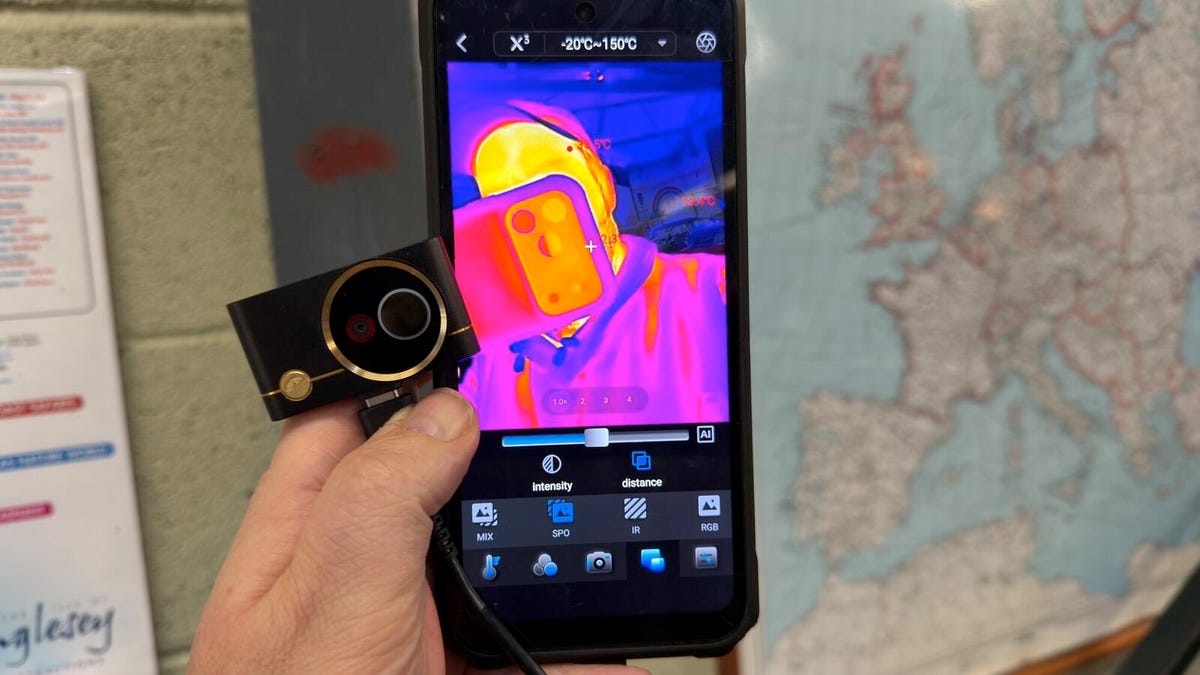
These compact devices plug into smartphones (and sometimes computers) and are operated via an app. The advantages are compelling: they’re small enough to fit on the end of a cable and reach tight spaces, there’s no battery to worry about, and because they’re connected to your phone, capturing images and video is incredibly easy.
There are drawbacks, though. They aren’t cheap — and you can find cheaper standalone units that may even outperform them. Their small size also makes them easy to misplace on a job site or in a toolbox. Additionally, many models tie you to a specific smartphone platform, though some newer models work on both Android and iPhone.
I’ve tested quite a few of these dongles, and they represent a great middle ground between standalone units and phones with built-in thermal cameras. Standout options include the Thermal Master P4 (iOS and Android), Topdon TC001 (iOS and Android), and the Klein Tools TI223 (iOS and Android).
### 3. Smartphones with Built-In Thermal Cameras
Believe it or not, several Android smartphones from manufacturers like Blackview, Ulefone, and Oukitel come equipped with built-in thermal cameras. These devices are typically ruggedized, making them ideal for workshop or field use.
I’ve tested many of these thermal-enabled smartphones, and some favorites include the Ulefone Armor 29 Pro Thermal, Blackview XPLORE 1 Pro AI, and the Oukitel WP500 Ultra.
The most obvious advantage is convenience — since most of us are practically glued to our phones, your thermal camera is always within arm’s reach. And since you’re already charging your phone regularly, the thermal camera stays charged too.
The downsides? You won’t find thermal cameras in any flagship smartphones, there’s no iPhone option with one built in, and since most of these are ruggedized devices, they tend to be on the bulky side.
## Why Thermal Cameras Are So Incredibly Useful
Thermal cameras give you the superpower of seeing what’s otherwise invisible to the human eye. Even inexpensive models are remarkably sensitive, capable of detecting tiny temperature differences on objects both large and small.
Even a sub-$100 thermal camera can detect the temperature difference in air from your nostrils when you breathe in versus when you breathe out, and can pick up residual heat after you’ve touched a surface with your finger.
Whether you choose a standalone unit, a dongle, or a ruggedized smartphone, a thermal camera is one of those tools that quickly pays for itself — and then some.
—
*Original article: [ZDNET – Why a thermal camera is the best tool you don’t own yet](https://www.zdnet.com/article/why-a-thermal-camera-is-the-best-tool-you-dont-own-yet/) by Adrian Kingsley-Hughes*# The Incredible Versatility of Modern Thermal Cameras
Modern thermal cameras possess an almost eerie degree of sensitivity, and this remarkable capability opens the door to some genuinely impressive applications. Here’s a look at just a few of the many practical tasks these devices can handle around the home and workshop.
## Energy Audits and Home Inspections
One of the most valuable uses for a thermal camera is conducting an energy audit. By scanning windows, doors, roofs, and walls, you can quickly identify areas where heat is escaping, or where insulation is thin or entirely missing. This allows homeowners to pinpoint exactly where energy is being wasted and take corrective action.
## Electrical Fault Finding
Overloaded circuits, faulty breakers, and loose electrical connections all manifest as hot spots in a thermal image. Detecting these issues early provides a critical warning long before they escalate into a serious fire hazard.
## Damp and Moisture Inspection
Moisture intrusion into a loft or ceiling appears as a distinctly cool patch on a thermal scan. Checking these vulnerable areas after rainfall is an excellent strategy for catching damp problems early, before mold and rot have a chance to take hold.
## Leaky Plumbing Detection
Wet patches hidden behind walls or beneath floors retain heat differently than dry material. This means that otherwise invisible plumbing leaks can be spotted without resorting to destructive exploration with a sledgehammer.
## Pest Detection
Suspect mice, rats, or a wasp’s nest lurking in a loft or wall cavity? Living animals generate enough body heat to appear clearly on a thermal image — even through walls.
## Diagnosing Faulty Circuit Board Components
Faulty electronic components tend to either overheat and reveal themselves as hot spots, or fail completely and show up as cold spots. This makes thermal imaging an invaluable diagnostic tool when troubleshooting electronics.
## The Best Way to Master Your Thermal Camera
The most effective way to learn how to use a thermal camera is simply to use it. Keep the camera close at hand and point it at everything around you. You may attract a few curious looks, but this constant scanning gives you a thorough understanding of what the world normally looks like in the thermal spectrum. Over time, anything that is unusually hot or cold will immediately stand out.
## Real-World Savings
Recently, a water heating tank developed an intermittent fault — sometimes heating, sometimes not. This was a repeat of a previous issue that had cost around $1,500 in diagnostic fees and replacement parts, yet the problem had persisted. This time, a thermal camera was used to trace the wiring from the switch to the heater, revealing a bad connection inside a wall switch. The metal box was radiating far more heat than expected because a single wire had come loose. After refitting the wire, the problem was finally resolved. Had it not been for the thermal camera, a far more expensive repair might have been undertaken unnecessarily.
Once you start exploring the world through a thermal lens, you’ll quickly discover that modern thermal cameras are an indispensable tool that pays for itself many times over — but perhaps best kept away from pets.
