



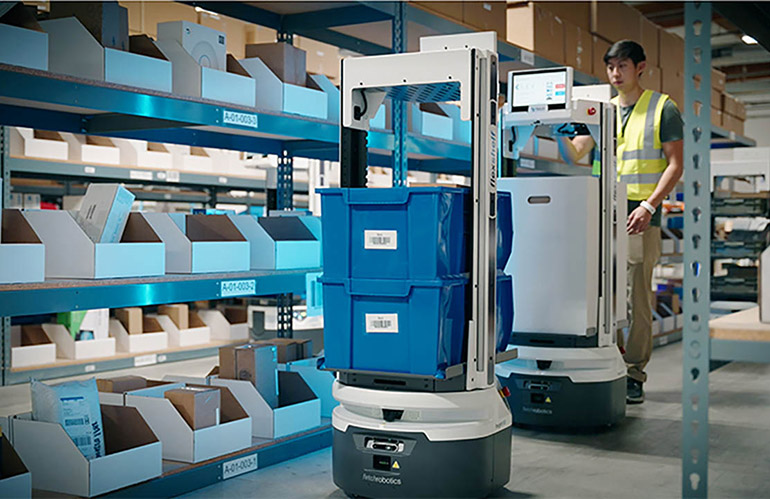
In a transfer to bridge the hole between basis AI and industrial {hardware}, Skild AI has acquired the robotics division of Zebra Applied sciences (previously Fetch Robotics). Skild stated the acquisition will assist it deploy its “omni-bodied” intelligence layer throughout the worldwide logistics sector. By integrating its hardware-agnostic AI “brain” with Zebra’s battle-tested warehouse platforms, the acquisition goals to rework task-specific automation right into a unified, autonomous success ecosystem whereas fueling Skild AI’s proprietary knowledge flywheel.
In a weblog article on the Skild web site, the corporate outlined a couple of particulars of the acquisition. Monetary particulars of the acquisition weren’t disclosed.
In keeping with the article, the acquisition indicators a pivot away from “brittle,” task-oriented robotics towards a unified intelligence layer able to controlling numerous types of machines. By merging its hardware-agnostic basis mannequin with Zebra’s established Symmetry orchestration platform, Skild AI goals to remove human bottlenecks within the success pipeline and create a self-reinforcing knowledge flywheel that would redefine productiveness within the multi-billion-dollar logistics and 3PL industries.
Skild CEO and co-founder Deepak Pathak instructed The Robotic Report that “the Fetch Team is the main reason for the acquisition as they bring years of deployment experience.” Skild plans to help the prevailing Fetch/Zebra put in base, promote new Fetch robots, and combine the Skild Mind into Fetch merchandise. This, the corporate stated, will improve the robots’ capabilities and open up new superior manipulation options for the warehouse.
The Zebra Symmetry platform is basically the fleet administration layer of the software program, coordinating and orchestrating the robots’ work. As seen within the video above, Skild has a imaginative and prescient of bringing collectively any mixture of robotic options to finish a given workflow.
It’s clear that Skild is enthusiastic about persevering with to develop the Symmetry software program and combine it deeply with the Skild Mind. Nonetheless, it’s not clear if Skild will proceed to develop the Fetch autonomous cell robotic (AMR) platform.
Skild is constructing an information flywheel
Skild is targeted on constructing out its “data flywheel” to coach AI world fashions. The first differentiator for Skild is the Skild Mind, a basis mannequin designed to function any machine that strikes. Skild designed the AI to adapt to bodily modifications, akin to a robotic shedding a limb or altering its heart of mass, without having retraining from scratch.
Skild AI makes use of a “catch-22” decision technique: robots want knowledge to enhance, however solely succesful robots will be deployed to assemble knowledge.
The corporate solves this by a phased rollout:
- Section 1 (Semi-Structured): Preliminary deployment in predictable environments like factories, warehouses, and knowledge facilities.
- Section 2 (Dynamic Environments): Shifting into hospitals, inns, and building websites.
- Section 3 (Unstructured): Attaining general-purpose robots able to working in totally unpredictable environments, akin to personal houses.
Skild AI companions with main Unique Tools Producers (OEMs) to embed its mind into current industrial infrastructure.
Key companions embody ABB Robotics, Common Robots, and Cellular Industrial Robots (MiR), which permit Skild to scale rapidly by using the {hardware} footprint of a few of the world’s largest robotics suppliers.
As seen with the Zebra Applied sciences acquisition, Skild integrates its AI into current software program platforms, like Symmetry, to handle massive fleets of numerous robots underneath one intelligence layer.
A protracted and winding path for Fetch Robotics
Zebra’s portfolio beforehand included Fetch cell robots for components success. | Supply: Zebra Applied sciences
Fetch Robotics was based in 2014 by Melonee Sensible and was an early pioneer within the autonomous cell robotic (AMR) market. As an early chief within the AMR market, Fetch helped set the usual for logistics and warehousing verticals.
Subsequently, Zebra Automation acquired the corporate for $291 million in July 2021. On the time, Zebra Applied sciences already owned 5% of Fetch Robotics by an earlier funding. Zebra acquired the remaining 95% of Fetch Robotics. Sensible left the Zebra to grow to be CTO at Agility Robotics and is now CPO at Kuka Robotics.
In a shock transfer, Zebra introduced in December 2025 that it was “winding down” the Fetch robotics division of the corporate.
What’s not clear within the Skild acquisition, and stays undisclosed, is what number of workers had been left within the Fetch robotics division following the introduced closure final December. There has doubtless been a mind drain since that announcement.
“Zebra Technologies has decided to explore strategic options for our robotics automation business,” the corporate stated in an emailed assertion to The Robotic Report in December. “This move will enable Zebra to further sharpen our strategic focus on digitizing and automating frontline workflows and on our investments in key growth areas. Long term, we will continue to provide solutions that empower organizations to increase productivity, optimize inventory, and better serve consumers and patients across the industries we serve.”

The put up Skild acquires Fetch Robotics property from Zebra Automation appeared first on The Robotic Report.
