



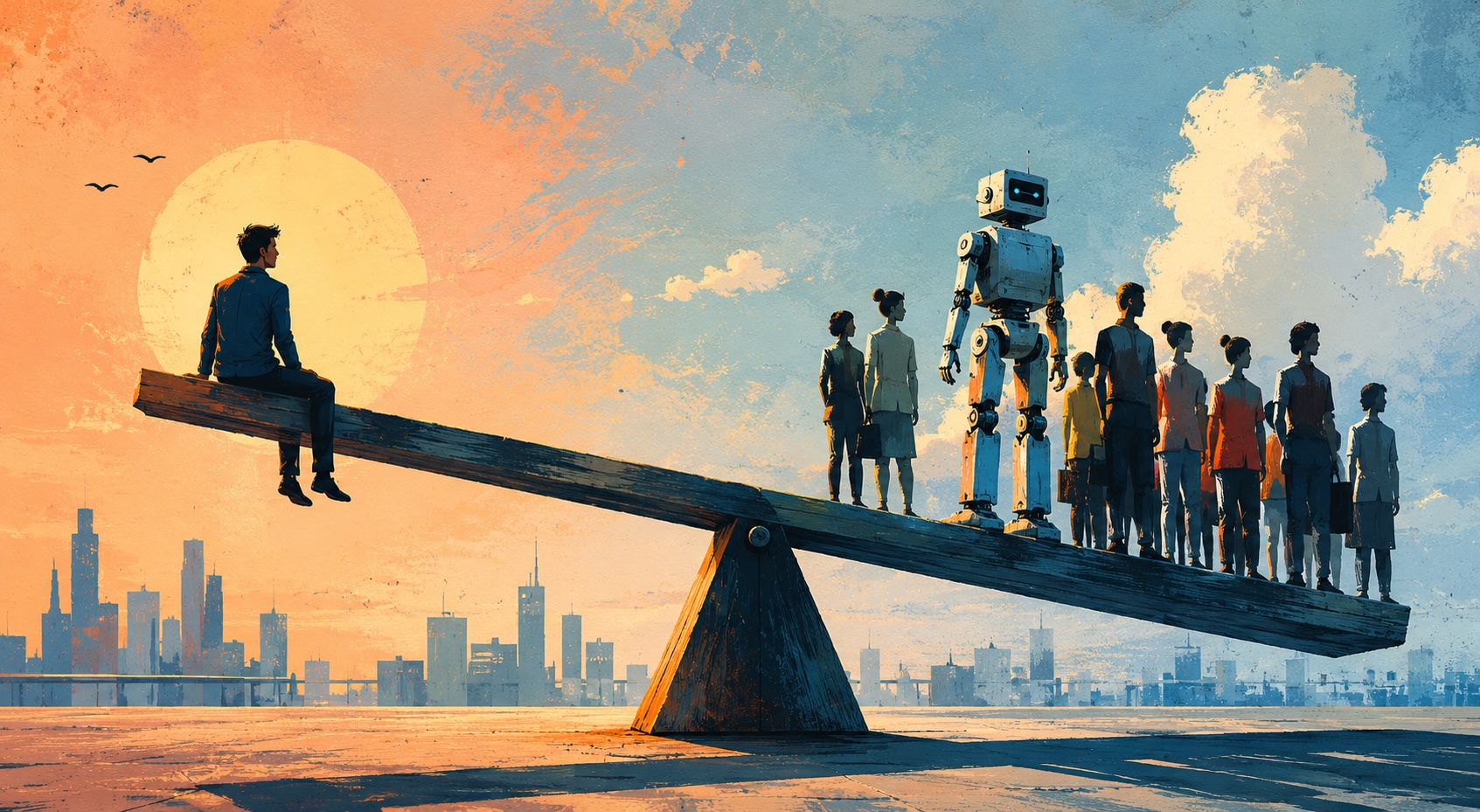
AI could cost you your job. Perhaps it already has. Maybe you’re finding it harder to break into a field that’s hiring fewer entry-level workers. And even if you manage to keep your position, the landscape is shifting: there are fewer roles available, the bar is higher, and you have less room to negotiate.
That said, AI by itself isn’t the real threat. The real issue is AI being rolled out in an economy where employees have almost no say in how the benefits of increased productivity get divided up.
Worrying About AI Makes Perfect Sense
Every major technological shift has transformed the world of work. Certain roles vanish, new ones appear, and over time, society adjusts. So is AI really any different from past innovations that eliminated some jobs while boosting efficiency and spawning new opportunities? A growing number of people say yes, it is. While nobody can predict exactly what lies ahead, the concern is that AI stands apart because of how massive and how fast the upheaval could be.
The latest generation of AI agents can handle certain programming work at a level that rivals or even surpasses seasoned developers, and they’re starting to display distinctly human traits like discernment and aesthetic sense [1]. Software development is just the beginning of a wave that’s sweeping through knowledge-based fields, since an AI that writes code can also help design its own successor.
But the ripple effects are showing up across all kinds of roles. A translator focused on standard business correspondence watches their client base evaporate in a matter of weeks. A support agent is reassigned to monitor chatbots rather than interact with customers. A junior paralegal who used to build skills by reviewing case files and conducting research now finds themselves competing with senior colleagues who are supercharged by AI.
Many fear that a huge portion of desk-based knowledge work could be automated all at once, triggering widespread layoffs [2]. Even if AI does generate some new positions, those roles are unlikely to match the number and caliber of the ones being eliminated.
To make matters worse, eliminating jobs isn’t just an unintended consequence. Plenty of companies openly treat AI as a way to shrink their workforce. This mindset shows up in the glorification of the “one-person startup hitting a billion-dollar valuation” [3] and in provocative ad campaigns urging businesses to “stop hiring people” and switch to AI instead, which “doesn’t gripe about work-life balance” [4].
AI-Driven Automation Isn’t the Core Issue
Companies competing in open markets are naturally driven to cut costs and boost output. A big part of that equation is trimming labor expenses. So when a technology comes along that’s cheaper and more effective than human workers, businesses have every incentive to swap people out. Expenses shrink, shareholder returns grow. Nobody disputes that logic. But this framing paints technology as a win for business owners and a loss for employees, fueling resistance to innovation like the Luddite movement of the past.
There’s an often-ignored path where technology actually works in workers’ favor.
Picture an employee whose output jumps tenfold thanks to AI. Assuming demand stays flat and total production needs to remain the same, society has at least two options:
- One person stays employed while nine are let go.
- All ten keep their jobs but each works a fraction of the hours.
The technology itself doesn’t dictate which path we take.
That’s shaped by policy, worker influence, and the structure of our economic systems.
Higher Productivity Hasn’t Meant Shorter Workweeks
The historical record shows that productivity improvements rarely flow to workers on their own. Think about it: time is the most precious resource we have, and technology keeps reducing how long tasks take. You’d think that would translate into shorter workweeks. Since the end of World War II, workers have become vastly more productive thanks to industrialization, computing, supply-chain advances, and automation.
Yet most of those gains never became extra free time.² Instead, they became corporate profits, executive pay packages, and returns for investors.
Of course, sharing the rewards of productivity doesn’t have to mean just cutting hours. It could also look like better pay, improved public services, employee ownership stakes, or giving workers a larger slice of the wealth that automation creates. But when a technology’s net effect is widening inequality, that’s a clear signal the spoils weren’t distributed fairly.
So the fundamental political and economic question is: who gets to keep the gains? If too much flows to business owners, we could see the devastating outcomes described above. If more flows to workers, everyday people stand to benefit enormously. Leading economists throughout history, from Mill to Keynes, shared this optimistic vision, arguing that technology’s true promise is freeing people from the grind of work [5, 6].
The Division of Productivity Gains Has Always Been a Political Choice
The crux of the matter is how we resolve the tension between rewarding investors and rewarding workers. During the Industrial Revolution,¹ factory workers didn’t see automatic improvements from rising productivity. Owners amassed enormous fortunes while workers faced grueling conditions and punishing schedules [7]. Real change came only after unions organized, political movements pushed for reform, and labor protections were enacted through collective bargaining.
Starting in the 1980s, organized labor lost much of its clout, and the pattern shifted: technological advances have overwhelmingly favored owners over workers [8]. Labor’s influence has eroded to the point where we now assume that all the rewards from innovation should flow straight to business owners.
AI Could Lead Us Down Two Very Different Paths
If AI’s rewards continue flowing primarily to investors (as they have for the past half-century), the fallout could be devastating: widespread job losses, a surge in homelessness, and deepening inequality. Economic control could concentrate in the hands of a small cluster of companies and wealthy individuals, while millions face increasing financial instability. Even ideas like universal basic income [2] circle back to the same fundamental question: who actually owns the wealth that automation produces?³
If we instead steer AI’s benefits toward workers, technological progress doesn’t have to mean mass displacement. People could work fewer hours rather than being cast aside. A shorter workweek would open up space for creative pursuits, stronger relationships, better health, community involvement, and genuine rest.
So the real question isn’t “Will AI take our jobs?” It’s:
“Who gets to claim the productivity gains from AI?”
What We Should Be Pushing For
So, AI isn’t the one stealing your job — it’s the system that decides who reaps the rewards. The fight isn’t against the technology itself; it’s for a fairer distribution of the wealth it creates.
. AI offers the chance to hold onto your job while enjoying a better quality of life. However, this possibility depends on recognizing the power dynamics tied to work. Without systems that ensure AI’s advantages benefit everyone, the technology will only widen the gap between the rich and poor. Standing up for your rights may be necessary, but aiming at the wrong issue will lead to failure.
Focus on inequality, not the technology itself.
Naturally, companies can’t instantly cut work hours without adjusting pay. Global competition, market demands, and the drive for profit are genuine limitations. Yet this is exactly the core issue: our economic and social structures dictate how the rewards of technology are shared. If the system only incentivizes maximizing profits, AI won’t enhance working conditions—it will only deepen current disparities.
If workers’ interests are prioritized, however, we can strike the ideal balance between output and well-being. This might involve advocating for stronger labor protections and smarter policies, though paths vary. Worker cooperatives, where employees directly share in productivity gains, are one model. Publicly owned AI—as explored in Switzerland [9]—is another.
The Core Issue
AI isn’t compelling your employer to let you go. That’s a deliberate decision. Every significant technological shift poses the same fundamental question:
Who reaps the rewards?
If AI’s benefits flow only to business owners and investors, inequality will surge.
If those benefits are distributed widely, AI could shorten workdays, elevate living standards, and unlock freedoms once thought impossible.
AI won’t choose our future.
We will.
References
[1] Matt Schumer, Something Big Is Happening, 2026.
[2] A. Yang, The End of the Office, 2026.
[3] A. Ohanian,
[4] M.A. Bitoon, “Stop hiring humans” billboards provoke backlash against AI amid tech layoffs.
[5] J.S. Mill, Principles of Political Economy, 1848.
[6] Keynes, J. M. (1930). Essays in persuasion. Palgrave Macmillan London.
[7] E.J. Hobsbawm. “The standard of living during the Industrial Revolution: a discussion.” The Economic History Review 16.1 (1963): 119–134.
[8] The Productivity–Pay Gap, Economic Policy Institute, March 2026
[9]
[10] The cited data can be obtained through the ourworldindata database: Those statistics are obtained from Feenstra et al.—Penn World Table (2025)
Footnotes
- Outcomes varied greatly across the world—between colonizing and colonized nations, across different legal frameworks, democratic traditions, and economic systems. I’ve kept the discussion broad, as greater detail would distract from the article’s central theme: AI.
- World Penn Table data reveals that since 1950, average productivity has roughly quadrupled in the USA, increased tenfold in Greece, fifteenfold in Germany, and thirtyfold in South Korea [10]. Yet working hours haven’t dropped proportionally. Outside a handful of European nations, they haven’t fallen at all.
- In a world where AI replaces most labor, income from work taxes would plummet. To sustainably fund a universal basic income, we’d need to shift from taxing labor to taxing wealth.
Images in this article
All images were created by the author using ChatGPT 5.5.
