



# Controlling Electromagnetic Interference in Modern Industrial Systems
## The Growing Challenge of EMI in Automated Environments
As industrial automation continues to expand, electromagnetic interference has become one of the most persistent and difficult-to-diagnose problems engineers face today. Modern equipment such as servo drives, variable-frequency drives, and high-speed communication cables all generate electromagnetic fields and circulating interference currents that can disrupt nearby components and systems.
One of the most frustrating aspects of EMI is that it often reveals itself only after a system has been commissioned and put into operation. Consider a common scenario: a newly installed machine equipped with a frequency converter is placed adjacent to an existing production line. Almost immediately, the neighboring system begins experiencing unexpected malfunctions. These issues can stem from two primary pathways — either radiated fields penetrating the enclosure, or conducted interference traveling through the cable shielding directly into the control system.
When cable shields lack proper low-impedance grounding across a sufficient surface area, interference currents find their way into sensitive electronics. The results can be devastating, ranging from minor data communication errors to complete system shutdowns that halt production lines and cost significant time and money.
## Stopping Interference at Its Entry Point
The most effective EMI prevention strategy addresses the problem where interference currents first enter or propagate within a system. Three critical transition points demand attention: the cable shield itself, the entry point where cables pass through the enclosure wall, and the overall equipotential bonding of the entire system.
Rather than treating EMC (electromagnetic compatibility) as an afterthought, leading engineering teams now integrate shielding solutions directly at the cable entry point. This approach creates a clean, repeatable, and highly reliable connection between the cable shield and the ground potential of the enclosure the moment a cable passes through the cabinet wall.
Products featuring 360-degree contact design around the cable shield ensure that the entire circumference of the shield makes consistent electrical contact with the grounding system. This technique significantly reduces operational interference, simplifies root-cause analysis when problems do arise, and helps facilities maintain compliance with electromagnetic compatibility standards — ultimately reducing downtime and improving overall system availability.
## Advanced Shield Clamp Technology
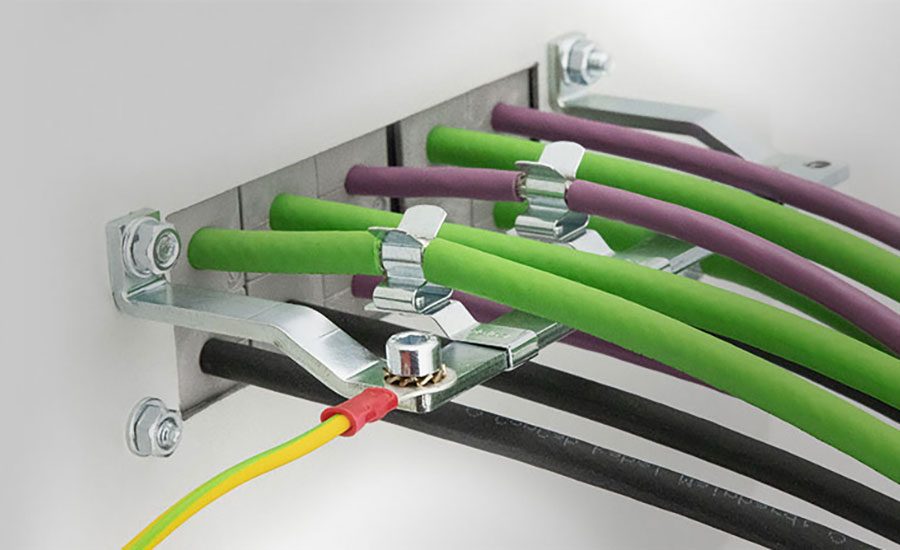
One of the most important innovations in EMI prevention involves shield clamps designed specifically for industrial environments. These components create a permanent, low-resistance path between the cable shield and the earth ground, allowing high-frequency interference currents to be safely dissipated rather than allowed to circulate within the system.
What separates high-performance shield clamps from standard alternatives is the quality of the connection. Engineers must consider several factors: the length of the connection path (shorter is better), the contact resistance (lower is better), the spring pressure applied to the shield (higher and more consistent is better), and the total contact area between the clamp and the shield (larger is better).
Modern shield clamps achieve contact areas significantly larger than traditional spring-loaded designs — some offering up to 50 percent more surface contact. This expanded area, combined with constant spring pressure, ensures that the shielding connection remains stable even when the equipment experiences vibration, thermal cycling, or mechanical stress during operation.
These clamps are designed to be maintenance-free and come in a wide variety of mounting configurations, including direct panel mounting, DIN rail installation, bus bar connections, and C-rail mounting. Many models also accommodate large clamping ranges, which means fewer distinct part numbers are needed to handle varying cable diameters — simplifying inventory management and reducing stocking costs.
## Shielding Cable Entries and Enclosure Walls
While shield clamps handle the connection between the cable and the ground plane, another layer of protection exists at the point where cables pass through the enclosure wall itself. Specially designed cable entry systems use conductive elastomer grommets and flat conductive gaskets to create a continuous electromagnetic barrier at the penetration point.
These systems are especially valuable because they work with pre-terminated cables — meaning connectors do not need to be removed during installation, saving significant time and effort on the factory floor. Both radiated (field-related) interference and conducted (shield-related) interference can be addressed simultaneously through this approach.
For environments requiring additional protection against moisture and particulates, versions with IP55 ratings are available, combining electromagnetic shielding with dust and water ingress resistance. This is particularly relevant for installations in the food and pharmaceutical industries, outdoor renewable energy systems, and other demanding applications.
One practical challenge with cable entries is sizing. Because the final cable diameter is often not known until installation day, engineers frequently end up with openings that are either too large — compromising the seal — or too small — preventing the cable from passing through. Variable-seal designs with wide adjustment ranges solve this problem by accommodating a broad spectrum of cable diameters with a single product, ensuring a proper seal and reliable shield connection regardless of the actual cable size.
## The Role of Equipotential Bonding
Effective electromagnetic shielding is meaningless without proper equipotential bonding across the entire system. Every conductive component — cabinet frames, cable shields, mounting rails, ground conductors, and equipment chassis — must be interconnected so that no unwanted voltage differences can develop between them.
When all conductive parts are bonded together at the same potential, interference currents have a predictable, low-impedance path to flow safely into the earth ground rather than finding alternative routes through sensitive electronics. This fundamental principle is why many manufacturers now offer comprehensive grounding and bonding strap solutions alongside their EMC components.
Engineers who treat EMI as a system-wide challenge — rather than trying to solve it with isolated components — achieve far more reliable results. The entire signal path, from the cable exiting a drive motor through the shielding, into the entry point, through the enclosure wall, and down to the grounding bus bar must be considered as one continuous electrical pathway.
## Applications Across Industries
Reliable EMC solutions are essential across a remarkably wide range of industrial sectors. In mechanical engineering, high-speed servo systems and frequency converters demand robust shielding to prevent interference with adjacent equipment. Control panel builders rely on compact, easy-to-install EMC components to meet stringent regulatory requirements while maximizing panel space.
The rail industry faces particularly harsh EMI challenges due to the density of electronic systems operating in close proximity, combined with significant vibration and electromagnetic noise from traction motors. Pharmaceutical manufacturers require both EMI control and contamination protection to meet cleanroom and regulatory standards. The food industry demands durable components that withstand washdown procedures and corrosive cleaning agents.
Even the rapidly growing solar photovoltaic sector benefits from EMC solutions, as large inverter installations and high-voltage DC cabling can generate significant interference that affects monitoring and control systems.
In all of these applications, the common priorities remain the same: a compact design that saves valuable panel space, a secure and stable shield connection that endures the full lifecycle of the equipment, straightforward installation even during retrofits and upgrades, and long-term operational reliability that prevents costly downtime.
The key takeaway for engineers and system designers is that EMI must be addressed as early as possible in the design process — ideally starting at the cable entry point — rather than being treated as a troubleshooting exercise after problems emerge.
## Frequently Asked Questions
**What is electromagnetic interference (EMI) and why is it a growing concern?**
EMI refers to unwanted electromagnetic energy that disrupts the normal operation of electronic devices and systems. As automation increases and more high-power electronic equipment operates in close proximity, the density of interference sources has grown substantially, making EMI management a critical engineering consideration.
**How do I know if my system has an EMI problem?**
EMI symptoms often include intermittent communication errors, unexplained resets, degraded signal quality on analog sensors, or unexpected behavior in networked devices. Many of these issues only become apparent after a new machine or drive system is commissioned near existing equipment.
**What is the most common source of EMI in industrial settings?**
Frequency converters (variable-frequency drives), servo drives, and high-speed data communication lines are among the most prolific sources of electromagnetic interference in modern industrial facilities.
**Why is 360-degree shield contact important?**
A 360-degree connection ensures that the entire circumference of the cable shield makes continuous electrical contact with the grounding system. Any gap or discontinuity in the shield connection creates an impedance that allows interference currents to bypass the ground path and enter the system instead.
**What is equipotential bonding and why does it matter?**
Equipotential bonding is the practice of connecting all conductive parts of a system to the same electrical potential. It prevents voltage differences from developing between components, which ensures that interference currents flow safely to ground rather than through sensitive electronics.
**Can EMI shielding solutions be used in retrofit installations?**
Yes. Many modern EMC components are specifically designed for retrofitting existing panels and equipment, with compact designs and versatile mounting options that accommodate space constraints and pre-existing cable routing.
**What IP rating should I look for in an EMC cable entry?**
For general industrial use, IP54 or IP55 ratings provide adequate dust and water protection alongside EMI shielding. The choice depends on the specific environmental conditions, such as washdown requirements or outdoor exposure.
**How do I select the right shield clamp for my application?**
Key considerations include the cable shield diameter, the required clamping range, the mounting method (panel, DIN rail, bus bar, or C-rail), and whether additional strain relief or sealing is needed. Many manufacturers offer configuration tools to simplify this selection process.
## Conclusion
Managing electromagnetic interference in industrial environments requires a proactive, system-wide approach that begins at the most vulnerable points in the electrical infrastructure — the cable shield connections, the enclosure penetration points, and the grounding architecture. By investing in high-quality EMC components such as shield clamps with large contact areas, conductive cable entry systems, and proper equipotential bonding hardware, engineers can prevent costly malfunctions, reduce troubleshooting time, and ensure continuous system availability.
The diversity of modern industrial applications — from high-speed manufacturing and rail transport to pharmaceuticals and solar energy — underscores the universal importance of electromagnetic compatibility. As automation continues to evolve and system densities increase, EMC design will only grow in significance as a core engineering discipline.
Thank you for reading
