



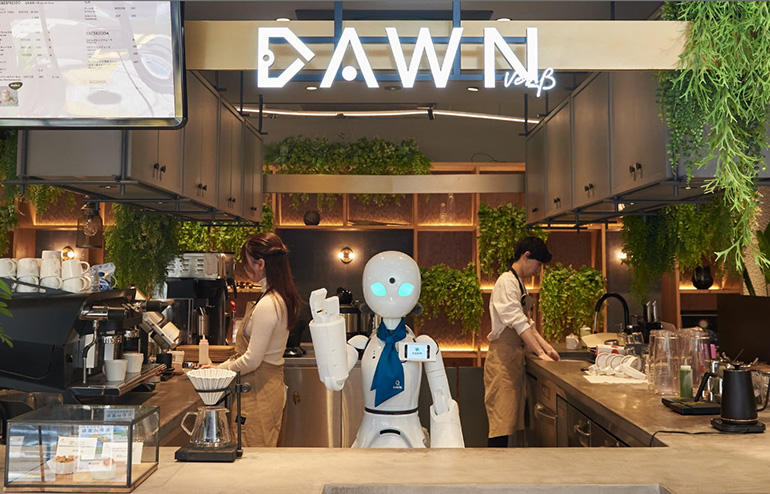
At the Dawn cafe, individuals with disabilities control robots from a distance, demonstrating how humans and robots can work together across various industries. Source: OryLab
In Japan, robot cafes operated remotely by people with disabilities highlight an often-overlooked aspect of automation: Robots can open doors to employment rather than shut them. This same idea is now taking shape in manufacturing.
This perspective challenges the widespread belief that robots will take over human jobs. According to the International Federation of Robotics (IFR), 542,000 robots were installed in 2024—more than twice the number from a decade earlier.
Robots are increasingly seen as tools that create value beyond just saving time. Slightly more than half of manufacturers worldwide are now using robots to improve product quality. Rather than worrying about whether AI will replace humans, manufacturers should be asking more meaningful questions:
- Which processes should incorporate AI?
- How can emerging technologies expand the production workforce?
- How should companies prepare for AI-driven systems and automation?
Why fully replacing humans isn’t realistic
Most manufacturers lack the IT infrastructure needed to make generative AI work, much less physical AI. It’s well known that this industry still relies heavily on manual processes, including gathering data and information.
In fact, manufacturing has one of the largest data gaps across all industries: 70% of manufacturers still collect data by hand.
Looking closer, there are two specific technical challenges that show just how difficult this gap is to bridge. The first is accurately capturing the connection between purpose and action. This means understanding not just what a worker does, but also why they do it that specific way.
This is a critical factor to address before simply inserting robots into a process, which is the second challenge. The action must be converted into instructions that a robot can follow. In recent years, advances in motion sensors paired with advanced generative AI systems have sped up progress in this area.
However, the first challenge is much harder to solve, because the people who understand processes most deeply are the operators working on the factory floor. Their expertise has been refined through years—sometimes decades—of hands-on experience, becoming largely instinctive. That instinct is tough to capture and program into a robot, and this is where a significant knowledge gap exists.
Closing that knowledge gap is perhaps the biggest and most overlooked obstacle between manufacturers and truly autonomous robots. The foundational data and IT infrastructure simply aren’t in place for more advanced robotics that go beyond performing basic, repetitive tasks.
To make workflows and the broader digital ecosystem of each organization ready for AI and robots, companies will need to completely rethink how these workflows are designed and managed—starting from scratch.
 Submit your session idea for the 2026 RoboBusiness
The manufacturing workforce is changing
Modernization and digital transformation can’t happen without people. The skills that will matter most include strategic thinking, problem-solving, creativity, and critical analysis. These are exactly the abilities needed to redesign processes around advanced robotics and remotely operated systems.
Manufacturers also need people who can think like data scientists and engineers while also being strong communicators, problem solvers, designers, and strategists. When robots handle lower-risk tasks, the manual labor that’s freed up can be redirected toward strategic leadership, managing vendor relationships, ensuring compliance, and designing AI systems. Human connection remains an irreplaceable part of manufacturing.
People’s physical presence will still be necessary for certain tasks as well. In mobile phone manufacturing, for instance, assembling specific components still demands the specialized dexterity that only humans can provide.
In the coming years, humans will need to stay closely involved in training robots to handle more complex assembly work. This itself requires knowledgeable, skilled guidance—whether on the workshop floor or operating these systems from a distance.
A forward-looking workforce embraces robot collaboration
A forward-looking workforce is more selective than ever, where people and robots work together rather than against each other.
Manufacturers would be wise to invest in reskilling and training to prepare their workforce for the next wave of AI. When the goal is augmentation rather than replacement, the focus should be on upskilling, training, and redesigning operations. Employees need to be comfortable working alongside and supervising AI tools.
At the heart of this is establishing a clear set of priorities and guardrails that dictate how AI and robotics are used on the factory floor, as well as how workers are trained to manage them. Without question, safety must be the top priority, followed by quality and productivity.
It’s very tempting to prioritize productivity and quality first, but manufacturers who take this approach do so at the expense of worker well-being. The cost is simply too high: violating labor laws, harming reputation and relationships, and facing legal consequences that could devastate a company.
Reskilling and training programs must be built on this priority structure, ensuring that employees stepping into oversight roles understand that safety is always the highest, non-negotiable standard.
The second most sought-after skill is the ability to understand and contextualize details while maintaining a big-picture perspective and awareness of broader implications. Employees must be able to think both top-down and bottom-up within remote and automated operations.
Finally, workers need the adaptability to change their approach as tools and workflows evolve. AI technology is still advancing rapidly, and the cost of switching is relatively low compared to other technologies. If the purpose or environment changes, manufacturers and their teams must be ready to pivot to better maximize return on investment (ROI).
Examples of worker enhancement
Empowering Workers with Disabilities Through Robots
Panasonic’s trial program employs OryLab’s OriHime avatar robots to enable individuals with physical disabilities to participate in workplace operations. The outcomes are highly encouraging: roughly 94% of participants expressed a more favorable perception of the capabilities and drive of employees with physical impairments. They also indicated a willingness to collaborate with such colleagues going forward.
OryLab’s OriHime robotics platform is built to close the physical barriers that often exclude people with disabilities from employment. Its OriHime-D avatar allows workers to perform remote tasks that require a physical presence, and Panasonic noted that the trial demonstrates the potential of robots to complement and enhance human work.
These are the same OryLab robotics solutions that one to ONE Holdings plans to adopt as part of its wider strategy focused on robots augmenting human labor.
Prepare Both People and Manufacturing Systems for Flexibility
A critical operational factor when deploying teleoperated systems like delivery or service robots is workforce training and adjustment. Effectively incorporating avatar robotics generally demands that both on-site staff and remote operators master new ways of communicating and working together.
For office-based teams, this may involve learning how to engage productively with remote operators, working around technical constraints such as response delays or restricted camera views, and updating workplace accessibility and communication norms.
For remote operators, onboarding would likely include instruction on navigation controls, communication platforms, task management, and handling the distinct cognitive challenges that come with operating through an avatar interface.
For too long, the narrative surrounding robots on the production floor has been cast as a zero-sum game where people lose and machines win. This is simply not accurate, and the reality is far more complex.
Manufacturers must take the lead by championing human-in-the-loop approaches to automation and robotics, rather than rushing to deploy these solutions wherever a quick return is identified. The path to efficient production runs through a workforce that is more inclusive, collaborative, and AI-savvy, strengthened—but not supplanted—by robots.

About the Author
Shinichiro Nakamura serves as president of one to ONE Holdings, a manufacturing and technology group operating across Japan, Vietnam, and the U.S. Through its network of affiliated companies, the group has invested in advanced manufacturing technologies, smart factory solutions, and industrial innovation.
Nakamura has spearheaded the company’s global growth and modernization initiatives, with an emphasis on how technology can shape the future of manufacturing and workforce development. Before joining the family business, Shin worked as a consultant at Bain & Co. and subsequently earned his MBA from MIT Sloan.
