



**AGIBOT Unveils Four Embodied AI Products, Showcasing Real-World Industrial and Service Deployment at WAIC 2026**
At the recent World Artificial Intelligence Conference (WAIC 2026) in Shanghai, AGIBOT presented a significant portfolio of new robotic products designed to bridge the gap between advanced AI capabilities and reliable, scalable real-world use. The company highlighted solutions aimed at operating over long durations in public and industrial environments, underscoring a shift from one-off demonstrations toward consistent, practical value.
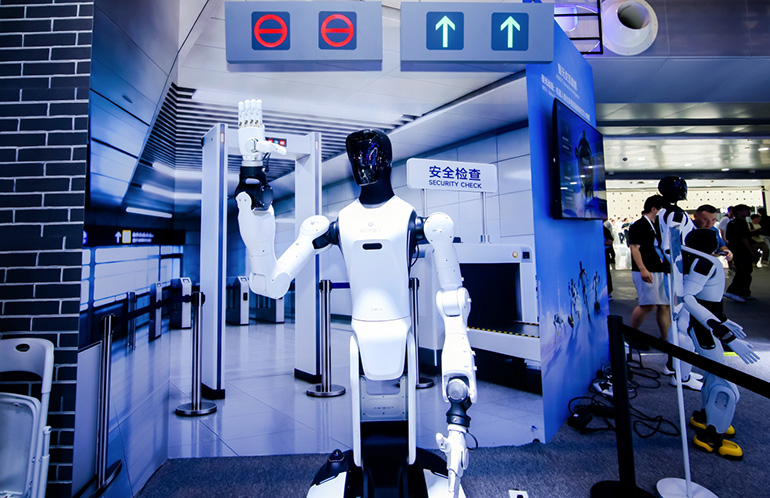
For the first time publicly, AGIBOT showcased its full-size humanoid platform, heavy-payload industrial task robot, and direct-drive dexterous manipulation systems, along with an educational variant. These announcements were accompanied by demonstrations of more than 30 robots operating across the conference venue, providing visitor guidance, information services, and other tasks.
—
### **Product Portfolio Designed for Commercial and Industrial Use**
**AGIBOT A3 Ultra**
The A3 Ultra is a full-size humanoid robot built for long-duration service in public-facing and commercial settings. Standing 1.74 m (5.7 ft.) tall and weighing 60 kg (132.2 lb.), it features 51 active degrees of freedom (DoF) and can lift up to 5 kg per arm, with up to eight hours of combined operating time.
The robot is equipped with 3D lidar, RGB-D cameras, fisheye cameras, and binocular vision, along with GPS, RTK, and UWB positioning for navigation and coordination in diverse environments. Powered by NVIDIA Thor for high-level embodied AI processing, it supports direct charging, battery replacement, and autonomous charging to support continuous service workflows.
**AGIBOT G2 Max**
Positioned as the company’s first heavy-payload, force-controlled embodied task robot, the G2 Max is designed for material handling, palletizing, and other industrial operations. It combines higher load capacity with force-controlled arms, adjustable working height, and omnidirectional wheeled mobility.
Engineered to work alongside existing production equipment, the G2 Max handles repetitive physical tasks requiring both strength and controlled interaction. Its energy system supports battery replacement and autonomous charging to minimize operational interruptions in continuous production settings. During a live factory integration in Nanchang, China, the robot completed a closed-loop quality inspection workflow, inspecting approximately 3,000 units per shift with cumulative operation of over 64 hours and downtime loss below 4%.
**OmniHand 3 Ultra-M**
This flagship direct-drive dexterous hand is designed for embodied AI training, teleoperation, demonstration capture, and contact-rich manipulation. With 20 active DoF in a human-scale form factor weighing 630 g (22.2 oz.), it supports a whole-hand load of up to 5 kg, with opening or closing times of 0.3 seconds and repeatability of ±0.2 mm.
Vision-based tactile sensors at the fingertips and a tactile array in the palm enable detection of contact, force, and object position. The fully direct-drive architecture facilitates responsive force regulation during complex manipulation tasks.
**AGIBOT X2 EDU**
Targeted at education, competitions, and scientific research, the X2 EDU is a humanoid robotics development platform standing approximately 1.3 m (4.2 ft.) tall with 29 DoF, including 7 DoF per arm. It supports an end-effector payload of up to 3 kg (6.6 lb.).
The platform features a fully modular architecture, allowing disassembly and reconfiguration across the hardware chain. Open motion-control and hardware interfaces enable developers to integrate end effectors, sensors, and additional computing modules to suit teaching and research needs.
—
### **Industrial Deployments and Continuous Task Execution**
AGIBOT highlighted multiple industrial deployments developed with partners such as Longcheer Technology and PIA Automation. Applications include mass-production loading and unloading, chip handling, and production-line material movement.
At Longcheer’s factory in Nanchang, AGIBOT integrated its G2 robots into a tablet quality-inspection line. The robots execute a closed-loop workflow covering material collection, precision placement, equipment interfacing, and finished product return. The system was integrated in 36 hours and has inspected about 3,000 units per shift for more than 64 hours continuously, with downtime loss kept below 4%.
These deployments, according to AGIBOT, differ from one-off motion demonstrations because they require robots to maintain production rhythms, repeat tasks consistently, respond to changes in object position and surrounding conditions, and coordinate with upstream and downstream equipment.
Beyond industry, AGIBOT’s robots have been deployed in tourism, transportation, and commercial services, supporting guided tours, route guidance, visitor interaction, and on-site assistance.
—
### **Live Demonstrations and Embodied AI Forum**
At the WAIC booth, AGIBOT presented dynamic motion, human-robot collaboration, and multi-step commercial service tasks. Demonstrations included robots playing table tennis and boxing, serving beverages, and providing guidance in public venues. These showcased how teleoperated movement can translate into coordinated, low-latency physical action within commercial workflows that combine perception, navigation, manipulation, and task sequencing.
Operating in busy public spaces requires robots to navigate around visitors, respond to changing conditions, and maintain consistent performance over extended periods, offering a practical test of mobility, interaction, and operational reliability.
A dedicated Manipulation Intelligence Zone at the AGIBOT booth highlighted the company’s manipulation foundation models, dexterous systems, and task-development technologies, illustrating how perception, reasoning, action planning, and physical control integrate to support complex environment task execution.
AGIBOT also hosted the WAIC 2026 Embodied AI Forum, bringing together researchers, technology leaders, and robotics entrepreneurs from China and overseas to discuss the development of physical AI, advances in embodied intelligence, and technical and operational requirements for scaling robots from research systems into real-world applications.
—
### **FAQ**
**What types of robots did AGIBOT unveil at WAIC 2026?**
AGIBOT unveiled four new products: the AGIBOT A3 Ultra full-size humanoid robot, the AGIBOT G2 Max heavy-payload industrial task robot, the OmniHand 3 Ultra-M direct-drive dexterous hand, and the AGIBOT X2 EDU humanoid robotics development platform.
**What is the AGIBOT A3 Ultra designed for?**
The A3 Ultra is designed for long-duration operation in public-facing, commercial, and service environments. It can be used for guidance, information services, and other interactive roles that require extended uptime and autonomous operation.
**How does the AGIBOT G2 Max differ from other task robots?**
The G2 Max is AGIBOT’s first heavy-payload, force-controlled embodied task robot, intended for material handling, palletizing, and industrial operations. It combines higher load capacity with force control, adjustable working height, and omnidirectional mobility for integration into existing production lines.
**What applications has AGIBOT demonstrated in industrial settings?**
AGIBOT has demonstrated applications such as mass-production loading and unloading, chip handling, and production-line material movement. In one deployment, its robots performed quality inspection on tablets in a closed-loop workflow with over 64 hours of cumulative operation and low downtime loss.
**What is the OmniHand 3 Ultra-M used for?**
The OmniHand 3 Ultra-M is designed for embodied AI training, teleoperation, demonstration capture, and contact-rich manipulation. It is suitable for tasks requiring high dexterity and force regulation in complex manipulation scenarios.
**What was the purpose of the AGIBOT X2 EDU?**
The X2 EDU is a humanoid robotics development platform for education, competitions, and scientific research. Its modular architecture and open interfaces allow developers to customize end effectors, sensors, and computing modules for teaching and research.
**How many robots did AGIBOT operate at WAIC 2026?**
Beyond the exhibition booth, more than 30 AGIBOT robots operated across WAIC venues, providing visitor guidance, information services, and other demonstrations.
**What is AGIBOT’s “Three Intelligences in One” architecture?**
AGIBOT refers to an architecture that integrates locomotion, interaction, and manipulation into a unified system, aimed at developing general intelligence for physical operation in the real world.
—
### **Conclusion**
AGIBOT’s showcase at WAIC 2026 highlighted a comprehensive approach to embodied AI, spanning humanoid platforms, industrial task robots, and dexterous manipulation systems. By emphasizing real-world deployments, continuous task execution, and integration with existing production and service workflows, the company underscored a practical path toward scaling embodied AI beyond isolated demonstrations. With its new product lineup, active industrial partnerships, and focus on reliability and long-duration operation, AGIBOT is positioning itself at the forefront of translating general intelligence into physical applications across commercial and industrial environments.
