



# U.S. Government Declares Foreign-Made Robotics Imports a National Security Risk
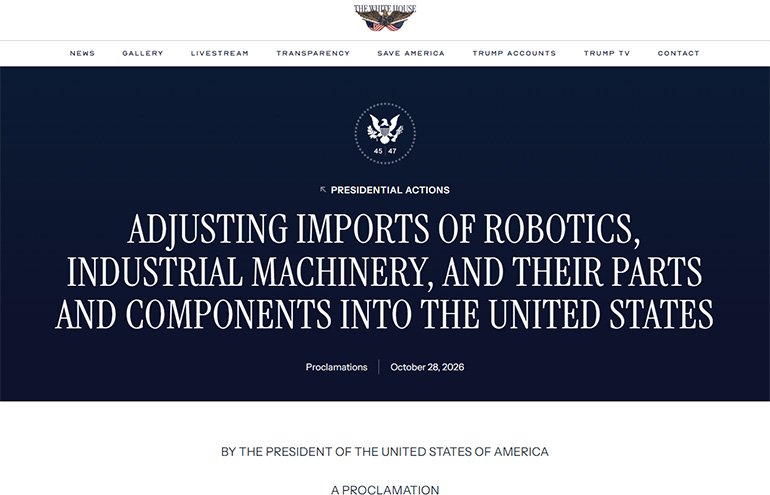
The White House has formally announced that an investigation under a federal trade law has concluded that the growing volume of robotics and industrial machinery entering the United States from overseas poses a threat to both national security and the nation’s economic standing. This move signals a potential shift in how the country sources the automated systems that power modern manufacturing, defense operations, and critical infrastructure.
## What Is Happening?
The president issued a formal proclamation after receiving a report from the Department of Commerce. The report, conducted under a specific section of trade law that allows the government to examine threats to national security, found that robotics and industrial equipment are being imported at levels that could undermine U.S. self-sufficiency.
The proclamation highlighted several key points:
– Robotics and industrial machinery are essential to manufacturing processes used for defense, commercial purposes, and dual-use applications.
– These technologies contributed to approximately $7.1 trillion in shipments of manufactured goods in 2024 and the production of roughly $86 billion worth of equipment that same year.
– Advanced systems — including autonomous mobile robots, humanoid machines, four-legged robots, and unmanned ground vehicles — provide direct support to military operations.
– Over the past decade, the volume of such imports has increased while cybersecurity risks associated with them have also grown.
## What Comes Next?
Rather than imposing immediate penalties, the president directed trade officials to begin negotiations with international partners to bring robotics imports to levels that do not jeopardize U.S. security. This process is expected to take several months and could involve tariffs, quotas, or other trade measures depending on how discussions unfold.
Several major companies have already been expanding domestic production capacity for robotics equipment. Experts note, however, that the most pressing gap lies not in finished robots but in the underlying components — sensors, motors, precision gears, and encoders — that are largely sourced from abroad.
## Why It Matters
The United States remains heavily dependent on foreign suppliers for both complete robotic systems and the parts that go into them. As global competition intensifies and concerns over supply chain vulnerabilities grow, the government is taking steps to encourage homegrown production and strengthen the domestic supply chain for automation technology.
Industry observers expect this determination to accelerate investments in U.S.-based robotics manufacturing and component production, though concrete trade actions are likely to follow only after negotiations with trading partners.
—
## Frequently Asked Questions
### What is a Section 232 investigation?
A Section 232 investigation is a process authorized under U.S. trade law that allows the Department of Commerce to examine whether imports of a particular product threaten national security. If a threat is identified, the president may take corrective action, which can include tariffs or other trade restrictions.
### Will there be immediate tariffs on foreign robots?
No. The recent proclamation does not impose tariffs right away. Instead, the government is directing trade representatives to enter negotiations with foreign partners over the coming months. Tariffs or other measures may follow depending on the outcome of those talks.
### Which types of robots are affected?
The investigation covers a broad range of robotics and industrial machinery, including autonomous mobile robots, humanoid robots, quadruped robots, unmanned ground vehicles, and the components that go into these systems. Both finished products and individual parts are included.
### Why are robotics imports considered a national security concern?
Robotics are used extensively in defense applications, military operations, critical infrastructure sectors, and advanced manufacturing. Heavy reliance on foreign imports creates vulnerabilities, especially if supply chains can be disrupted by geopolitical tensions or cybersecurity threats.
### Which companies are already building robots in the U.S.?
Several major robotics manufacturers have announced investments in expanding their U.S. production operations. Companies that produce industrial robots and automation equipment are among those increasing their domestic footprint.
### What are the biggest gaps in U.S. robotics supply chains?
The most significant gaps are in the components side — sensors, actuators, precision gears, encoders, and other parts that are essential to building robotic systems but are currently sourced primarily from overseas manufacturers.
### How might this affect the cost of robots?
If trade measures such as tariffs are eventually implemented, the cost of imported robots and components could rise. This may accelerate the shift toward domestic production, though short-term pricing effects will depend on the specifics of any trade agreements reached.
—
## Conclusion
The U.S. government’s recent Section 232 determination marks a significant step in addressing the country’s dependence on foreign-made robotics and industrial machinery. By identifying these imports as a national security concern, the administration has opened the door to potential trade policy changes that could reshape how the United States sources the automation technologies it relies on. While immediate tariffs are not on the table, the direction of this policy points toward strengthening domestic production capacity and supply chains. Companies, investors, and manufacturers in the robotics sector should pay close attention as negotiations unfold over the coming months, as the outcome could have lasting implications for global trade dynamics and the future of American manufacturing.
Thank you for reading
