



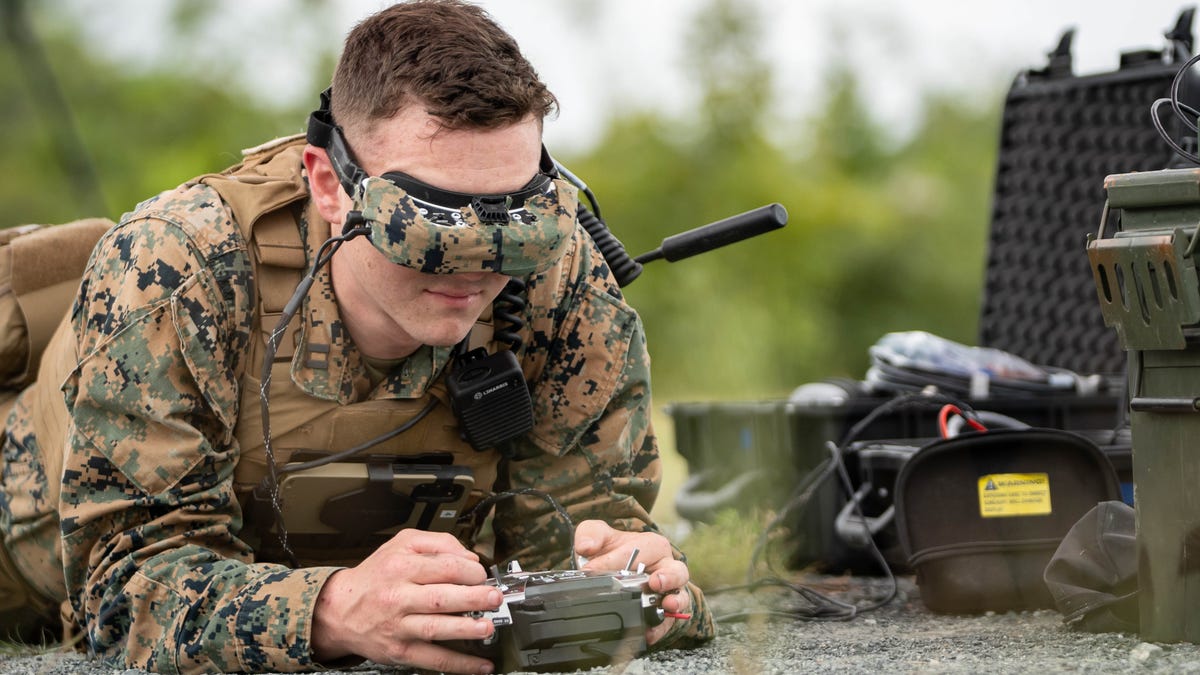
More than a year after the Navy established its robotics warfare (RW) specialist rating, or job specialty, to manage its growing menagerie of small aerial drones and ground robots, the job field is thriving and growing — and other services are taking notice.That’s according to Master Chief Petty Officer Christopher Rambert, who helped create the rating and now manages it. Rambert, who began his career in the Navy as an aviation electrician’s mate, says he became aware of the need for a robotics specialty when his work expanded to flying drones for Naval Special Warfare Command. He saw the similarities between his past experiences and new role, he says, but also gained an appreciation for the technical aspects of drone operation and the need for dedicated experts. ‘Milestone in the future of warfighting’In both aviation and robotics, “it’s almost ingrained in you that you have to be quick on your feet and deal with things fast in order to come up with solutions to sometimes very complex problems, because you do have a flight schedule that has to get met — that airplane has to take off, and there’s really no way around it,” Rambert says. “And that’s very similar to operating different drones in a combat theater … you know you have a mission, and how do you use that experience that you had previously?”The Navy officially launched its new robotics warfare specialist job field in March 2024, calling the move “a significant milestone in the future of warfighting and maintaining the tactical edge.”“Robotic systems provide additional warfighting capability and capacity to support our traditional combatant force, allowing the option to take on greater operational risk while maintaining a tactical and strategic advantage,” service officials said in a fact sheet published at the time. For the Navy, those systems include autonomous unmanned miniature sailboats that can provide surveillance for nearby ships; drone submersibles that can carry sensors or weapons; and unmanned aircraft that can launch from ship decks to refuel aircraft or provide eyes in the sky, among many others.While robotics warfare started as one of the smallest ratings in the Navy, Rambert says, with just about 217 jobs, it has grown substantially since then. Within the first year, the field had grown to 468 jobs, he says, and it is now expected to reach 517 by the end of fiscal year 2026. It’s also spurred interest and conversations with other military services as they seek to get the most out of their unmanned and autonomous platforms. Growing interest in technology across branchesThe Army launched its own robotics technician military occupational specialty (MOS) in May 2025, and Rambert says the Coast Guard and the Marine Corps have also expressed interest to the Navy in creating a similar field. Meanwhile, the other services are seeking other ways to match emerging technology with new jobs. The Army is reportedly creating an MOS focused on artificial intelligence and machine learning in order to apply the technology to “evolving mission objectives.” While the Army has not formally announced the new job field and officials declined to confirm it to us, the service did launch a new course for 25 soldiers this year aimed at mastering AI fundamentals. Goals included learning how to purchase gear and equipment more efficiently and improving battle planning and decision-making.“Your ability to work with experts who are working with AI every day and your ability to apply AI in the field are extremely essential to the Army mission,” Maj. Gen. Stephanie Ahern, the Army’s director of strategy, plans and policy, told course participants in May. “Please continue to be an agent of change; you are a part of the solution, and you are not in it alone.”The Marine Corps emphasized its plans to make small deadly drones a part of the future battlefield in March 2025 with its launch of the Attack Drone Team, a small group of Marines who will compete in inter-service, national and international competitions, hone their drone operating skills and develop ways to integrate the small and relatively inexpensive machines into ground unit operations.In addition to the quickening pace of developing technology, the emergence of aerial drones as a key weapon in current conflicts like the Russia-Ukraine war has increased the need to maintain and develop these skills, Col. Scott Cuomo, commander of Weapons Training Battalion in Quantico, Virginia, said in an April 2025 interview.“We’re learning from combat — it’s what you would expect the U.S. military to do on the behalf of the American people,” Cuomo said. “So, we’re working through it step by step, rapidly. So it’s pretty exciting.”The benefits of the Navy’s robotics specialty are already becoming clear, Rambert says, as recently trained sailors depart their commands and take their expertise with them to other parts of the service. With a dedicated job pipeline, he says, the Navy doesn’t have to “start from scratch” with training on robotic systems every time a sailor arrives at a new post.“By creating the RW rating, the Navy is proactively addressing any shift and ensuring that we have skilled personnel to operate and maintain advanced technology as it’s coming online,” Rambert says.
Trending
- The Hidden Monetization Gap: Why Small Crypto Wallet Apps Fail to Cash In on Their Users
- ConnectWise Halts Cloud Backup Operations Following Cyberattack Targeting Microsoft 365 Tenant Infrastructure
- Empowering Social Services Caseworkers Through Strategic Technology Investments
- Google Unveils Harness2: A Powerful Open-Source Framework for Recursive AI Agent Orchestration
- Google Warns: Self-Replicating AI Remains a Myth Despite AI Writing Most Code
- Google AitM Phishing Campaign UAT-11985 Weaponizes Spoofed Event Invitations to Compromise Taiwanese Research Institutions
- How Cloudflare and OpenAI Are Revolutionizing AI Discovery for Everyone
- How Hardware Wallets Keep Your Cryptocurrency Safe With Offline Cold Storage
