



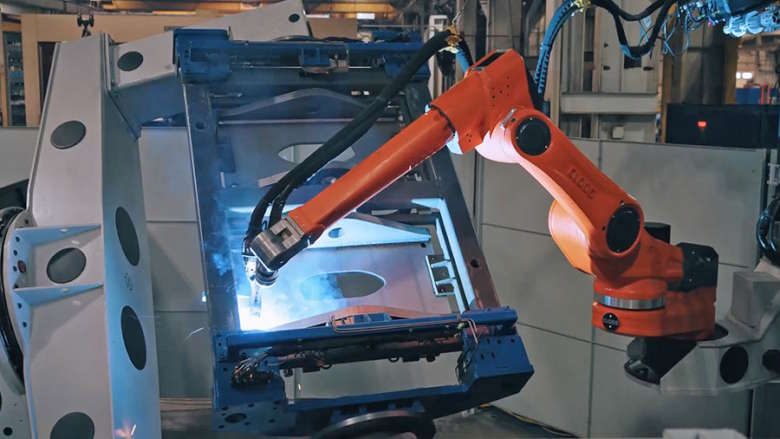
Volvo Development Gear in Shippensburg, PA, and CLOOS North America in suburban Chicago go manner again.
As a heavy tools producer, Volvo produces massive steel assemblies requiring excessive welding deposition charges and robotic programs able to optimum positioning. CLOOS has been supplying welding expertise for greater than 70 years.
Volvo’s first CLOOS machine, a robotic system that might routinely alter to weld compactor drums of various lengths and diameters, was bought in 1998. To place that in perspective, Google was based in the identical yr.
“With each size we had to do a new setup,” recollects Karen Geesaman, head of producing engineering and upkeep at Volvo. “And with the system from CLOOS, the robot was able to adjust to each size and diameter of drum without us having to touch it. That was super helpful, reduced our setup times, increased quality, and reduced manual weld time.”
The success of that first system kicked off a robust bond between the 2 producers. As we speak, Volvo has 12 CLOOS programs in operation at its meeting plant.
“We’ve been working together for decades,” says Nate Alleman, Volvo’s head of wheel loader end-to-end circulation. “Because of our relationship with that team, we’ve switched over all of our robots completely to CLOOS.”
Volvo’s meeting plant in Shippensburg, PA, manufactures wheel loaders, compactors and different development tools. Picture courtesy CLOOS North America
The Problem
Volvo developed a deep familiarity with automation in the course of the previous 37 years, and that’s altering how the corporate thinks about addressing meeting challenges.
On the lookout for fast solutions on meeting and manufacturing subjects?
Strive Ask ASM, our new good AI search device.
Ask ASM
“There are times when we’re discussing some problem, and we’ll joke, ‘Well, if we could only solve this,’” Alleman says. “And then we stop and think, ‘What if we could actually solve that?’”
Time after time, Volvo has reached out to CLOOS to work collectively on new options to its thorniest issues.
Most just lately, Volvo observed that its expert employees had been spending extra time on non-value-added duties—shifting materials, hooking it as much as a crane, and setting it in a fixture—as a substitute of doing what they do greatest: complicated welds. It was draining time and vitality that might have been higher spent on extra vital work.
The Resolution
Working with Volvo and one other provider specializing in autonomous automobiles, CLOOS created a state-of-the-art robotic welding system through which completely different applied sciences work in live performance.
An autonomous cellular robotic (AMR) independently collects materials from a welder’s cell, transports it throughout the manufacturing flooring, and hundreds it into one other automated cell. That cell has an automatic positioning system—virtually resembling a rotisserie or tuning fork—that each helps and articulates the fabric. That enhanced articulation supplies two axes of positioning, enabling entry to all six sides of the weld.
The “tuning fork” system sits on a swiveling mechanism. As soon as the half is loaded into the fixture, the entire meeting rotates to an enclosed cell the place a welding robotic finishes the job.

This automated positioning system allows one set of elements to be loaded and unloaded whereas a six-axis robotic welds a second set of elements. Picture courtesy CLOOS North America
That rotation reveals a second fork, this one holding one other element that’s simply been accomplished. Whereas the brand new materials is being welded on the opposite facet, the AMR takes the completed element, strikes it down the road, and returns to its unique place to start out the entire course of over once more.
The automated system has dramatically diminished cycle occasions, permitting Volvo to fulfill rising manufacturing calls for with out compromising high quality. The automated course of has improved ergonomics and requires much less handbook intervention, liberating up expert welders for extra crucial duties.
“We’re probably at least a third faster in this operation than we were before,” Alleman says. “We’re getting better welds, better reach and locations, so that we have less manual welds afterwards. We’re taking out that non-value-added work…and keeping those welders on the welding task. This gets us one step further in being the best plant we can be.”
“Adding the CLOOS system into our fabrication department was a big help,” says Justin Brindle, manufacturing crew lead at Volvo. “With the AMR to load and unload, we’re capable of stroll away and never have to look at it. And the weld velocity with the CLOOS robotic is so a lot better than what we’ve had prior to now. It’s truly welding sooner than we will construct elements.

Autonomous cellular robots routinely load and unload a robotic welding cell. Picture courtesy CLOOS North America
“With the old system, we couldn’t run lights out,” he continues. “With the new system, we are able to run lights out. Within the first week of us using the new system, I could tell a huge difference with the weld speed and the quality of the welds coming from this new system.”
The collaboration between CLOOS and Volvo highlights that fixing automation issues isn’t nearly robots—it’s about relationships.
“We’ve had a good relationship over all those years. We have great respect for CLOOS, for their products, the reliability of their service—everything. Anything we work with them on, we always have great outcomes,” says Troy Renninger, a weld engineer at Volvo.
For extra info on robotic welding, click on right here. To see a video of the system in motion, click on right here.
For extra info on welding, learn these articles:
Servo Drives Ease Integration of Welding Robots
Truck-Physique Welding Will get Elevate From Tandem Robots
Cobot Welding System Boosts Output
