



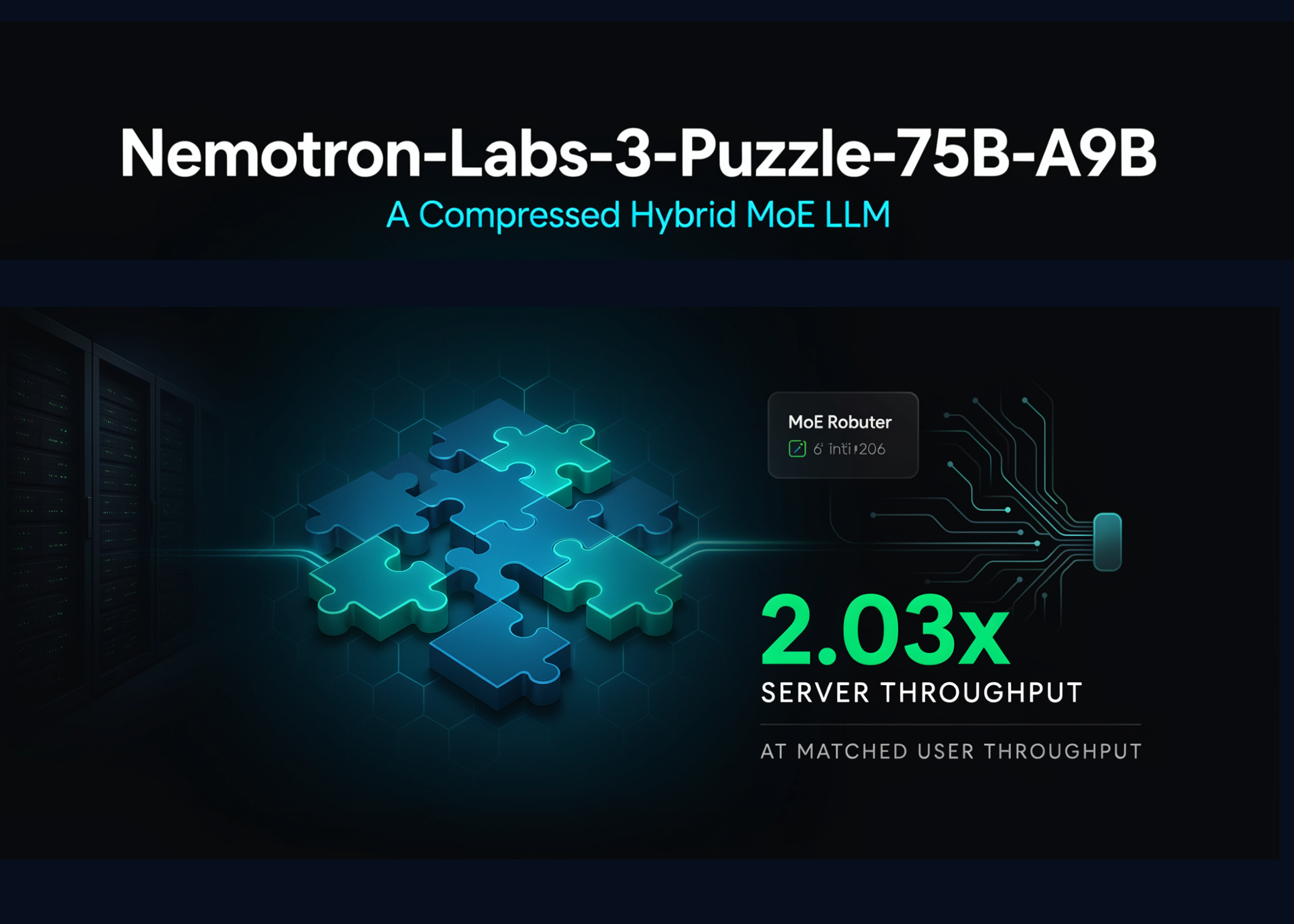
**Compressed MoE Model from NVIDIA Delivers Major Inference Cost Reductions**
NVIDIA AI researchers have taken a major step toward making large Mixture-of-Experts (MoE) models practical for production deployment. In a new paper, they report dramatic gains in inference throughput and memory efficiency by applying their “Puzzle” neural architecture search framework to compress the 120.7‑billion‑parameter Nemotron‑3‑Super into a 75.3‑billion‑parameter variant called **Nemotron‑Labs‑3‑Puzzle‑75B‑A9B**. The compressed model retains 73% of the active parameters while achieving up to **4× higher aggregate decode throughput** under realistic long‑context workloads.
**Why Compression Matters for MoE Models**
Large language models based on the MoE paradigm—where only a subset of experts is activated per token—promise higher capacity at lower cost. However, serving them efficiently remains challenging because per‑user token rates, key‑value (KV) cache, and multi‑token state (e.g., Mamba SSMs) jointly limit how many concurrent users a single GPU node can handle. The NVIDIA team set out to prove that thoughtful architecture search could break these bottlenecks without sacrificing accuracy.
**Key Results**
– **Model size reduced**: Total parameters drop from 120.7B to 75.3B (62.4%); active parameters fall from 12.8B to 9.3B (73.1%). The 88‑layer hybrid Mamba‑Transformer layout is preserved, with 40 Mamba blocks, 40 MoE blocks, and 8 attention blocks.
– **Throughput gains**: Across a range of batch and context configurations, the compressed model delivers **1.6× to 2.14× higher total tokens‑per‑second** compared to the original Super at matched precision. Decode‑heavy workloads (e.g., 8K input / 64K output) see the largest improvements.
– **1M‑context concurrency**: On a single H100 with 80GB HBM, Super can only sustain **1 concurrent request** at 1M tokens because its weights occupy ~70GB. Puzzle‑75B‑A9B reduces weight memory to ~44.5GB, enabling **8 simultaneous 1M‑token requests**—a **8× increase** in concurrency—with aggregate decode throughput roughly **4× higher**.
– **Iterative search outperforms single‑step**: A three‑stage “Iterative Puzzle” strategy consistently beats a one‑shot compression approach, improving average benchmark scores by **0.57 points** at the same target.
– **Accuracy tradeoffs are uneven**: Instruction‑following and agentic benchmarks suffer most (e.g., Arena‑Hard ‑4.2, SWE‑Bench ‑2.6). Others, such as RULER and AA‑LCR, remain nearly intact.
**How Puzzle Works**
Puzzle treats neural architecture search as a discrete optimization problem. It defines a rich but tractable search space built on three pruning techniques:
1. **Intermediate channel pruning** within MoE experts,
2. **Top‑k expert reduction** per token,
3. **SSM state size reduction** (128 → 96 channels).
A mixed‑integer program then selects one configuration per layer under deployment constraints. Rather than compressing all at once, the team uses **iterative distillation and short RL fine‑tuning** to recover quality across multiple stages. This gradual approach yields higher final accuracy than direct compression.
**Deployment and Quantization**
The paper provides production‑ready recipes for **FP8**, **NVFP4**, and **BF16** checkpoints:
– FP8 and NVFP4 quantization cut memory footprint further without significant accuracy loss.
– NVFP4 is especially effective on H100, where memory is the binding constraint.
– Multi‑token prediction heads are transferred directly from Super, and continued training fixes a deployment mismatch that otherwise lowers acceptance lengths.
**Use‑Case Takeaways**
– **Ultra‑long RAG**: One GPU can now serve **8× more concurrent users** at 1M context.
– **Interactive coding**: Throughput increases by **>2×** in high‑output regimes.
– **Prefill‑heavy pipelines**: Gains are smaller (≈1.6×), because compression helps most when decoding dominates.
– **Agentic workloads**: The 2.6‑point SWE‑Bench gap highlights that some capabilities still require targeted recovery.
**In short**, NVIDIA’s work shows that compressing large MoE models via Neural Architecture Search is not just an academic exercise—it translates into real‑world cost savings, higher concurrency, and substantially better throughput for long‑context and interactive applications.
—
*Source: “Meet Nemotron-Labs-3-Puzzle-75B-A9B,” NVIDIA AI team, arXiv:2607.04371v2. All performance and accuracy numbers are drawn directly from the paper’s tables and figures.*
