



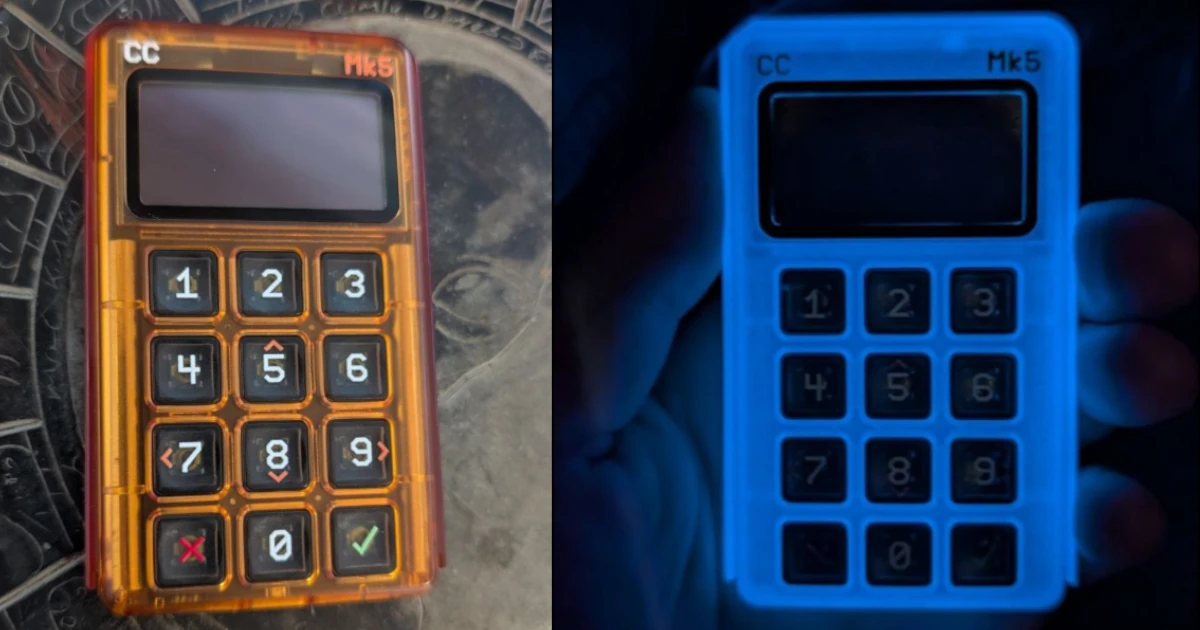
Coinkite, a company dedicated exclusively to Bitcoin hardware wallets, has just unveiled the MK5. This new model represents a notable step forward in terms of comfort and ease of use compared to the popular MK4 Coldcard. It continues the robust security legacy established by earlier versions while making everyday interaction with the device significantly smoother. Available in a variety of colors and designs, this review will examine the Orange and glow-in-the-dark editions. We’ll take a closer look at how its updated shape and interface improvements affect the overall experience and whether the upgrade justifies the investment.
The MK5 builds on the highly respected security foundation of the MK4—a device known for pioneering the use of dual secure element chips paired with another processor to enhance protection. In contrast, the MK5 shifts focus toward refining the user experience. Key enhancements include upgraded NFC functionality, redesigned buttons, a sleeker plastic body, and a notably larger display among other updates. This marks the first major hardware refresh in Coinkite’s top-tier lineup since the MK4 debuted in 2022, and it incorporates select innovations first introduced with the Coldcard Q the following year.
What’s new in the MK5 Coldcard?
The most noticeable improvements relate to usability—the screen, for instance, is significantly larger, roughly 30% bigger than before. According to the official announcement, it features a 1.54-inch display protected by durable Gorilla Glass, which not only looks better but also feels more resilient compared to prior models.
Another standout change is the button design. Unlike the recessed buttons on the MK4 that required pressing into a slot, the MK5’s buttons sit nearly flush with the device’s surface. This makes them far easier to operate. Pressing them delivers a satisfying click with clear tactile feedback—much more comfortable than the imprecise touchscreens found on competing hardware wallets, which can often feel sluggish and awkward.

You’ll also immediately notice a refreshed physical design. The screen no longer protrudes above the keypad area; instead, the entire front forms a smooth rectangle with gently rounded corners. The result is a sleeker, more contemporary appearance that still honors Coinkite’s signature cypherpunk aesthetic—transparent panels reveal the internal components, giving it that distinctive tech-forward look.
Additionally, the MK5 includes a snap-on protective cover for the buttons and screen. This half-case slides on and off effortlessly and can be fully removed, fitting snugly over the back of the device. Its design allows unobstructed access to the USB port at the bottom whenever needed.

NFC Push Transactions
Finally—and importantly—Coinkite has strengthened NFC functionality in the MK5. Short for Near Field Communication, NFC enables
Near Field Communication (NFC) has become an increasingly popular technology within the Bitcoin space. From “tap to pay” Lightning Bolt cards featuring creative laser-eye designs, to Coinkite’s Tapsigner devices, and Cashu’s “tap to send” functionality developed by Calle, NFC is making its mark.
NFC offers a compelling advantage over other wireless technologies like Bluetooth or Wi-Fi—technologies that some hardware wallet manufacturers have turned to despite some notable drawbacks, particularly their range. By design, NFC operates over very short distances, measured in mere centimeters, whereas Bluetooth and Wi-Fi work across tens of meters. This means the far-fetched threat scenario of someone parking outside your home with a powerful antenna, intercepting your transactions or remotely connecting to your device, simply goes away.
Furthermore, NFC does away with the cumbersome multi-step pairing process common to other wireless connections. It is essentially on or off. You open your scanning app, and the data transfer happens almost instantly—no PINs to enter, no scrolling through long lists of Bluetooth devices to find yours. The user experience is far simpler in theory. It is also a significant improvement over the clunky process of passing SD cards between devices to transfer pre-signed transactions. While NFC technically crosses the “airgap” boundary on the MK4 and MK5, it still combines the best aspects of all wireless connectivity options and is disabled by default. Just as you have the option to connect the MK5 to a computer via USB for data transfer, the NFC antenna can also be permanently disabled at a hardware level by physically cutting a specific wire inside the device.
Coinkite’s NFC Push Transaction (PushTX) software is open source and requires significantly fewer lines of code than comparable Bluetooth or Wi-Fi implementations. The complete NFC PushTX code is open source. While the code for the client-facing web application has no defined license—presumably intended for integration into any web service—the open source hardware code is subject to a non-commercial license.
The Colors of the MK5

Catering to Bitcoiners’ passion for unique collectibles, the MK5 is available in an exciting range of stylish case options. These include a sophisticated, gold-flecked transparent gray, a striking, vibrant orange, and even a cool glow-in-the-dark model. I had the opportunity to test the orange and blue glow-in-the-dark version, though I wouldn’t have minded getting my hands on the gold-flecked one either.
The designs strike a great balance—transparent enough to showcase the internal components yet colorful enough to be eye-catching. Here, you can see them in person.


Supply Chain Security
The packaging caught my attention — the box housing the hardware also included a purchase order listing the enclosed items, which were sealed inside tamper-evident security bags. The bags used notably sturdy plastic, not the kind you’d tear open by hand; you’d need a knife to cut through them. Each bag was labeled with a unique serial number, visible in the photos below. Inside the bag, a matching plastic strip carried the same number. And when the devices were powered on for the first time, that same number appeared on the screen. This is a flash memory code programmed into each device at the factory, making it significantly harder for anyone to intercept and tamper with the hardware’s firmware. An additional step would be to share the bag number with the buyer via email or through a login on the website, giving them an independent way to cross-check the number.
If anything about the packaging looks suspicious, you’re encouraged to snap some photos and contact Coinkite support.
The battery and exposed hardware shown in the image below is the COLDPOWER Adapter by Coinkite, which I happened to have on hand and decided to test as well. It’s designed to power the device in a completely airgapped setup — no cables connected to any computer at all, since even a compromised Wi-Fi repeater plugged into an outlet could potentially leak signals through the power lines (lol).


Room for Improvement?
Getting NFC Push Tx to work smoothly with mobile wallets was a bit hit-or-miss. I tested it with Cove, Bull Bitcoin, and Nunchuck. Of the three, Nunchuck offered the best experience, with Cove close behind. Bull Bitcoin appears to have either disabled the feature or buried it somewhere hard to find. Cove is a relatively young project that’s likely to see rapid improvements in the months ahead, while Nunchuck — a highly capable and feature-rich wallet — took me a few minutes to get the hang of but ultimately delivered the best interface of the three.
Even with the upgraded NFC antenna, I had to take off my phone’s absurdly thick case to get a reliable connection, but that’s a minor inconvenience in the grand scheme of things.
Conclusion: Is Upgrading to the MK5 Worth It?
As a proud owner of what I now recognize is a seriously outdated MK3, moving to the MK5 feels like a massive leap forward. At just $167 plus shipping, it’s a no-brainer. That’s an entire generation of security and UX improvements I didn’t even realize I was missing.
For active MK4 users, the larger screen and improved buttons are a genuine quality-of-life upgrade, and the enhanced NFC antenna should pay off by making transaction flows noticeably smoother. Again, compared to other hardware wallets on the market, the price is very reasonable.
For passive MK4 owners who only make a handful of transactions per year, though, the upgrade might not be worth the effort. They’re still receiving firmware updates and benefiting from all the security enhancements, and they likely won’t miss the improved UX all that much.
Disclaimer: Coinkite provided Bitcoin Magazine with a couple of free MK5 Coldcards for the purpose of testing and reviewing their product.
