



For years, cryptocurrency markets have flourished on speculative trading and the massive growth of decentralized finance platforms and their associated tokens.
This continues to hold true for emerging sectors like perpetual decentralized exchanges and prediction markets. However, as traditional financial institutions dive deeper into tokenizing real-world assets, it has become clear that much of crypto’s existing infrastructure isn’t built to support the complex financial products that institutions aim to move onto blockchains.
A contributor to the recently completed ERC-7943 (uRWA) token standard pointed out that the patchwork nature of today’s decentralized finance landscape wasn’t designed with regulated financial assets in mind—assets that typically require robust identity verification systems and common standards for interoperability.
“You can’t simply put regulated assets on a blockchain and expect to bypass the rules,” explained Dario Lo Buglio, co-founder and blockchain lead at tokenization firm Brickken, in an interview with Cointelegraph.
“Those who prefer to operate outside regulatory frameworks can continue doing so in decentralized finance—just without regulated assets.”
While decentralized finance enthusiasts have traditionally resisted token freeze features, these exact controls are precisely what institutional players look for. Source: ethereum.org
Current Standards Fall Short for Every RWA Scenario
Another widely adopted standard, ERC-3643—commonly referred to as T-REX or the Token for Regulated Exchanges—is among the leading frameworks enabling tokenized securities on the Ethereum network.
It already offers several compliance-focused capabilities that institutions expect, such as identity-based access controls and tools that let asset issuers step in when necessary.
However, Lo Buglio noted that this framework was built primarily with securities in mind and doesn’t easily adapt to the expanding variety of tokenized assets now making their way onto blockchain platforms. This limitation is making cross-platform interoperability more challenging as more organizations explore bringing traditional financial instruments onchain.
“As the process of tokenizing becomes simpler, the more complex challenge becomes ensuring these assets function seamlessly across various compliance frameworks, custodial services, trading venues, wallets, and institutional-grade platforms,” shares Markus Levin, co-founder of XYO, speaking with Cointelegraph.
Levin believes that initiatives like uRWA could play a key role in creating uniformity around how tokenized assets embed details related to identity verification, access permissions, regulatory compliance, and transaction rules throughout Ethereum-based ecosystems.
“If executed effectively, this dramatically simplifies the process of moving, validating, and integrating regulated assets—eliminating the need for every institution to construct its own disconnected infrastructure,” he added.
Tokenized real-world assets have expanded from approximately $6.4 billion at the beginning of 2025 to nearly $34 billion as of this Thursday, based on figures from RWA.xyz. Standard Chartered forecasts this figure could surge to $2 trillion by late 2028, while Boston Consulting Group anticipates a staggering $18.9 trillion by 2033.
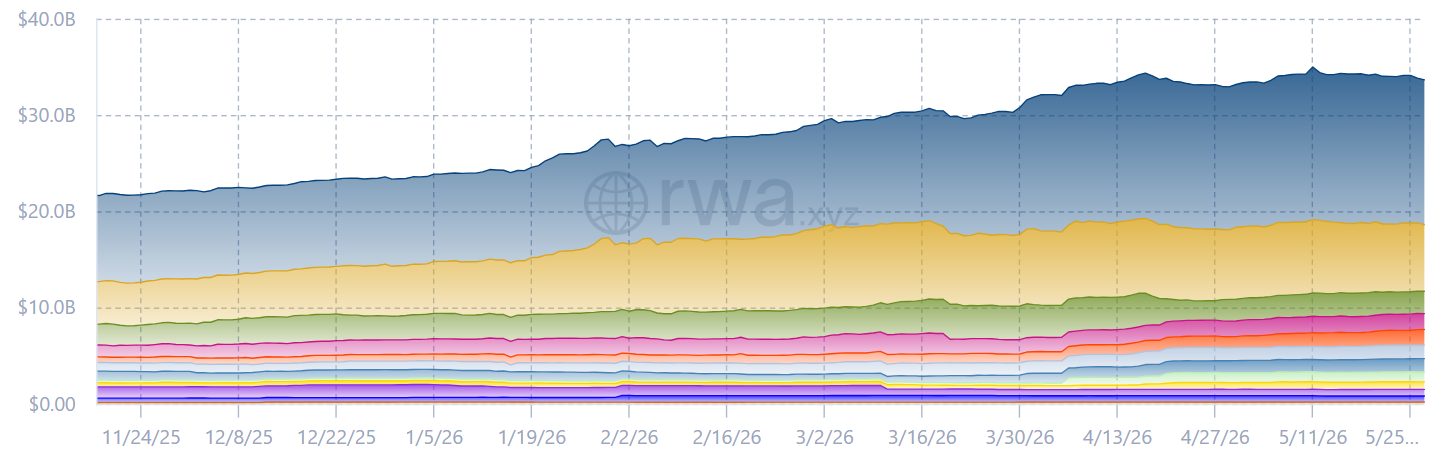
When stablecoins are included in RWA calculations, the combined market capitalization nears $340 billion. Source: RWA.xyz
Related: Wall Street’s Tokenization Surge Faces a Liquidity Challenge: Axis CEO
Levin further observed that institutions have primarily gravitated toward assets offering reliable income streams, genuine yields, and well-defined legal frameworks.
“The market is prioritizing tokenization for assets that stand to gain the most from quicker settlement cycles, programmable collateral functionality, and reduced operational complexity,” he noted.
Also see: How Elliott Wave Theory Helps Identify BTC Market Tops and Bottoms
Emerging Privacy Demands from Institutions
Privacy continues to pose a significant challenge for institutions venturing into onchain finance, especially for organizations reluctant to reveal their portfolio strategies or transaction patterns on publicly accessible blockchains.
“It’s unrealistic to expect firms like BlackRock to publish their entire holdings on a public ledger for anyone to see—and yet they still want to conduct transactions onchain,” he remarked.
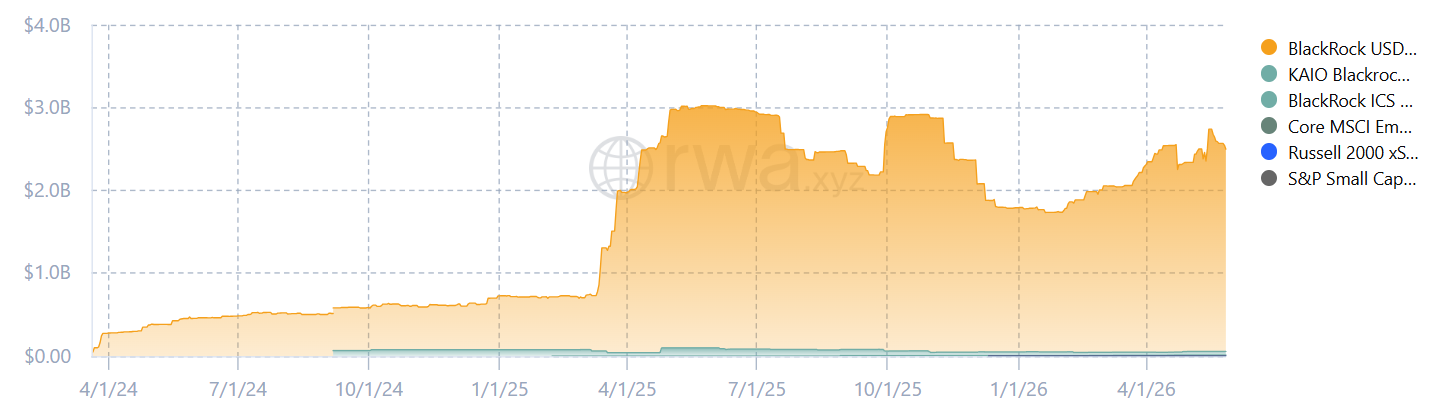
BlackRock’s institutional liquidity fund holds approximately $2.5 billion in assets. Source: RWA.xyz
Related: Security Breaches in DeFi Undermine Institutional Trust as Hazards Exceed Returns
Lo Buglio pointed out that numerous existing tokenization frameworks were conceived for public Ethereum-compatible networks and don’t always transition smoothly to privacy-focused chains, where transaction processing methods and underlying data architectures frequently differ from conventional EVM setups.
Canton Network, backed by major names such as Goldman Sachs, Microsoft, and Cboe Global Markets, was specifically engineered to facilitate privacy-protected financial coordination among institutional participants.
In contrast to public blockchains where transaction histories are openly visible to all network participants, Canton restricts data access to only those with a legitimate need to see it, while still enabling synchronized settlement across institutional boundaries.
This design philosophy has drawn criticism from some developers who contend that the network misses essential traits typically associated with public blockchains, most notably a universally shared and accessible state.
This ongoing debate underscores a widening gap between infrastructure rooted in crypto-native decentralized finance principles and the blockchain solutions that major financial institutions seem more inclined to embrace for regulated asset management.
AI-Powered Agents Could Expand RWAs Beyond Traditional Finance
Much of today’s discussion around tokenized real-world assets has focused on banking systems and institutional frameworks. Yet, certain developers suspect that the infrastructure currently under construction for RWAs may eventually extend its reach into machine-operated financial systems.
“When AI agents start independently managing and allocating capital, they’ll require assets that reside onchain in a format they can interpret and interact with,” explains Taran Dhillon, who leads digital assets strategy at tokenization firm Kula, in conversation with Cointelegraph.
Dhillon highlights that numerous productive real-world assets remain largely cut off from automated financial systems due to the absence of standardized digital frameworks.
“The standards we’re developing now must be capable of functioning across diverse jurisdictions and asset categories—not merely within the established boundaries of today’s financial markets,” he emphasized.
Echoing this perspective, Lo Buglio noted that ERC-7943 was conceived less as a single rigid implementation and more as an adaptable framework that enables tokenized assets to flow across increasingly interconnected blockchain networks.
On Wednesday, ERC-7943 reached the “final” milestone within the Ethereum Improvement Proposal process, signaling that developers can now build and deploy smart contracts utilizing this standard without worrying about future modifications to its specifications. The coming phase will likely shift focus toward broader adoption across tokenization platforms.
Despite the introduction of yet another tokenization standard, this alone may not instantly resolve the very standardization challenges it seeks to address.
Lo Buglio conceded that ERC-7943 was deliberately crafted as a more adaptable and less prescriptive framework compared to certain predecessors.
Major financial institutions and blockchain development teams continue to explore proprietary solutions and tailor-made compliance architectures for their needs.
Magazine Feature: Burning Question: Is a Universe of Just 2–5 Cryptocurrencies Really Enough?
