



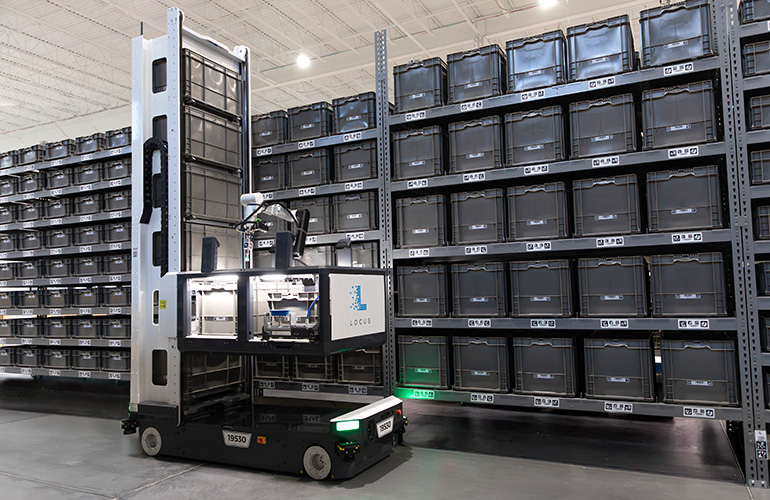
Cell manipulation is beginning to scale in response to provide chain challenges. Locus Robotics at the moment introduced at MODEX the worldwide launch of Locus Array. The system combines a cell robotic, an built-in choosing arm, and AI-powered notion for autonomous execution.
“The No. 1 problem facing supply chains today is uncertainty,” mentioned Rick Faulk, CEO of Locus Robotics. “Whether it’s COVID-19, peak seasons, or tariffs, costs have climbed while productivity hasn’t.”
“Warehouse operations are facing increasing pressure from labor constraints, rising costs, and constant variability that traditional systems can’t absorb,” he said. “Locus Array brings autonomy into real-world operations at scale, introducing a fundamentally different, system-level approach designed to solve these challenges at their core.”
“Array is a step toward a facility that runs itself, a holy grail of warehousing,” Faulk advised Automated Warehouse. “Array is the culmination of our 10-year roadmap, from humans plus the LocusBots to deploying 17,000 AMRs and assisting in more than 7 billion picks. We looked at design and workflows in multiple buildings in very disciplined ways to have the flexibility to scale up and down.”
Quiet Logistics was an early adopter of Kiva Techniques‘ cell robots, however in 2012, Amazon purchased Kiva and took its robots off the marketplace for its personal wants. Quiet Logistics used its expertise as a third-party logistics supplier (3PL) to create Locus Robotics. It surpassed 6 billion robot-assisted picks in October 2025.
The corporate now serves greater than 150 clients at over 350 services in 20 international locations, famous Peter Ashe, senior vp for operations at Locus. “Sixty percent of medical supplies, such as artificial knees, use Locus robots for next-day shipping to healthcare facilities across the U.S.,” he mentioned.
Locus is seeking to convey Array to Europe and Asia-Pacific, Ashe added.

Locus Array allows robot-to-goods workflows
Locus mentioned Array offers its clients the next capabilities:
- Fast, high-density throughput with streamlined order success: The system, first proven at ProMAT final yr, processes orders in parallel and consolidates work immediately within the aisle, growing throughput and supporting round the clock operations.
- Autonomous execution throughout a number of workflows: Faulk mentioned Array can deal with choosing, putaway, induction, drop-off, slotting, and replenishment, decreasing handbook labor by 90%.
- Quicker time to worth with minimal disruption: Array could be deployed in weeks slightly than months with out redesigning services or including complicated infrastructure, asserted Locus.
- Versatile, scalable efficiency in dynamic environments: The built-in system is designed to scale with quantity and adapt to altering layouts, SKUs, and demand with out transforming workflows.
- Coordinated, multi-robot execution: Array works with the Locus Origin (launched in 2016) and Vector (launched in 2023) AMRs to cowl 100% of SKUs inside a single, unified system. Locus mentioned it will probably ship a fast return on funding (ROI) with its scalable, low upfront price robotics-as-a-service (RaaS) mannequin.
Collectively, these capabilities introduce a brand new class of warehouse automation: robots-to-goods (R2G), claimed Locus. On this mannequin, good robots like Locus Array go on to stock and execute success duties inside the aisle.
By embedding a number of workflows immediately into the robotic, R2G expands automation past assisted processes to grow to be absolutely autonomous, based on Locus. “This minimizes travel, maintains continuous SKU availability, while also enabling higher storage density within existing warehouse layouts,” it mentioned.
“Unlike person to goods or goods to person [G2P], in our system, the robots travel, and the racks of inventory don’t have to,” Ashe continued.
Additionally, in contrast to some automated storage and retrieval techniques (ASRS), objects is not going to get caught within the grid if there’s a energy failure or bigger or hazardous merchandise are concerned. Guide choosing continues to be potential, if much less environment friendly, he added.

LocusONE makes use of bodily AI to unify the robotic fleet
The LocusONE platform makes use of synthetic intelligence to orchestrate Locus Array as a part of a unified fleet alongside the Locus Origin and Vector AMRs. It dynamically assigns work primarily based on real-time demand, coordinating robots, workflows, and stock motion as a single system that scales and adapts with operations over time.
Locus mentioned LocusONE “delivers consistent performance and the operational confidence required to outperform in an uncertain environment.” With basis fashions and inference operating on NVIDIA know-how on the sting, LocusINTELLIGENCE helps optimize buyer operations.
“Physical AI has arrived,” declared Faulk. “Nobody else is doing this at the same scale with vision models getting smarter and more efficient. Our great differentiator is that we’re not coming out of a lab but from real-world deployments. Array can perceive, reason, and act.”
“Picking has traditionally been one of the hardest tasks to automate,” mentioned Kait Peterson, vp and head of selling at Locus. “With LocusONE, the system is continually learning for the lowest cost per pick.”
DHL Provide Chain expands partnership with Array
Among the many clients already utilizing Locus Array in reside operations is DHL Provide Chain, a long-standing world buyer of Locus Robotics. It lately accomplished 1 billion picks with Locus techniques and deployed its first Array at a web site in Columbus, Ohio.
“Innovation is only real when it’s scaled; otherwise, it’s just a nice idea,” Tim Tetzlaff, world head of digital transformation at DHL, advised Automated Warehouse. “Since we announced the 1 billionth pick — a pink beanie in Las Vegas on Feb. 12 — we made 21 million more in the following three to four weeks. Locus is a key component of our enterprise infrastructure. Picking is a huge opportunity because it requires a lot of labor.”
At DHL, three Arrays use omnidirectional wheels to retrieve totes weighing as much as 66 lb. (29.9 kg) from commonplace, double-deep racking as much as 10 ft. (3 m) excessive and go them to Origin and Vector robots. Locus mentioned the cell manipulators can decide 60% to 70% of e-commerce SKUs, together with 30% of polybags. It will possibly additionally act as a buffer for batch choosing and sortation.
“The launch of the Locus Array marks a pivotal second in DHL’s accelerated digitalization journey, shifting us past conventional assisted choosing into a brand new period of high-density, autonomous success,” said Sally Miller, world chief info officer at DHL Provide Chain.
“By being the first to deploy Locus Array, we are not just addressing today’s labor and capacity challenges; we are actively engineering a more agile supply chain,” she added. “This innovation permits us to maximise vertical house and dramatically cut back handbook touches, guaranteeing that we proceed to supply our clients with the pace and reliability they anticipate from the world’s logistics chief.”
The businesses proceed to have quarterly conferences to have a look at the well being of the operations and any IT upgrades. “We talk a lot about flexibility, but resiliency is another aspect of support that DHL provides to retailers,” mentioned Faulk.
Attendees at MODEX in Atlanta this week can see Locus Array at Sales space B10704. As well as, DHL is working with firms similar to AutoStore, Boston Dynamics, and SVT Robotics, which may even be on the provide chain occasion.
Editor’s word: Jasmine Lombardi, chief buyer officer at Locus Robotics, will take part within the opening keynote panel on “Building Reliable Robots at Scale” at subsequent month’s Robotics Summit & Expo in Boston. Registration is now open.

The submit Locus Robotics launches Locus Array for absolutely autonomous success appeared first on The Robotic Report.
