



Picture by Creator
# Introduction
The world of information engineering is stuffed with buzzwords. For a newbie knowledge scientist, listening to phrases like “data lake,” “data warehouse,” “lakehouse,” and “data mesh” in the identical dialog may be complicated. Are they the identical factor? Do they compete with one another? Which one do you really want?
Figuring out these ideas is essential as a result of the construction you select determines the way you retailer, entry, and analyze your knowledge. It impacts every thing from the velocity of your machine studying fashions to the way you depend on your corporation stories.
On this article, I clarify these 4 approaches to knowledge administration in easy phrases. By the top, you’ll perceive the variations, strengths, and weaknesses of every structure and know when to make use of them. On the finish of the article, you’ll have a transparent roadmap to get by means of the trendy knowledge panorama.
# Understanding the Knowledge Warehouse
Let’s begin with the oldest and most established idea: the information warehouse. Think about a clear, organized library. Each guide (piece of information) is in its appropriate place, cataloged, and formatted to be simply learn.
A knowledge warehouse is strictly the clear, organized library for structured knowledge. A knowledge warehouse is a single central location that shops structured, processed knowledge optimized for evaluation and reporting. It follows the “schema-on-write” precept. What this implies is that earlier than knowledge is even loaded into the warehouse, it have to be cleaned, reworked, and structured into a particular format — often tables with rows and columns.
// Key Traits
- It primarily shops structured knowledge from transactional programs, operational databases, and line-of-business functions.
- It depends closely on extract, remodel, load (ETL). Knowledge is extracted from sources, reworked (cleaned, aggregated), after which loaded into the warehouse.
- As a result of the information is preprocessed and structured, querying is extremely quick and environment friendly. It’s optimized for enterprise intelligence (BI) instruments like Tableau or Energy BI.
- Enterprise analysts can simply question the information utilizing SQL with no need deep technical experience.
// Figuring out the 4 Parts of a Knowledge Warehouse
Each knowledge warehouse consists of 4 important parts, that are:
- Centralized database: The core storage system
- ETL instruments: Extract, remodel, load instruments that course of knowledge
- Metadata: Knowledge in regards to the knowledge (descriptions, context)
- Entry instruments: Interfaces for querying and reporting
# Defining the Load Supervisor in a Knowledge Warehouse
A load supervisor is a element that handles the ETL course of. It extracts knowledge from sources, transforms it in keeping with enterprise guidelines, and masses it into the warehouse. Consider it because the loading dock employees who obtain shipments, verify stock, and place objects of their appropriate areas.
# Reviewing Widespread Instruments
In style knowledge warehouse options embrace Snowflake, Amazon Redshift, Google BigQuery, and Microsoft Azure Synapse. Is Snowflake a knowledge warehouse? Sure, Snowflake is a cloud-based knowledge warehouse that separates storage from compute, permitting impartial scaling of every.
// Figuring out When to Use a Knowledge Warehouse
Use a knowledge warehouse if you want:
- Quick question efficiency on structured knowledge
- Enterprise intelligence and reporting
- A single supply of reality for enterprise metrics
- Knowledge consistency and excessive knowledge high quality
- Supporting enterprise selections based mostly on historic, dependable knowledge

Conventional knowledge warehouse structure displaying ETL pipeline from sources to central warehouse to BI instruments | Picture by Creator
# Understanding the Knowledge Lake
As knowledge begins to extend in quantity and selection, like social media posts, photos, and web of issues (IoT) sensor knowledge, the inflexible construction of the information warehouse turns into an issue. That is the place you have to use the information lake.
If a knowledge warehouse is a library, a knowledge lake is a reservoir. It follows the “schema-on-read” precept. You retailer knowledge in its uncooked, native format first and solely apply construction when you’re able to learn and analyze it.
// Key Traits
Knowledge lakes use schema-on-read, which means you outline the construction if you learn the information, not if you retailer it. They will deal with all knowledge sorts:
- Structured knowledge (tables, CSV information)
- Semi-structured knowledge (JSON, XML, logs)
- Unstructured knowledge (photos, movies, audio information)
// Figuring out Knowledge Lake Workloads
Knowledge lakes primarily help on-line analytical processing (OLAP) workloads for analytics and massive knowledge processing. Nonetheless, they will additionally ingest knowledge from on-line transaction processing (OLTP) programs by means of change knowledge seize (CDC) processes.
// Clarifying Apache Kafka and Knowledge Lakes
No, Apache Kafka is just not a knowledge lake. Kafka is a distributed occasion streaming platform used for real-time knowledge insertion. Nonetheless, Kafka typically feeds knowledge into knowledge lakes, performing because the pipeline that strikes streaming knowledge into storage.
// Reviewing Widespread Instruments
In style knowledge lake options embrace Amazon S3, Azure Knowledge Lake Storage (ADLS), Google Cloud Storage, and Hadoop HDFS.
// Figuring out When to Use a Knowledge Lake
Use a knowledge lake if you want:
- Storing large quantities of IoT sensor knowledge for future machine studying tasks
- Holding consumer clickstream logs for behavioral evaluation
- Archiving uncooked knowledge for regulatory compliance
- Flexibility to retailer any knowledge kind
- Knowledge science and machine studying use circumstances
- Value-effective storage (knowledge lakes are cheaper than warehouses)

Knowledge lake structure displaying various knowledge sources flowing into uncooked storage with numerous shoppers accessing knowledge | Picture by Creator
// Additional Key Traits
- It shops all knowledge sorts, each structured and semi-structured (JSON, XML, logs) and unstructured knowledge (photos, movies, audio).
- It makes use of extract, load, remodel (ELT). Knowledge is extracted and loaded in its uncooked kind first. The transformation occurs later when the information is learn for evaluation.
- It’s constructed on high of low cost, scalable object storage (like Amazon S3 or Azure Blob Storage); it’s cost-effective storage; it’s less expensive to retailer petabytes of information right here than in a warehouse.
- Knowledge scientists love knowledge lakes as a result of they will discover uncooked knowledge, experiment, and construct fashions with out being restricted by predefined schemas.
Nonetheless, this flexibility comes at a price. With out correct administration, a knowledge lake can rapidly flip right into a “data swamp,” a chaotic mess of unusable, uncataloged knowledge.
A large reservoir with a number of pipes flowing in (Logs, Photographs, Databases, JSON) | Picture by Creator
# Understanding the Lakehouse
Now you’ve got the low-cost, versatile knowledge lake and the high-performance, dependable knowledge warehouse. For years, organizations had to decide on one or preserve two separate programs (a pricey “two-tier” structure), resulting in inconsistency and delays.
The lakehouse is the answer to this drawback. It’s a new, open structure that mixes one of the best of each worlds. Consider a lakehouse as a library constructed instantly on high of that uncooked water reservoir. It provides warehouse-like construction and administration options like atomicity, consistency, isolation, sturdiness (ACID) transactions and knowledge versioning instantly onto the low-cost storage of a knowledge lake.
// Key Traits
- Knowledge Lake Storage makes use of a budget, scalable object storage of a knowledge lake for all of your knowledge sorts.
- One of many warehouse options is that it provides a administration layer on high that gives options historically solely present in knowledge warehouses, reminiscent of:
- ACID Transactions: Making certain knowledge consistency, even with a number of customers studying and writing concurrently.
- Schema Enforcement: The power to outline and implement knowledge buildings when wanted.
- Efficiency Optimization: Strategies like caching and indexing to make querying quick, just like a warehouse.
- There’s direct entry; knowledge scientists and engineers can work instantly with the uncooked knowledge information for machine studying, whereas enterprise analysts can question the identical knowledge utilizing BI instruments by way of the optimized layer.
This eliminates the necessity to preserve a separate warehouse and a separate lake. It creates a single supply of reality for all of your knowledge wants.
// Reviewing Use Instances
- Operating each BI stories and superior machine studying fashions on the identical, constant dataset
- Constructing real-time dashboards on streaming knowledge that can be saved for historic evaluation
- Simplifying knowledge structure by changing a fancy ETL pipeline that strikes knowledge between a lake and a warehouse
# Understanding the Knowledge Mesh
We’ve mentioned knowledge lake, knowledge warehouse, and lakehouse; they’re all primarily technological architectures. They reply the query, “How do I store and process my data?”
Knowledge mesh is completely different. It’s a socio-technical structure. It solutions the query, “How do I organize my teams and my data to scale effectively in a large organization?”
Think about an enormous, monolithic software constructed by one large group. It turns into sluggish, unstable, and laborious to handle. The answer was to interrupt the applying into smaller, impartial microservices owned by completely different groups. Knowledge mesh applies this identical precept to knowledge.
As an alternative of getting one central knowledge group answerable for all the information within the firm (a central knowledge lake or warehouse), knowledge mesh distributes the possession of information to the area groups that comprehend it greatest.
// Figuring out the 4 Pillars of Knowledge Mesh
Knowledge mesh rests on 4 basic rules, that are:
- Enterprise domains (advertising, gross sales, finance) personal their knowledge end-to-end.
- Datasets are handled as merchandise with clear documentation and high quality requirements.
- A self-serve knowledge platform the place infrastructure makes it straightforward for domains to handle and share knowledge.
- It turns into a centralized coverage with decentralized execution.
// Inspecting an Instance of a Knowledge Mesh
Contemplate a big e-commerce firm. As an alternative of 1 central knowledge group dealing with all knowledge:
- The advertising area owns buyer interplay knowledge, offering clear, documented datasets.
- The stock area owns product and inventory knowledge as a dependable product.
- The success area owns transport and logistics knowledge.
- All domains use a shared self-service platform however preserve their very own knowledge pipelines.
// Evaluating Knowledge Mesh and Knowledge Warehouse
Knowledge mesh and knowledge warehouse serve completely different functions. A knowledge warehouse is a know-how; a knowledge mesh is an organizational framework. They don’t seem to be primarily separate; you’ll be able to implement knowledge mesh rules whereas utilizing knowledge warehouses, knowledge lakes, or lakehouses as underlying applied sciences.
Knowledge mesh is healthier when:
- Your group has a number of impartial enterprise domains
- Central knowledge groups turn into issues
- That you must scale knowledge initiatives throughout a big group
- Area consultants perceive their knowledge greatest
Knowledge warehouses stay higher for:
- Centralized reporting and analytics
- Organizations with sturdy central knowledge governance
- Smaller organizations with out a number of distinct domains
// Reviewing Widespread Instruments
Knowledge mesh platforms embrace instruments for knowledge discovery, sharing, and governance: Apache Atlas, DataHub, Amundsen, and cloud suppliers’ knowledge mesh options.
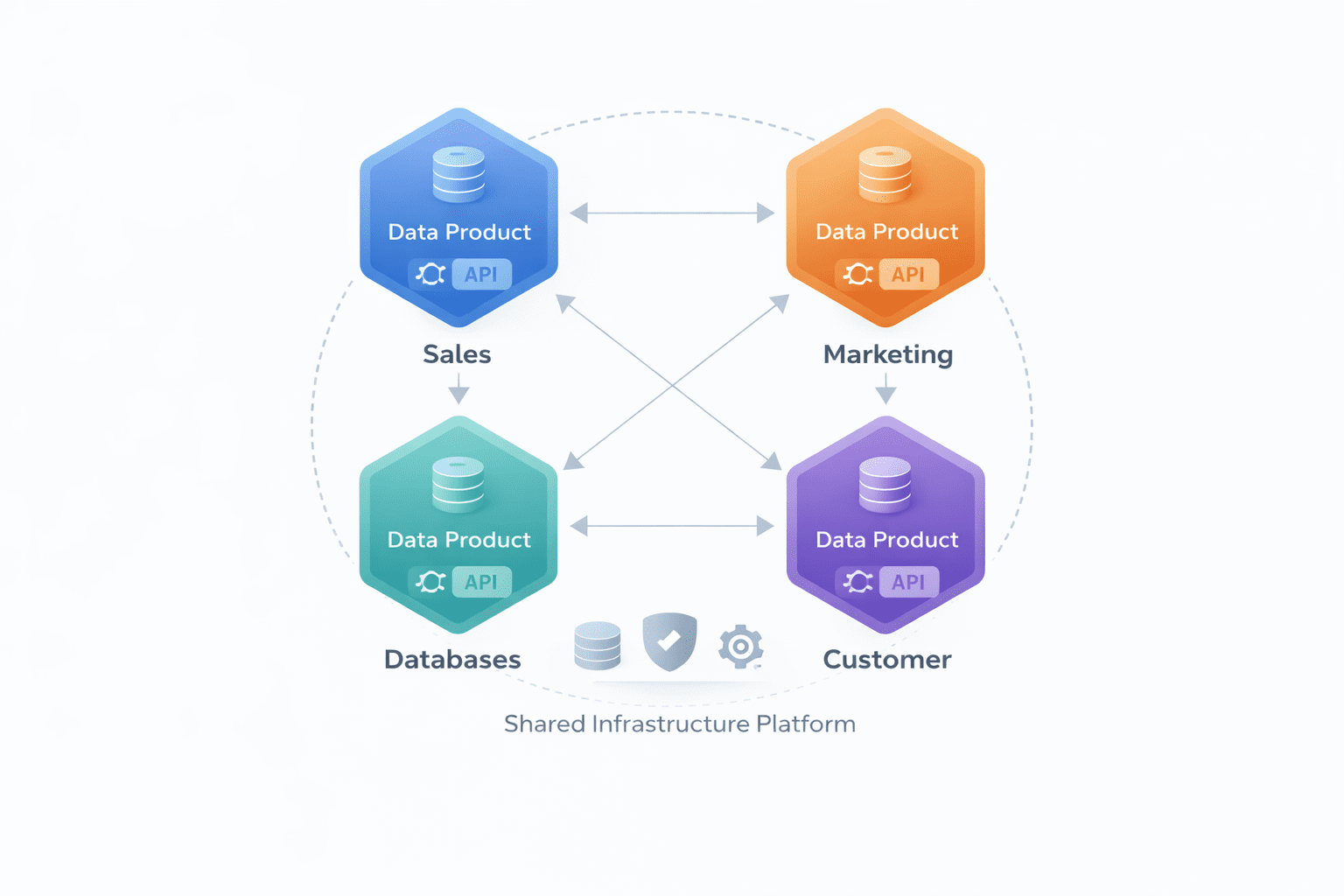
Knowledge mesh structure displaying interconnected domains every proudly owning their knowledge merchandise with a shared infrastructure platform | Picture by Creator
// Key Ideas of Knowledge Mesh
- Knowledge is owned by the useful enterprise area that generates it (e.g., the gross sales group owns gross sales knowledge, and the advertising group owns advertising knowledge). They’re answerable for serving their knowledge as a “data product.”
- Every area group treats their datasets as a product for which it’s the steward. This implies the information have to be clear, well-documented, safe, and accessible by way of an outlined interface (like an API).
- A central platform group supplies the instruments and infrastructure, for instance, the “data plane” that makes it straightforward for area groups to create, preserve, and share their knowledge merchandise. That is typically constructed on a lakehouse structure.
- Governance is just not a top-down central mandate. As an alternative, a federated group of leaders from completely different domains agrees on world requirements (for safety, interoperability, and so on.) that each one knowledge merchandise should comply with.
Consider it this manner: you’ll be able to construct a knowledge lakehouse (the know-how), however to handle it throughout an enormous firm with out chaos, you want a knowledge mesh (the organizational mannequin).
// Reviewing Use Instances
- Massive enterprises with a whole bunch of groups are struggling to seek out and belief knowledge from a central knowledge lake
- Organizations that need to cut back the bottleneck of a central knowledge engineering group
- Corporations wish to foster a tradition of information possession and collaboration throughout enterprise models
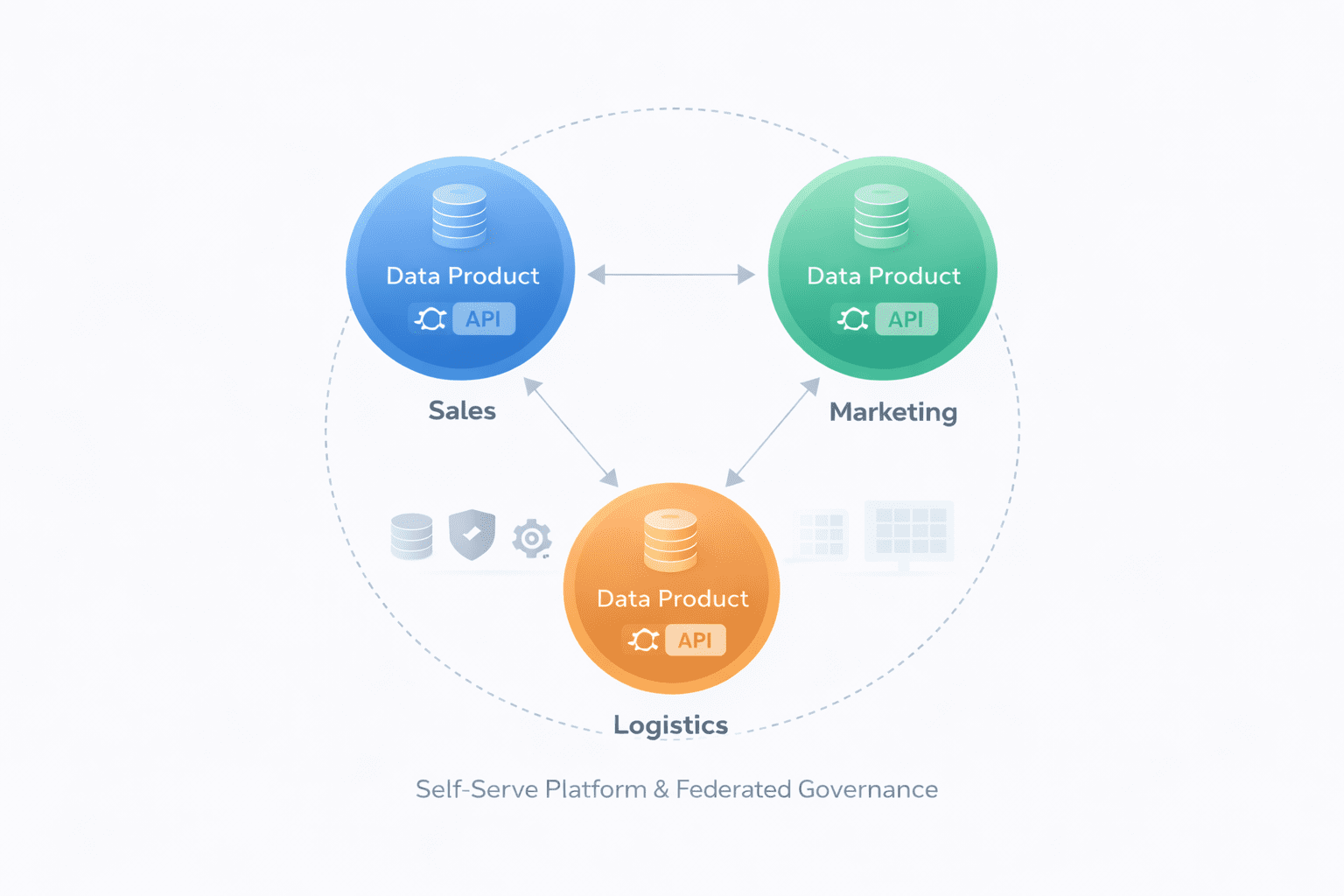
A diagram displaying a number of domains | Picture by Creator
To summarize the variations between these architectures, right here is a straightforward comparability desk.
| Function | Knowledge Warehouse | Knowledge Lake | Lakehouse | Knowledge Mesh |
|---|---|---|---|---|
| Main Focus | Expertise (Storage) | Expertise (Storage) | Expertise (Storage + Administration) | Group (Individuals + Course of) |
| Knowledge Kind | Structured solely | Structured, semi-structured, unstructured | Structured, semi-structured, unstructured | Every type, organized by area |
| Schema | Schema-on-write (enforced) | Schema-on-read (versatile) | Helps each | Outlined by area knowledge merchandise |
| Major Customers | Enterprise analysts | Knowledge scientists, engineers | Knowledge scientists, analysts, and engineers | Everybody, throughout domains |
| Key Objective | Quick BI reporting & efficiency | Low cost storage & flexibility | Single supply of reality, versatility | Decentralized possession & scale |
# Selecting the Proper Structure for Your Challenge
So, as a newbie knowledge scientist, how do you determine what to make use of? The reply relies upon closely on the context of your group.
- When you work at a small firm with conventional enterprise wants, you’ll probably work together with a knowledge warehouse. Your focus can be on working SQL queries to generate stories for stakeholders.
- When you work at a tech firm coping with various knowledge, you’ll most likely reside in a knowledge lake or a lakehouse. You can be pulling uncooked knowledge for testing and constructing options for fashions, and might have to make use of instruments like Spark or Python to course of it.
- When you be part of an enormous multinational company, you would possibly hear in regards to the knowledge mesh. As a knowledge scientist in a mesh structure, you’ll be a shopper of information merchandise from different domains (like utilizing the clear customer_360 knowledge product from the gross sales area) and probably a producer of your personal knowledge merchandise (like a model_predictions knowledge product).
# Conclusion
On this article, you’ve got been capable of perceive that the world of information structure is just not about choosing one winner. Every of those ideas solves a particular drawback.
- Knowledge warehouses provided reliability and efficiency for enterprise reporting
- Knowledge lakes embraced the variability and quantity of massive knowledge
- Lakehouses merged the 2, creating a versatile but highly effective basis for all knowledge workloads
- Knowledge mesh addresses the human and organizational problem of scaling knowledge possession in giant corporations
As you start your knowledge science journey, understanding the strengths and weaknesses of every will make you a simpler and well-rounded practitioner. You’ll know not simply the way to construct a mannequin but additionally the place to seek out the precise knowledge, the way to retailer your outputs, and the way to make sure your work suits into the broader knowledge technique of your group.
Shittu Olumide is a software program engineer and technical author captivated with leveraging cutting-edge applied sciences to craft compelling narratives, with a eager eye for element and a knack for simplifying complicated ideas. It’s also possible to discover Shittu on Twitter.
