



# Cutting AI Costs: How Data Format Choices Can Slash Token Usage in Your AI Pipelines
## The Hidden Token Tax in AI Search and Retrieval
Modern AI agents are extraordinarily hungry for data. When tasked with a simple query — looking up a local business, retrieving product information, or pulling together a quick fact check — these agents don’t just fetch what they need. They ingest entire response payloads filled with data structures, metadata fields, tracking links, and formatting artifacts that serve no purpose for language model reasoning. The result is a silent but significant token tax that accumulates with every API call, quietly inflating costs and crowding out valuable context windows.
This problem is particularly acute in agentic workflows, where a single user request can trigger multiple search calls, recursive query expansions, and repeated retrievals. Each iteration compounds the waste, and before long, a seemingly trivial task has consumed thousands of tokens on content the model never actually used for its output.
## Why Your Data Format Matters More Than You Think
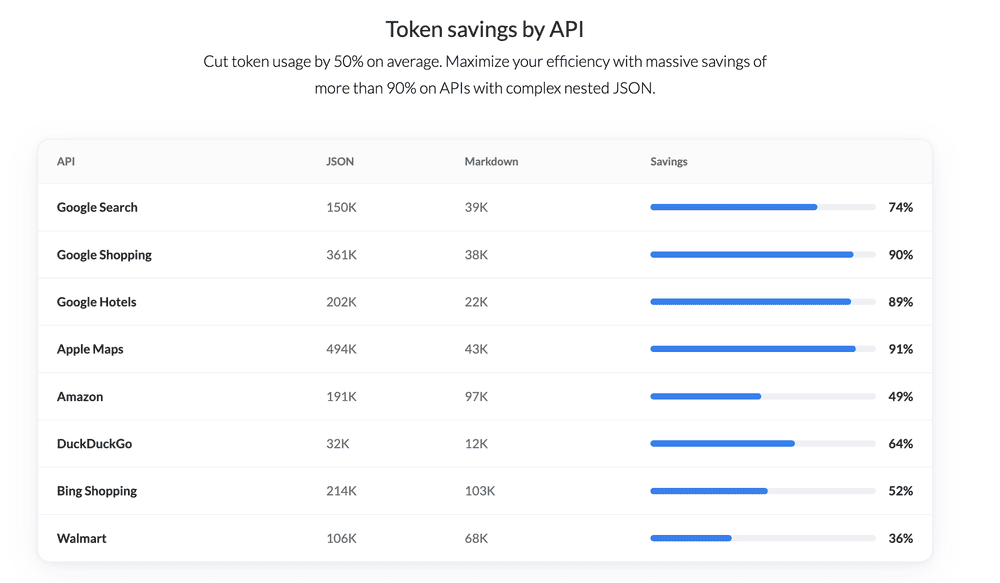
Most developers focus their optimization efforts on prompt engineering, model selection, or caching strategies. Rarely does anyone look at the raw format of the data being fed into the model. Yet the structure of a response payload can have a dramatic impact on token consumption — sometimes reducing usage by more than half with a single formatting change.
Consider a typical search API response delivered in JavaScript Object Notation (JSON). The response includes a rich hierarchical structure: separate keys for titles, URLs, displayed links, snippets, and embedded metadata. It carries internal routing fields designed for the API provider’s own query refinement system. It includes image URLs, thumbnail references, and pagination objects. None of these elements help a language model understand the content, yet every single one of them costs tokens.
When that same information is delivered in Markdown format, the transformation is remarkable. Internal routing noise disappears. Image references and icon URLs are stripped. Nested metadata is collapsed into clean, readable tables. Titles and links merge into single, natural inline expressions. The semantic content remains intact — the model still receives all the information it needs — but the overhead is nearly eliminated.
In one documented comparison, a search query that produced a JSON response of over 24,000 tokens yielded a Markdown output of roughly 6,400 tokens. That is a reduction of more than 70%, achieved without losing a single piece of meaningful information. Further filtering can push this even lower, delivering focused results in under 1,300 tokens.
## What Gets Stripped When You Switch to Markdown
The Markdown transformation is not a blunt instrument. It surgically removes the elements that bloat token counts while preserving the informational backbone a model relies on. Here is what typically gets eliminated or restructured:
**Internal routing and tracking fields.** API responses often contain fields like internal link identifiers and query refinement endpoints. These are designed for the provider’s infrastructure, not for a language model to consume. Markdown strips these entirely.
**Visual elements and thumbnails.** Image URLs, icon references, and thumbnail links are valuable for user-facing interfaces but add nothing to a model’s reasoning. Markdown drops these without a second thought.
**Redundant metadata and pagination objects.** JSON preserves every structural detail, including result counts, page numbers, and nested arrays. Markdown flattens this hierarchy into clean, scannable tables and inline references.
**Separated key-value pairs.** In JSON, a single result might spread its title, URL, displayed link, and snippet across multiple separate fields. Markdown compresses these into a single readable line with a native hyperlink, dramatically reducing key names and structural repetition.
The underlying principle is straightforward: anything that exists for a system to parse or a browser to render, but not for a model to read, is token waste. Identifying and eliminating that waste is one of the most overlooked optimization opportunities in AI engineering.
## When JSON Still Makes Sense
Markdown is not a universal replacement for structured data. There are scenarios where the precise data types and field-level control of JSON remain essential. If your pipeline needs exact numeric prices stored as integers, floating-point ratings, geographic coordinates, or structured arrays for downstream processing, JSON’s rigid typing is valuable and appropriate.
For example, consider a price comparison engine that needs to extract and compute with coupon prices, original prices, and sale prices stored as distinct numeric fields. In that context, JSON’s explicit type declarations are critical. Markdown’s table-based representation, while far more token-efficient, would lose that structural precision.
The key insight is matching the format to the consumer. When the end reader is a language model performing summarization or analysis, Markdown’s lean representation is ideal. When the end reader is a code-based processing pipeline that depends on typed fields and nested structures, JSON remains the right choice. The data and the underlying credits are identical — only the shape changes.
## Implementing the Switch in Your Workflow
Adopting a more token-efficient format is often as simple as adding a parameter to your existing API calls. Many search and retrieval APIs now support Markdown output through a query parameter, an alternative endpoint, or a request header. The change requires no modification to your core logic and imposes no additional cost — it simply returns the same information in a leaner container.
For teams building agentic systems, the cumulative impact is substantial. Small per-call savings compound rapidly across thousands or millions of queries. A 70% reduction in response payload size does not just save money on token costs; it also frees up context window space, allowing agents to retain more relevant information across longer conversations and more complex workflows.
Additionally, many APIs offer field-level restriction tools that let you specify exactly which data keys to include in the response. By selecting only the fields your model actually needs, you can reduce payload sizes even further before the data ever leaves the server. This server-side filtering is especially powerful when combined with Markdown formatting, creating a two-layer optimization strategy.
## Measuring Your Real-World Savings
The most effective way to understand the impact of format optimization in your own systems is to run your own benchmarks. Pick a query you already execute regularly, request the same results in both formats, and measure the token counts side by side. Then experiment with field restrictions to see how much further you can trim the payload.
Every integration is different, and the savings will vary depending on the types of queries you run, the structure of the responses, and how your agents consume the data. But the pattern is consistent and compelling: the format of your data matters, and small changes in how you request and structure API responses can yield outsized improvements in efficiency.
## FAQ
### Why do AI agents consume so many tokens during simple searches?
AI agents tend to pull in entire response payloads, including metadata, tracking fields, image references, and structural artifacts that serve no purpose for model reasoning. A simple search can generate nested objects and redundant data that the agent never actually uses, yet you pay for every token in the response.
### Does switching to Markdown change the quality of results?
No. Markdown output preserves all the informational content a model needs — titles, descriptions, links, and structured data — while removing the formatting overhead that inflates token counts. The semantic quality of the response is identical; only the container changes.
### Can I use Markdown for every type of API response?
Markdown is optimized for language model consumption and works best for search results, summaries, and retrieval tasks. However, if your system requires precise numeric types, nested arrays, or structured data for programmatic processing, JSON remains the better choice. The right format depends on who is reading the output.
### Is there a performance difference between Markdown and JSON responses?
There is no meaningful difference in response generation time or retrieval speed. The Markdown format is simply a different representation of the same underlying data. Any performance improvements come from reduced token processing costs downstream.
### How can I test token savings in my own system?
Take a query you already run frequently, request the same results in both Markdown and JSON formats, and compare the token counts using a tokenizer or your API provider’s usage metrics. You can also experiment with field restrictions to measure additional savings from payload filtering.
### Are there any hidden costs or limitations with Markdown output?
Markdown output is typically available at no additional cost alongside JSON responses, using the same API credits. However, Markdown is not suitable for every use case — particularly those requiring exact numeric precision or structured array processing for downstream code pipelines.
## Conclusion
The conversation around AI efficiency has long centered on model selection, prompt design, and inference optimization. While all of those areas matter, there is a simpler and often overlooked lever hiding in plain sight: the format of the data you send to your models. By choosing leaner output formats, stripping unnecessary fields, and matching the structure of your API responses to what your models actually need, you can cut token consumption dramatically — sometimes by more than two-thirds — without sacrificing a single byte of meaningful information.
Every token saved compounds. In agentic systems with high query volumes, these savings translate directly into lower costs, faster responses, and more available context for complex reasoning. The next time you audit your AI pipeline, look beyond the model and the prompt. Look at the payload itself. That is where some of the easiest and most impactful optimizations live.
Thank you for reading
