



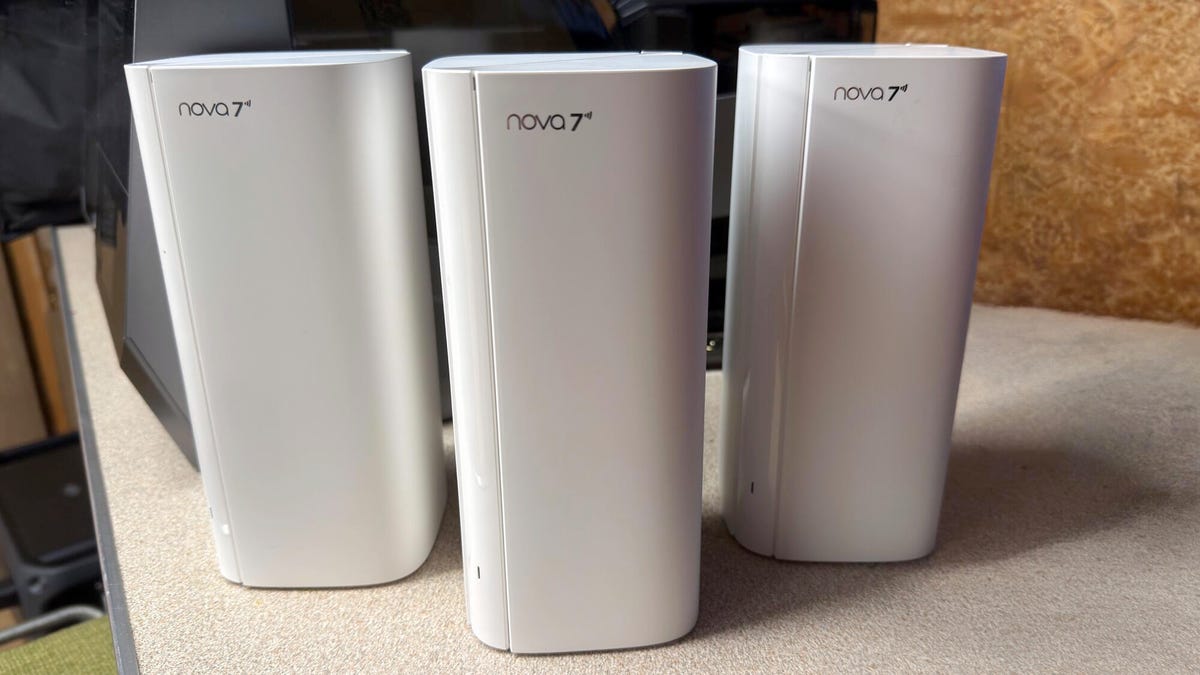
Tenda BE5100 3-Pack Mesh Wi-Fi System
pros and cons
- Makes mesh Wi-Fi easy to set up
- App offers pro-grade features, such as diagnostics
- Excellent hardware with Wi-Fi 7 support for a fraction of the price of some systems.
- Units feel a bit cheap and “plasticky.”
- Spare satellite units retail for $100 each.
Follow ZDNET: Add us as a preferred source on Google.
Anyone who’s ever held their phone high in the air like a tech-inspired yoga pose knows the frustration of a weak Wi-Fi signal. In the past, I’d try to fix this by adding a repeater or an extra router, but those fixes came with their own issues—juggling different network names and dealing with constant drop-offs in connection quality. Wi-Fi extenders weren’t much better, usually taking a decent connection and making it worse.
Also: I set up a $4 router reboot timer, and it’s made my internet reliably faster
Thankfully, those days are behind us, at least if you’re using the Tenda BE5100 3-Pack Mesh Wi-Fi System.
Best wifi range extenders deals of the week
Deals are selected by the CNET Group commerce team, and may be unrelated to this article.
The mesh advantage
Mesh Wi-Fi has evolved from the old extender days into something much smoother. Instead of separate networks and manual switching, a single system now covers your whole home. Multiple units spread across different rooms all share the same network name, and moving around is seamless—no more signal drops between floors.
Also: I’ve fully converted to adaptive chargers from fast ones and already feel safer
The only catch? A lot of mesh systems I’ve seen are pricey—some going for $500 or more. They’re solid, sure, but that price tag is tough for many households.
This is exactly where the BE5100 (also known as the ME6 Pro) steps in. You get three units, each loaded with five internal antennas and five high-power FEMs (Front-End Modules), supporting broadband speeds up to 2,000 Mbps and Wi-Fi speeds hitting 688 Mbps on 2.4 GHz or a blazing 4,323 Mbps on 5 GHz.
Plus, if you want your setup to stay relevant, it’s Wi-Fi 7 capable. Homes filled with smart devices and gadgets—welcome to the IoT age—the BE5100 runs smoothly even with 160+ connected devices.
Yes, there are Ethernet ports on the back of the satellites.
Adrian Kingsley-Hughes/ZDNET
Not a tech nerd? Even if you just stream, call, back up files, or scroll cat videos, this system is more than up to the task.
Also: The 4 streaming services I swear by – and my bill is just $40 a month
Even homes or small offices with heavy use won’t slow it down.
Blanket coverage
Three units give you up to 6,600 square feet of coverage. When I tested it in a two-story old stone house (those thick walls!), this setup left zero dead zones, while the broadband provider’s default router struggled everywhere but next to the modem.
The Tenda app offers a lot of power and control over the network you create.
Screenshot by Adrian Kingsley-Hughes/ZDNET
Many mesh Wi-Fi systems can be a headache to set up—IP addresses, manual resets—but the Tenda app (iOS/Android) makes setup painless and keeps things simple. If you do mess something up, it’s easy to start fresh.
Also: Traditional Wi-Fi router vs. mesh: How to decide between the 2 popular networking options
Once your main unit is running, adding satellites is as easy as pressing the mesh button and using the app to link everything.
Simple.
NFC and diagnostics
An unexpected bonus is the included self-adhesive NFC sticker. After setting up your network, you can write your details onto the sticker with the Tenda app so new guests can connect with one tap. I haven’t seen that on any other router before.
The writable NFC tag is a nice touch.
Adrian Kingsley-Hughes/ZDNET
One thing to keep in mind — the app does not lock the tag against rewriting (this is intentional, so you can update it later if your network setup changes), meaning someone with bad intentions could tamper with and alter the tag. In a workplace environment, I recommend using an app to set a password on the tag to keep unauthorized users from making changes.
Another aspect of the system I find particularly valuable is the app’s diagnostic tool. Whenever there’s an issue, it reliably does its job. I introduced several simulated network failures, and it caught every one and suggested solutions.
When it comes to performance, the unit performed flawlessly. My office internet is a solid 150 Mbps fiber connection, but that’s light work for a system of this caliber. So I resorted to using my Starlink dish. Once configured correctly, this dish can reach download speeds of 400 to 500 Mbps.
Also: My new favorite AirTag alternative fits perfectly in my wallet – and is seriously durable
This is still only a fraction of the 2,000 Mbps capacity the BE5100 can handle, but it’s a reasonable workload. The system managed this throughput effortlessly and distributed bandwidth well across all the connected devices.
I tested the network by streaming 4K video from both Netflix and YouTube. I managed to run a dozen streams at the same time (my MacBook Pro handled eight streams without a hitch before Chrome’s memory consumption spiked), and I believe I could have added another six or so.
I then wanted to see how the Wi-Fi handled intensive data transfer, so I moved as much data as possible across my test environment by shuttling files between two of my Ugreen DH4300 4-bay NAS units and a Ugreen DXP8800 Plus.
The DH4300 tops out at roughly 300 Mbps each over the network — negligible in this scenario — but the DXP8800 Plus is exceptionally powerful, capable of handling up to 20,000 Mbps across its two gigabit Ethernet ports. The Wi-Fi network transferred a 30GB test file in under 100 seconds without any issues. I was genuinely impressed by the results.
ZDNET’s buying advice
At its regular price of $220, the Tenda BE5100 3-Pack Mesh Wi-Fi System is competitively priced. Currently, Amazon is running a deal where you can grab the three-pack for $190. If you’re covering a smaller area, a 2-pack is available for $140, suited for spaces up to 4,600 square feet. If you don’t need three units, there’s no sense paying for extras (but if you decide you want to add one later, it’ll cost you $100, so choose wisely).
