



Picture by Creator
# Introduction
For those who’re constructing purposes with massive language fashions (LLMs), you’ve got most likely skilled this state of affairs the place you alter a immediate, run it a number of instances, and the output feels higher. However is it really higher? With out goal metrics, you’re caught in what the trade now calls “vibe testing,” which implies making choices based mostly on instinct fairly than information.
The problem comes from a elementary attribute of AI fashions: uncertainty. In contrast to conventional software program, the place the identical enter at all times produces the identical output, LLMs can generate completely different responses to comparable prompts. This makes typical unit testing ineffective and leaves builders guessing whether or not their adjustments actually improved efficiency.
Then got here Google Stax, a brand new experimental toolkit from Google DeepMind and Google Labs designed to deliver accuracy to AI analysis. On this article, we check out how Stax allows builders and information scientists to check fashions and prompts in opposition to their very own customized standards, changing subjective judgments with repeatable, data-driven choices.
# Understanding Google Stax
Stax is a developer software that simplifies the analysis of generative AI fashions and purposes. Consider it as a testing framework particularly constructed for the distinctive challenges of working with LLMs.
At its core, Stax solves a easy however crucial drawback: how have you learnt if one mannequin or immediate is best than one other on your particular use case? Somewhat than counting on common standards that won’t replicate your utility’s wants, Stax helps you to outline what “good” means on your mission and measure in opposition to these requirements.
// Exploring Key Capabilities
- It helps outline your individual success standards past generic metrics like fluency and security
- You may check completely different prompts throughout varied fashions side-by-side
- You can also make data-driven choices by visualizing gathered efficiency metrics, together with high quality, latency, and token utilization
- It could possibly run assessments at scale utilizing your individual datasets
Stax is versatile, supporting not solely Google’s Gemini fashions but additionally OpenAI’s GPT, Anthropic’s Claude, Mistral, and others by API integrations.
# Shifting Past Customary Benchmarks
Normal AI benchmarks serve an vital goal, like serving to observe mannequin progress at a excessive degree. Nevertheless, they usually fail to replicate domain-specific necessities. A mannequin that excels at open-domain reasoning would possibly carry out poorly on specialised duties like:
- Compliance-focused summarization
- Authorized doc evaluation
- Enterprise-specific Q&A
- Model-voice adherence
The hole between common benchmarks and real-world purposes is the place Stax gives worth. It lets you consider AI methods based mostly in your information and your standards, not summary international scores.
# Getting Began With Stax
// Step 1: Including An API Key
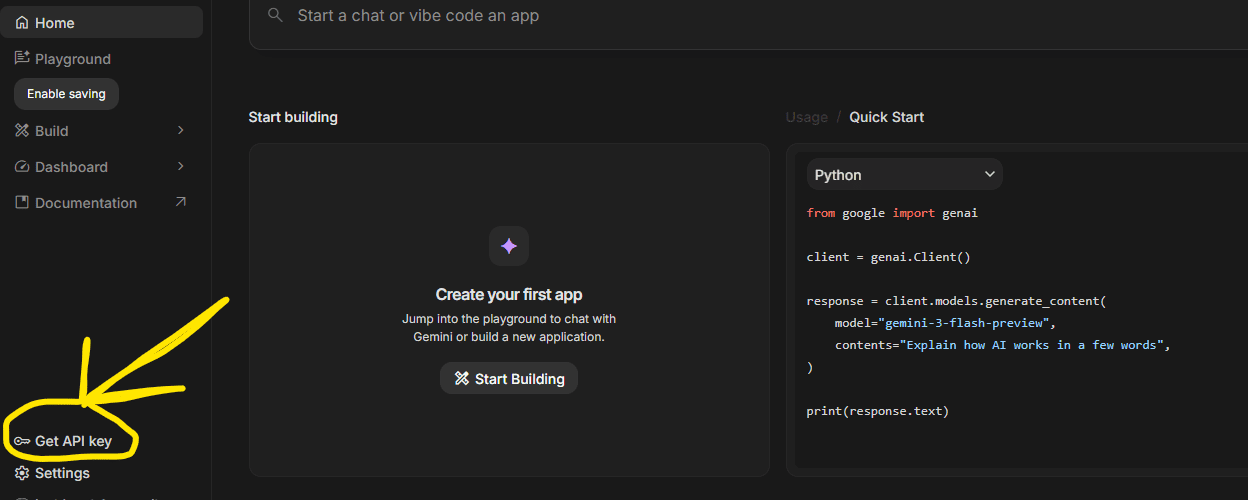
To generate mannequin outputs and run evaluations, you will want so as to add an API key. Stax recommends beginning with a Gemini API key, because the built-in evaluators use it by default, although you’ll be able to configure them to make use of different fashions. You may add your first key throughout onboarding or later in Settings.
For evaluating a number of suppliers, add keys for every mannequin you wish to check; this allows parallel comparability with out switching instruments.
Getting an API key
// Step 2: Creating An Analysis Undertaking
Initiatives are the central workspace in Stax. Every mission corresponds to a single analysis experiment, for instance, testing a brand new system immediate or evaluating two fashions.
You will select between two mission varieties:
| Undertaking Kind | Greatest For |
|---|---|
| Single Mannequin | Baselining efficiency or testing an iteration of a mannequin or system immediate |
| Aspect-by-Aspect | Instantly evaluating two completely different fashions or prompts head-to-head on the identical dataset |

Determine 1: A side-by-side comparability flowchart displaying two fashions receiving the identical enter prompts and their outputs flowing into an evaluator that produces comparability metrics
// Step 3: Constructing Your Dataset
A stable analysis begins with information that’s correct and displays your real-world use circumstances. Stax provides two main strategies to realize this:
Possibility A: Including Information Manually within the Immediate Playground
If you do not have an current dataset, construct one from scratch:
- Choose the mannequin(s) you wish to check
- Set a system immediate (optionally available) to outline the AI’s position
- Add consumer prompts that symbolize actual consumer inputs
- Present human scores (optionally available) to create baseline high quality scores
Every enter, output, and ranking robotically saves as a check case.
Possibility B: Importing an Current Dataset
For groups with manufacturing information, add CSV information immediately. In case your dataset does not embody mannequin outputs, click on “Generate Outputs” and choose a mannequin to generate them.
Greatest apply: Embrace the sting circumstances and conflicting examples in your dataset to make sure complete testing.
# Evaluating AI Outputs
// Conducting Guide Analysis
You may present human scores on particular person outputs immediately within the playground or on the mission benchmark. Whereas human analysis is taken into account the “gold standard,” it is sluggish, costly, and tough to scale.
// Performing Automated Analysis With Autoraters
To attain many outputs without delay, Stax makes use of LLM-as-judge analysis, the place a robust AI mannequin assesses one other mannequin’s outputs based mostly in your standards.
Stax contains preloaded evaluators for widespread metrics:
- Fluency
- Factual consistency
- Security
- Instruction following
- Conciseness

The Stax analysis interface displaying a column of mannequin outputs with adjoining rating columns from varied evaluators, plus a “Run Evaluation” button
// Leveraging Customized Evaluators
Whereas preloaded evaluators present a wonderful place to begin, constructing customized evaluators is one of the best ways to measure what issues on your particular use case.
Customized evaluators allow you to outline particular standards like:
- “Is the response helpful but not overly familiar?”
- “Does the output contain any personally identifiable information (PII)?”
- “Does the generated code follow our internal style guide?”
- “Is the brand voice consistent with our guidelines?”
To construct a customized evaluator: Outline your clear standards, write a immediate for the choose mannequin that features a scoring guidelines, and check it in opposition to a small pattern of manually rated outputs to make sure alignment.
# Exploring Sensible Use Circumstances
// Reviewing Use Case 1: Buyer Assist Chatbot
Think about that you’re constructing a buyer assist chatbot. Your necessities would possibly embody the next:
- Skilled tone
- Correct solutions based mostly in your data base
- No hallucinations
- Decision of widespread points inside three exchanges
With Stax, you’d:
- Add a dataset of actual buyer queries
- Generate responses from completely different fashions (or completely different immediate variations)
- Create a customized evaluator that scores for professionalism and accuracy
- Examine outcomes side-by-side to pick the very best performer
// Reviewing Use Case 2: Content material Summarization Instrument
For a information summarization utility, you care about:
- Conciseness (summaries underneath 100 phrases)
- Factual consistency with the unique article
- Preservation of key info
Utilizing Stax’s pre-built Summarization High quality evaluator provides you quick metrics, whereas customized evaluators can implement particular size constraints or model voice necessities.
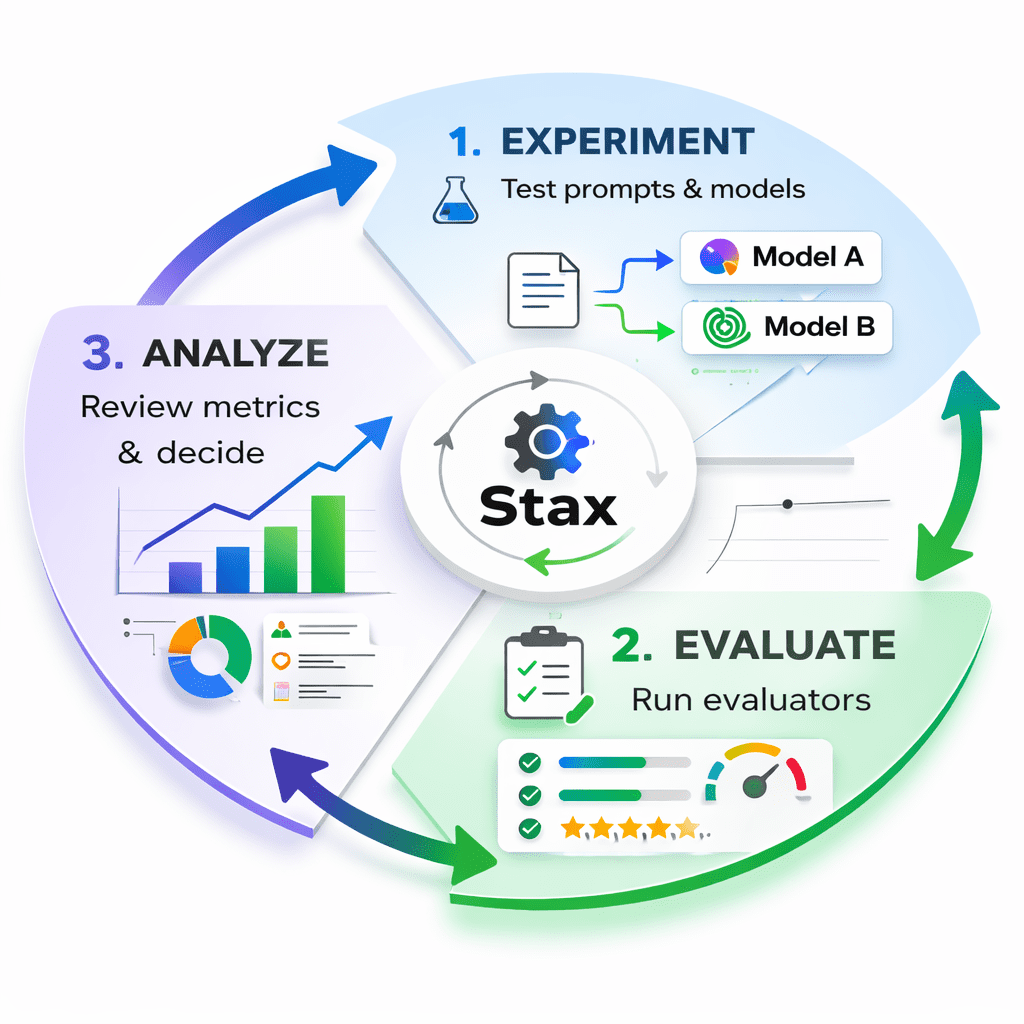
Determine 2: A visible of the Stax Flywheel displaying three levels: Experiment (check prompts/fashions), Consider (run evaluators), and Analyze (overview metrics and resolve)
# Deciphering Outcomes
As soon as evaluations are full, Stax provides new columns to your dataset displaying scores and rationales for each output. The Undertaking Metrics part gives an aggregated view of:
- Human scores
- Common evaluator scores
- Inference latency
- Token counts
Use this quantitative information to:
- Examine iterations: Does Immediate A constantly outperform Immediate B?
- Select between fashions: Is the sooner mannequin well worth the slight drop in high quality?
- Monitor progress: Are your optimizations really enhancing efficiency?
- Establish failures: Which inputs constantly produce poor outputs?

Determine 3: A dashboard view displaying bar charts evaluating two fashions throughout a number of metrics (high quality rating, latency, price)
# Implementing Greatest Practices For Efficient Evaluations
- Begin Small, Then Scale: You do not want tons of of check circumstances to get worth. An analysis set with simply ten high-quality prompts is endlessly extra beneficial than counting on vibe testing alone. Begin with a targeted set and broaden as you be taught.
- Create Regression Assessments: Your evaluations ought to embody checks that defend current high quality. For instance, “always output valid JSON” or “never include competitor names.” These stop new adjustments from breaking what already works.
- Construct Problem Units: Create datasets concentrating on areas the place you need your AI to enhance. In case your mannequin struggles with complicated reasoning, construct a problem set particularly for that functionality.
- Do not Abandon Human Evaluation: Whereas automated analysis scales nicely, having your workforce use your AI product stays essential for constructing instinct. Use Stax to seize compelling examples from human testing and incorporate them into your formal analysis datasets.
# Answering Incessantly Requested Questions
- What’s Google STAX? Stax is a developer software from Google for evaluating LLM-powered purposes. It helps you check fashions and prompts in opposition to your individual standards fairly than counting on common benchmarks.
- How does Stax AI work? Stax makes use of an “LLM-as-judge” strategy the place you outline analysis standards, and an AI mannequin scores outputs based mostly on these standards. You should use pre-built evaluators or create customized ones.
- Which software from Google permits people to make their machine studying fashions? Whereas Stax focuses on analysis fairly than mannequin creation, it really works alongside different Google AI instruments. For constructing and coaching fashions, you’d sometimes use TensorFlow or Vertex AI. Stax then helps you consider these fashions’ efficiency.
- What’s Google’s equal of ChatGPT? Google’s main conversational AI is Gemini (previously Bard). Stax can assist you check and optimize prompts for Gemini and examine its efficiency in opposition to different fashions.
- Can I prepare AI alone information? Stax does not prepare fashions; it evaluates them. Nevertheless, you need to use your individual information as check circumstances to judge pre-trained fashions. For coaching customized fashions in your information, you’d use instruments like Vertex AI.
# Conclusion
The period of vibe testing is ending. As AI strikes from experimental demos to manufacturing methods, detailed analysis turns into vital. Google Stax gives the framework to outline what “good” means on your distinctive use case and the instruments to measure it systematically.
By changing subjective judgments with repeatable, data-driven evaluations, Stax helps you:
- Ship AI options with confidence
- Make knowledgeable choices about mannequin choice
- Iterate sooner on prompts and system directions
- Construct AI merchandise that reliably meet consumer wants
Whether or not you are a newbie information scientist or an skilled ML engineer, adopting structured analysis practices will rework the way you construct with AI. Begin small, outline what issues on your utility, and let information information your choices.
Prepared to maneuver past vibe testing? Go to stax.withgoogle.com to discover the software and be a part of the group of builders constructing higher AI purposes.
// References
Shittu Olumide is a software program engineer and technical author keen about leveraging cutting-edge applied sciences to craft compelling narratives, with a eager eye for element and a knack for simplifying complicated ideas. You can even discover Shittu on Twitter.
