



# TimesFM-3: Google’s Multivariate Time Series Foundation Model Sets New Benchmark Standards
## A New Era in Forecasting
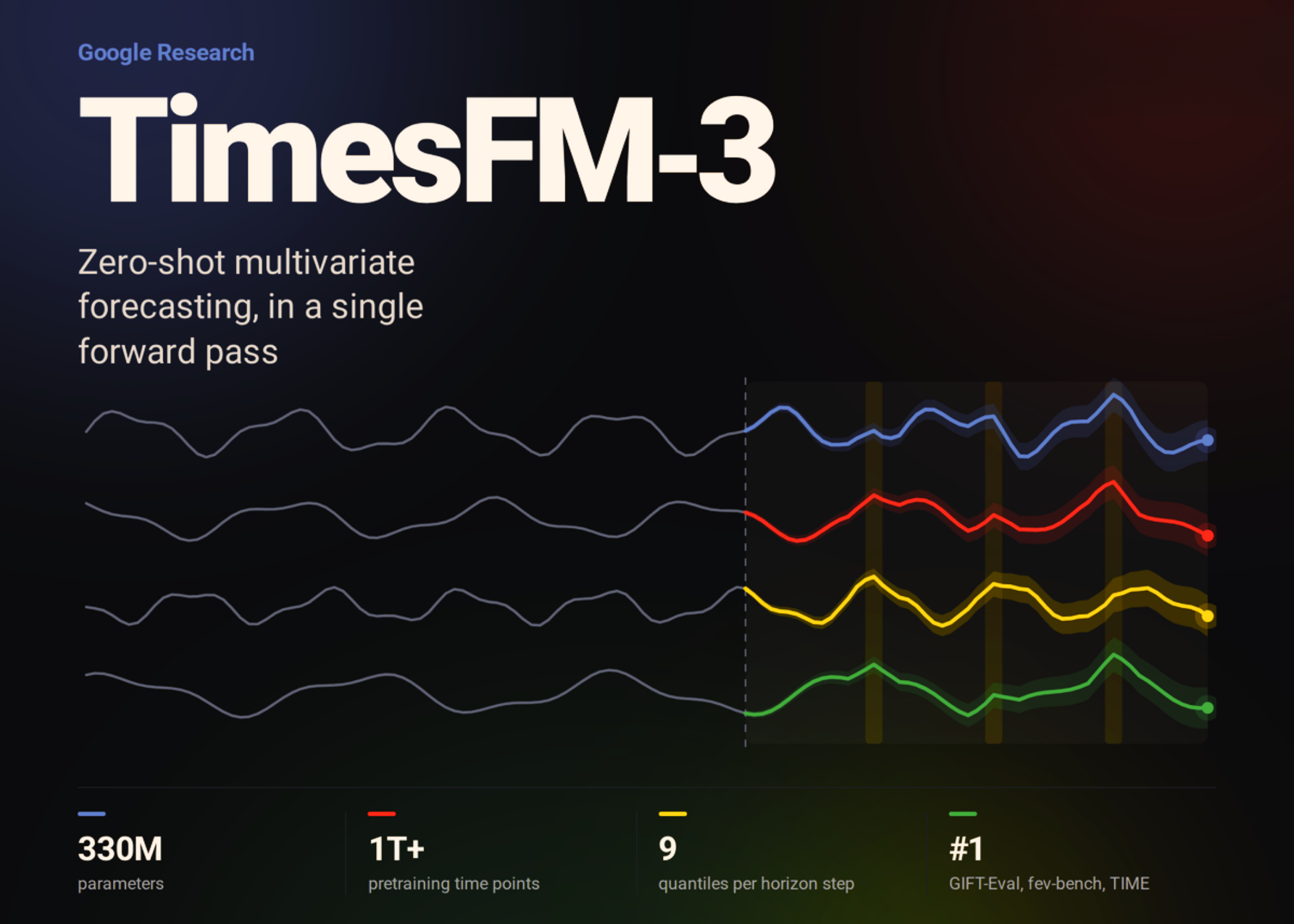
The landscape of time series forecasting has reached a significant milestone with the introduction of TimesFM-3 from Google Research. This 330 million parameter foundation model is purpose-built for multivariate forecasting — a capability that previous generations of the TimesFM family lacked entirely. By processing multiple related time series simultaneously in a single forward pass, TimesFM-3 dramatically reduces both computational cost and latency compared to traditional approaches that require serial processing of each series.
The model has been pretrained on an enormous corpus of over one trillion time points drawn from both real-world datasets and synthetic generators. This massive training foundation enables TimesFM-3 to generalize across diverse domains without requiring task-specific fine-tuning, making it remarkably versatile for practitioners facing a wide range of forecasting challenges.
## Why Multivariate Forecasting Matters
Every prior checkpoint in the TimesFM lineage, spanning versions 1.0 through 2.5, operated strictly in a univariate mode. Each model could forecast a single series using only the historical values of that same series. While this works for simple scenarios, it falls short when real-world dynamics come into play.
Consider a retailer trying to predict ice cream sales. The outcome is shaped by a web of interconnected signals: promotions running on specific days, shifts in foot traffic patterns, fluctuating weather conditions, and the proximity of holidays. None of these factors exist in isolation, and ignoring their influence leads to forecasts that miss critical drivers of demand.
TimesFM-3 was designed to handle exactly this kind of complexity. It natively supports three distinct types of input signals, all operating in a zero-shot fashion:
– **Multiple target series** are forecast jointly, with both point estimates and probabilistic quantile outputs generated for each series simultaneously.
– **Past covariates** capture information that is only available historically, such as observed foot traffic counts or temperature readings leading up to the forecast window.
– **Past-future covariates** include signals whose values are known in advance, such as a published marketing calendar or scheduled promotional events extending into the forecast horizon.
This three-pronged input design means the model can ingest cross-series dependencies, known future events, and historical context all at once — without any additional training or architectural modifications.
## Architectural Innovation
Under the hood, TimesFM-3 retains the decoder-only transformer architecture that has proven effective throughout the TimesFM family. However, several key design decisions set it apart.
### Patching Strategy
Raw time series data is first segmented into contiguous patches of 32 time steps. Each series is independently normalized before patching, ensuring that wildly different scales — say, daily revenue in thousands versus foot traffic in hundreds — do not dominate the learning process. Target tokens and past-covariate tokens each originate from a single patch, maintaining clean separation between signal types.
For past-future covariates, a novel lookahead mechanism is employed. The current patch is concatenated with subsequent patches representing the forecast horizon, allowing the model to “see” upcoming scheduled events before they unfold. This trick is especially powerful for covariates like promotional schedules, holiday calendars, and weather forecasts that are determined in advance.
### Dual Attention Mechanism
After patching, tokens are arranged into a two-dimensional grid and processed through two alternating attention mechanisms stacked across the transformer layers.
The first mechanism is **causal temporal attention**, which operates horizontally along the time axis within each individual series. It is strictly causal, meaning it only attends to earlier tokens in the same series, preventing any form of data leakage from future observations into the past.
The second mechanism is **full variate attention**, which operates vertically at each time step across all series in the batch. This allows the model to learn rich cross-correlations between series — for instance, recognizing that a spike in foot traffic at one store tends to coincide with increased sales at another nearby location.
These two attention modes alternate throughout the network, combining local temporal coherence with global cross-series awareness at every layer.
## From Autoregressive to Parallel Decoding
One of the most impactful changes in TimesFM-3 concerns how forecasts are generated. Earlier versions of TimesFM decoded one patch at a time in an autoregressive loop. Each completed patch was fed back into the model to condition the next, introducing cumulative latency and compounding prediction errors at each step.
TimesFM-3 replaces this sequential approach with **Contiguous Patch Masking**, a training strategy originally introduced with the TiRex model. During inference, masked placeholder tokens are appended for the entire forecast horizon. Target patches and past covariate patches within the horizon are masked, while past-future covariate patches remain fully visible. The alternating attention layers then fill all masked horizon patches simultaneously in a single forward pass.
The result is a dramatic speedup: instead of requiring N sequential passes for an N-patch horizon, the model needs exactly one. Each target series receives nine quantile outputs at every horizon step — specifically the 10th through 90th percentiles — providing rich probabilistic forecasts alongside point estimates.
## Benchmark Performance
Google evaluated TimesFM-3 against several strong baselines, including Chronos-2, the Toto 2.0 family, and TimesFM-2.5, across three well-regarded forecasting benchmarks: GIFT-Eval, fev-bench, and the TIME leaderboard.
The results are striking. Among all pretrained foundation models evaluated, TimesFM-3 claimed the top average rank across all three benchmarks for both point forecast accuracy and probabilistic forecast quality. Specific achievements include:
– **Rank #1 overall on fev-bench** across 100 real-world forecasting tasks.
– **Rank #1 overall on the TIME leaderboard** spanning 50 domain datasets and 98 evaluation tasks.
– **Rank #1 among foundation models on GIFT-Eval**.
These results confirm that native multivariate pretraining, combined with the parallel decoding strategy, yields measurable improvements over both univariate predecessors and competing multivariate models.
## Deployment Considerations
The source code for TimesFM is released under the permissive Apache 2.0 license, which means researchers and developers can freely inspect, modify, and experiment with the implementation. The code is publicly available and open for community contributions.
However, there is an important caveat regarding the model weights. The TimesFM-3.0 checkpoint ships under a custom license called `timesfm-non-commercial-license-v1.0`, which explicitly restricts usage to non-commercial and non-production scenarios. This means that while the model is fully suitable for benchmarking, academic research, and exploratory analysis, it cannot be deployed behind a production forecast API or integrated into a commercial product without obtaining separate permissions from Google Research.
For teams that need a production-ready multivariate forecasting foundation model, this licensing gap is a significant consideration and may motivate the search for alternative models or direct engagement with the rights holders.
## Frequently Asked Questions
**Q: What does “multivariate forecasting” mean in the context of TimesFM-3?**
A: Multivariate forecasting means the model can predict multiple related time series simultaneously, using information from all of those series as inputs. For example, it can forecast sales across multiple product categories at once, leveraging the dependencies between them — something a univariate model would need to do one series at a time.
**Q: How is TimesFM-3 different from TimesFM-2.5?**
A: TimesFM-2.5 was strictly univariate, forecasting one series from its own history. TimesFM-3 adds native support for multiple target series, past covariates, and past-future covariates, all processed in a single forward pass rather than autoregressively patch by patch.
**Q: Can I use TimesFM-3 in a commercial product?**
A: The source code is Apache-2.0 licensed and can be used freely. However, the pretrained model weights are distributed under a non-commercial license and cannot be used in production or commercial deployments without additional authorization from Google Research.
**Q: What kinds of covariates does TimesFM-3 support?**
A: It supports two types: past covariates, which contain information known only up to the current time (like historical weather or traffic), and past-future covariates, whose future values are already known (like scheduled holidays or planned marketing campaigns). Both types work without any fine-tuning.
**Q: How many quantiles does the model output?**
A: Each target series receives nine quantile outputs at every forecast horizon step — specifically from the 10th to the 90th percentile. This provides a probabilistic forecast that captures uncertainty alongside the central estimate.
**Q: Does TimesFM-3 require fine-tuning for new datasets?**
A: No. It operates in a zero-shot fashion for all three input types (multiple targets, past covariates, and past-future covariates), meaning it can generate forecasts on new data without any task-specific retraining.
**Q: What is Contiguous Patch Masking and why does it matter?**
A: Contiguous Patch Masking is a training technique where the model learns to predict all patches in a forecast horizon simultaneously, rather than one at a time. At inference time, this translates to a single forward pass covering the entire horizon, eliminating the latency and error accumulation of autoregressive decoding.
**Q: What benchmarks did TimesFM-3 top?**
A: It achieved the highest average rank among pretrained foundation models on GIFT-Eval, fev-bench, and the TIME leaderboard, across both point forecast accuracy and probabilistic forecast quality metrics.
## Conclusion
TimesFM-3 represents a meaningful evolution in time series foundation models. By moving from univariate to multivariate pretraining natively, and by replacing autoregressive decoding with parallel patch prediction, Google Research has delivered a model that is both more expressive and more efficient than its predecessors. The ability to ingest multiple targets alongside historical and future covariates in a single forward pass opens the door to forecasting workflows that more accurately reflect the interconnected nature of real-world data.
The strong benchmark performance across GIFT-Eval, fev-bench, and the TIME leaderboard validates the architectural choices, and the open-source codebase ensures that the research community can build upon and extend this work. The non-commercial license on the weights is a notable limitation for production use cases, but it does not diminish the model’s value as a research tool and benchmarking platform.
As the field of time series forecasting continues to mature, models like TimesFM-3 demonstrate that foundation models — pretrained at scale on diverse temporal data — are becoming indispensable tools for anyone working with sequential data across domains.
Thank you for reading
