




You’ve likely encountered this frustrating situation: a website refuses to load, a login page stalls, or an online service becomes completely inaccessible at the worst possible time. Often, the culprit isn’t an internal failure but a Distributed Denial-of-Service (DDoS) attack, an external assault designed to overwhelm the target.
DDoS attacks have remained one of the most straightforward methods to cripple an online service. By flooding a target with massive amounts of traffic, attackers exhaust its resources and render it unusable, all without needing to break into the system itself. Today, these attacks are increasingly packaged and marketed like any legitimate online product, with real-world consequences that are well-documented.
Cloudflare reported blocking a 7.3 Tbps attack in 2025 and later disclosed it had neutralized a staggering 31.4 Tbps attack in its Q4 2025 DDoS report. Microsoft also revealed that Azure had mitigated a 15.72 Tbps attack in October 2025, linking the activity to the Aisuru botnet.
Beneath these headline-grabbing incidents, underground vendors are locked in fierce competition, each trying to outdo the other with slick marketing. Recent activity analyzed by Flare researchers reveals a landscape featuring attack control panels, API access, subscription plans, reseller programs, customer support, botnet-driven power, techniques for targeting gaming servers, and claims of bypassing Cloudflare protection.
A comparison between two sets of DDoS-related underground data — one from early 2023 and another from early 2026 — illustrates just how rapidly the threat has evolved. What was once a fragmented world of scripts, tutorials, and scattered forum posts has transformed into a streamlined, easily purchasable product.
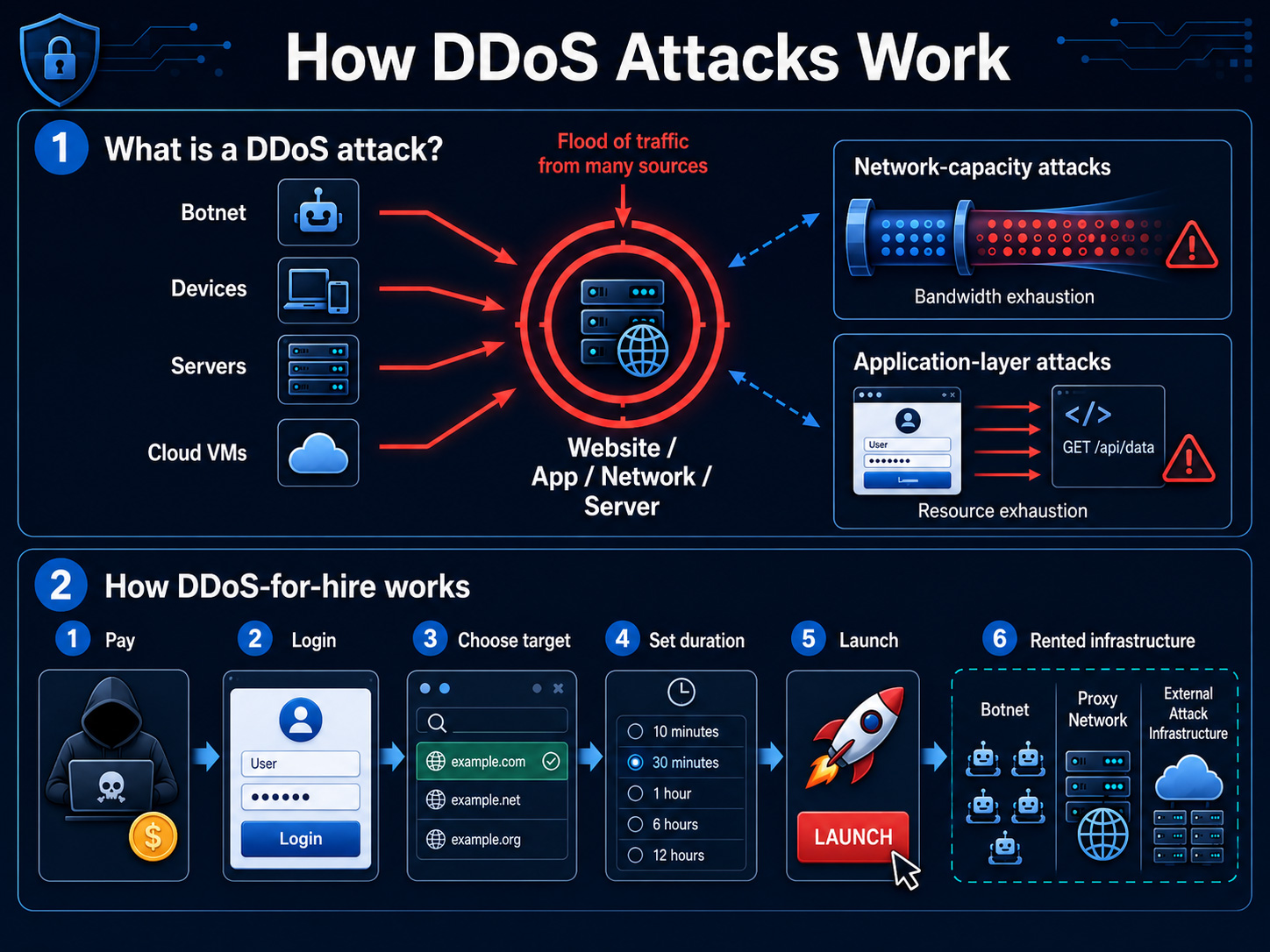
A DDoS attack aims to overwhelm a website, service, or server with traffic from countless sources. Some attacks target network bandwidth while others focus on application-level functions like login pages or APIs. The goal is consistent: to make the service unavailable, unstable, or too costly to maintain.
The rise of DDoS-as-a-service has further lowered the barrier to entry. Now, instead of building their own infrastructure, attackers can simply purchase access to a web panel, pick a target, set a duration, and leverage someone else’s botnet, proxy network, or attack infrastructure.
Flare Researchers’ Analysis
Flare researchers examined underground DDoS activity from two separate periods: the first five months of 2023 and the first five months of 2026. After cleaning and organizing the data, they identified several key trends.
| Topic | 2023 | 2026 | Change |
|---|---|---|---|
| Volume of records | 4,403 | 4,964 | Slight increase |
| High-signal DDoS service ads | 38 | 364 | ~10x increase |
| Unique ad clusters | 31 | 123 | ~4x increase |
| Unique actors | 15 | 41 | ~3x increase |
| Sources observed | 22 | 43 | ~2x increase |
An important note: This research focused exclusively on distributed denial-of-service (DDoS) attacks. A separate category, Denial of Service (DoS), exists, which targets servers differently but shares the same objective. For this study, only direct DDoS offerings were included, with careful efforts made to exclude standard DoS products.
These DDoS-as-a-service platforms are openly promoted across dark web forums and cybercriminals communities, precisely the channels that Flare continuously monitors.
Flare keeps watch over underground marketplaces, botnet network chatter, and threat actor activity across thousands of dark web sources, giving your security team early warning before emerging threats can disrupt your operations.
Detect your exposure for free
From Scattered Tools to Packaged Services
Posts from 2023 covered a broader range of topics. Promotions often centered on scripts, leaked tools, tutorials, or general “botnet service” listings.
A common 2023 listing (as shown in the image below) advertised a “Botnet Service L7 – L4” boasting Layer 3, Layer 4, and Layer 7 capabilities, optional API access, automated payments, high availability for attack slots, game server targeting, and Cloudflare bypass features. The same promotional text appeared across multiple platforms and sellers, suggesting widespread copying or reselling.
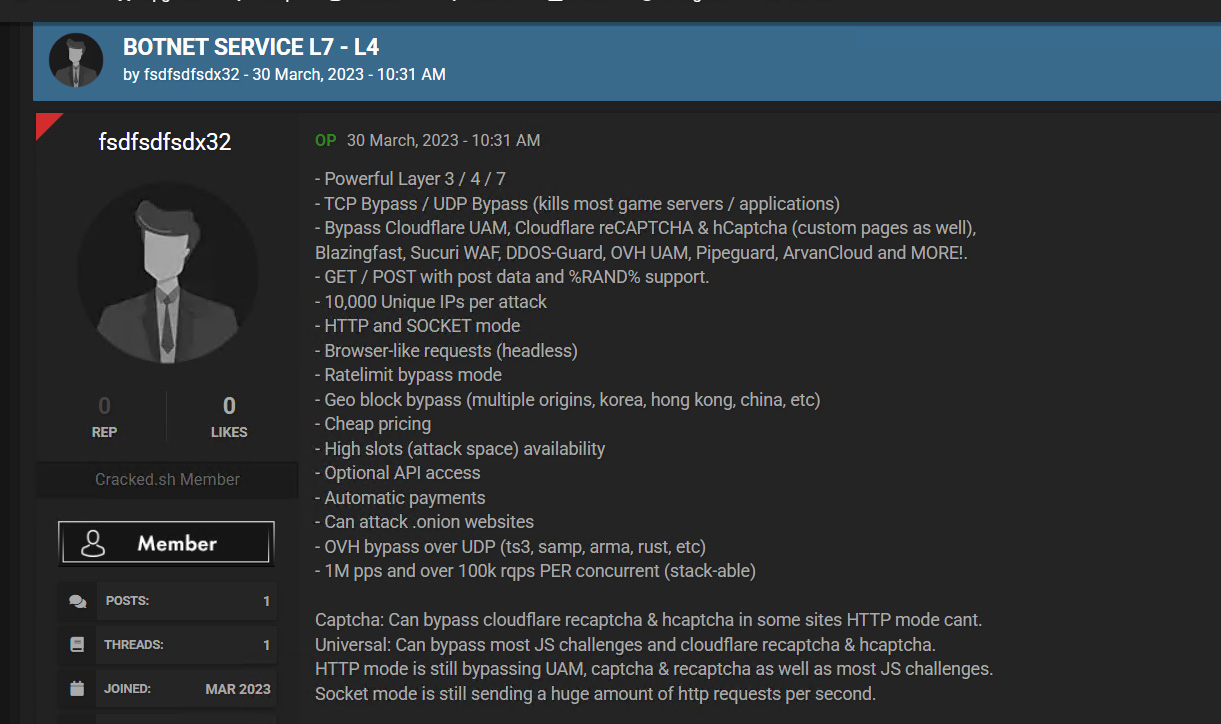
While the 2023 listings emphasized the technical offerings, more recent 2026 posts zero in on pricing and specific service details.
One promotion for “SatelliteStress” described the service as an IP stresser with an intuitive dashboard, API access, game server support, and plans starting at €20 a month. It emphasized that the service was “100% botnet-powered” and didn’t depend on third-party APIs, a clear effort to differentiate itself from middlemen who simply resell access to another provider’s infrastructure.
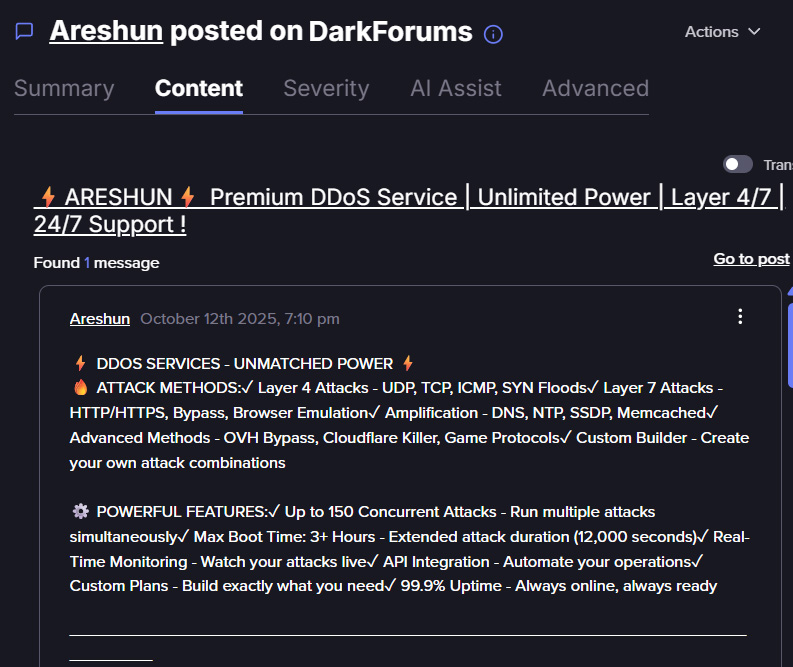
As another example, “Areshun” positions its “Premium DDoS Service” for both Layer 4 and Layer 7 attacks, including monitoring, API integration, custom plans, round-the-clock support, and discount codes. Like many others, it highlights specific services and their associated costs.
Sign up for the free trial to access if you aren’t already a customer.
“RebirthStress” follows a similar pattern, pitched as a botnet-driven stress testing tool for both IP and web targets. It boasts a free Layer 7 hub, over 400 attack slots, reseller-friendly features, and subscriptions starting at just $15 a month.
Reviewing these promotional posts side by side reveals a clear evolution. The 2026 listings are much more product-focused. Sellers are actively competing for customers, packaging their offerings with appealing features: effortless usability, full automation, comprehensive support, guaranteed privacy, reselling opportunities, and unwavering reliability.
Technical specifics haven’t vanished—they’ve simply become part of the sales pitch. Modern ads increasingly bundle Layer 4 and Layer 7 attack claims (meaning both network-level and application-layer attacks are supported), along with buzzwords like “panel,” “API,” “slots,” “bypass,” “monitoring,” “uptime,” and “support.”
One advertisement linked to THORCC promoted its network of more than 7,000 active Layer 4 bots.
Sellers are also highlighting analytics on bandwidth usage and attack statistics. Posts in both Russian and Danish advertise “professional stress testing,” touting their ability to bypass protections from Cloudflare and DDoS-Guard while handling high levels of attack frequency and long-lasting assaults.
It’s possible that these attackers are inflating their actual capabilities. However, the recurring themes in their marketing efforts are nevertheless valuable data points.
They indicate what buyers are being advised to prioritize beyond just raw traffic volume. This includes dedicated dashboards, automated features, claims of bypassing security, and the opportunity to easily initiate or resell attacks.
In 2026, hiring a DDoS assault is surprisingly affordable. The following price lists are currently being observed:
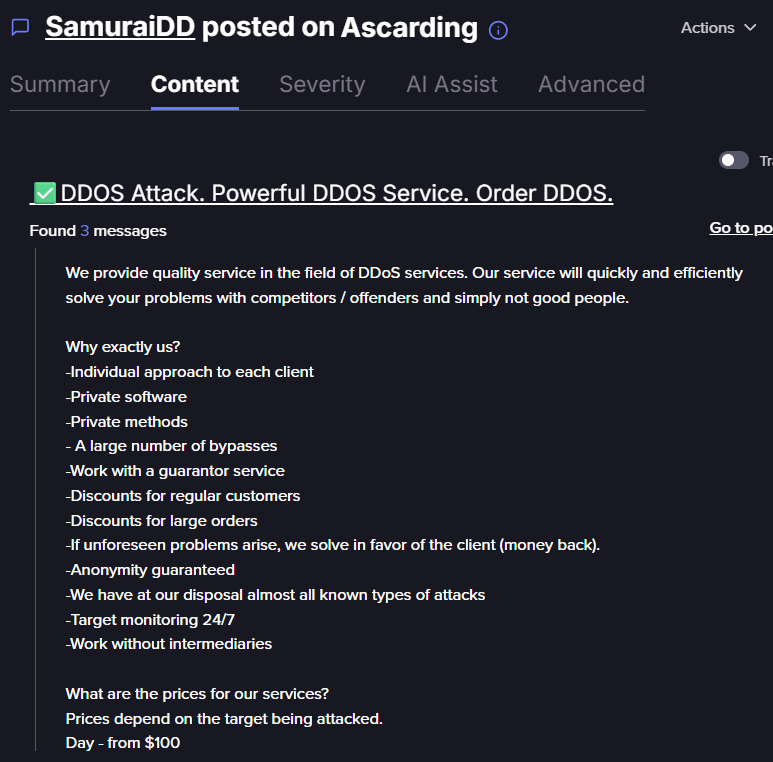
Some options carry a higher price tag. An attacker known as “SamuraiDD” promoted attacks beginning at $100 per day (refer to the image below).
Sign up for the free trial to access if you aren’t already a customer.
A different threat actor, “POWERDDOS,” utilizes a tiered pricing structure: $5 for testing, $100 daily for “weak” targets, $200 daily for “moderate” targets, and $500 daily for “strong” or protected targets.
Finally, there are “premium” options available, featuring infrastructure-level targeting. This includes a botnet-based DDoS network offered for a flat rate of $2,000.
The pricing structure suggests a market divided by customer demographic. Affordable tests and short-term attacks appeal to individuals with lower skill levels, while daily rates cater to those seeking one-on-one disruption. Longer-term operations are discussed privately, and more expensive infrastructure or reseller options are aimed at professional or enterprise customers.
Past studies on the booter economy (paid-for DDoS services allowing users to offload attacks using others’ resources) also reflect this cheap-access dynamic. For example, Akamai has reported that some booter services can be purchased for under $25 a month, often providing a period of free trial use.
Conclusions
DDoS-as-a-Service is no longer solely concentrated on traffic volume. The market is becoming more accessible, bringing costs down to purchase, operate, and resell. Today, it isn’t just about attack scale; it is about how easy it is to launch an attack through a user-friendly interface, various subscription packages, support teams, API integrations, and pre-made infrastructure.
This simplicity of access benefits a variety of malicious actors. Low-skilled hackers can pay for cheap, brief attacks, while more advanced adversaries are prepared to pay for extended or powerful campaigns. Additionally, affiliate salesmen can extend the attacker’s network. Consequently, network administrators should no longer assume that disruptive DDoS activity requires highly skilled operators.
Moving forward, the industry will likely shift toward more sophisticated business models. Expect to find clearer pricing, enhanced automation, well-structured affiliate partnerships, and aggressive marketing emphasizing their ability to bypass defenses and guarantee attack success.
Learn more by signing up for our free trial.
Sponsored and written by Flare.
