



# Jev by TypeSafe AI: A New Class of Model Built for Structured Decision-Making
## Introduction
The landscape of artificial intelligence has long been dominated by generative models capable of freeform conversation, creative writing, and code generation. A new entrant is challenging that paradigm by focusing on something far more specific: replacing the fuzzy, open-ended outputs of large language models with precise, typed, and probabilistically calibrated decisions. TypeSafe AI, founded by Diogo Almeida — a researcher who previously contributed to instruction-following studies at OpenAI — has introduced its flagship modeling effort under the name Jev, which it categorizes as a “System One” model.
Rather than acting as a chatbot or a text-generating assistant, Jev is engineered to sit inside decision pipelines, particularly those involving autonomous agents. It consumes a block of unstructured input (text or JSON) alongside a set of explicitly defined, typed questions, and returns answers that come with both a selected outcome and a confidence score. This design philosophy shifts the burden of interpretation away from downstream logic and toward the model itself, promising more predictable and auditable behavior in automated systems.
—
## How Jev Is Architected
### Three Fundamental Operations
Jev’s functionality revolves around three core primitives, each serving a distinct role in the decision process:
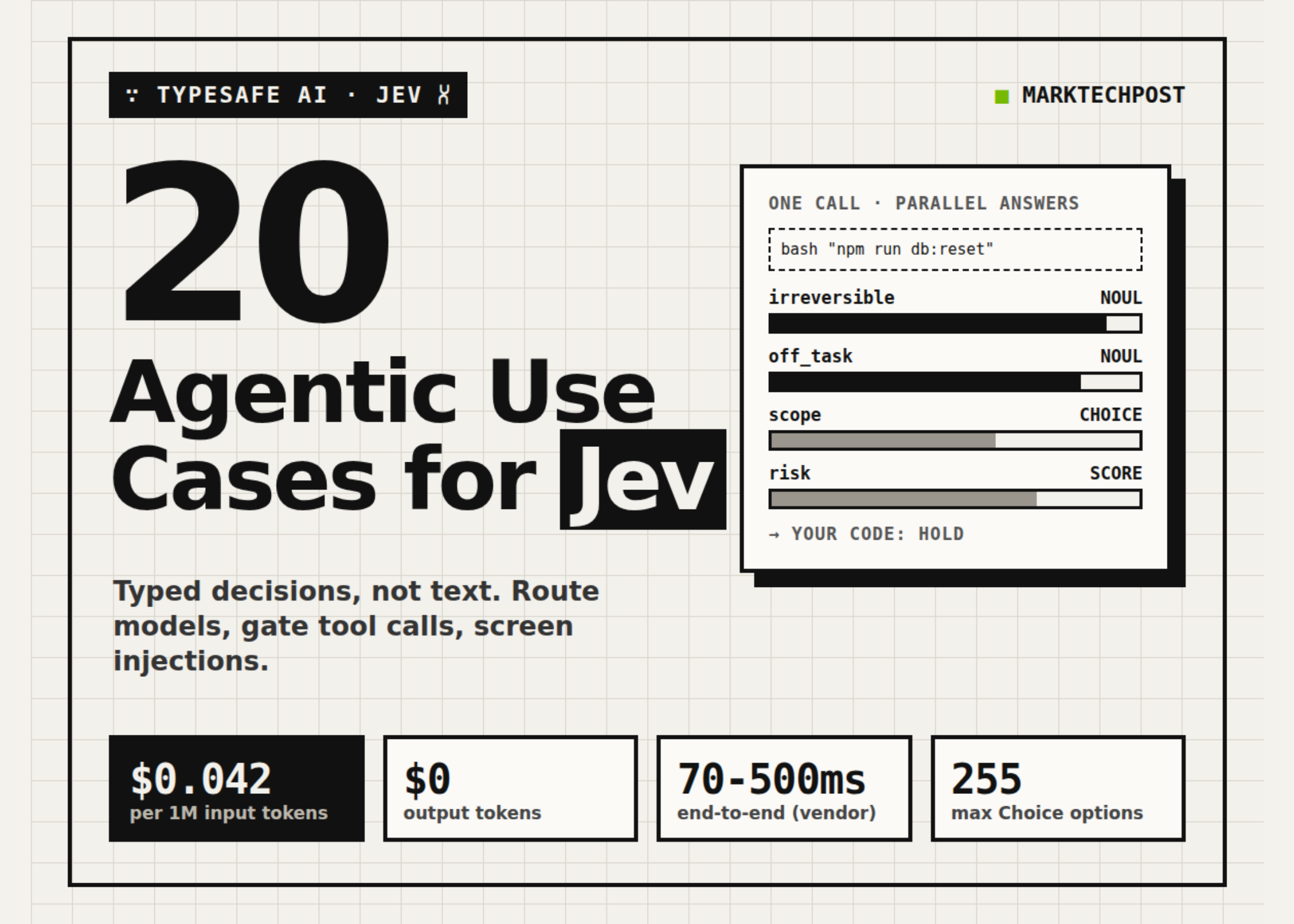
**Choice** is designed for scenarios where the system must select a single option from a predefined list. It assigns a probability to each available option and pairs that distribution with a confidence metric. The operation supports up to 255 possible options, making it suitable for anything from routing support tickets to selecting among hundreds of function signatures.
**Score** is used when decisions are ordered along a rubric or scale. Instead of picking a winner from a list, Jev evaluates the input against a hierarchy of levels and produces a probability distribution across those levels, again accompanied by a confidence value. This is useful for judging complexity, risk, or priority on a graduated scale.
**Noul** addresses true-false style questions. Given a statement, it returns a single probability between 0 and 1 indicating how likely that statement is to be true. This primitive is particularly valuable for safety gating — asking Jev whether a particular input is malicious, whether a command is destructive, or whether a piece of content is relevant.
### Parallel Evaluation
One of the architectural highlights of Jev is that all questions within a single call are evaluated against the same input state simultaneously. There is no sequential token generation followed by parsing; instead, the model produces all requested answers in one pass. This eliminates the overhead typically associated with multi-step prompting and validation loops, and it means that type safety is built into the response format from the start.
—
## Training Methodology: Calibrated Decisions Through Reinforcement Learning
TypeSafe has trained Jev using a proprietary technique called Reinforcement Learning for Calibrated Decisions (RLCD). The central goal of this approach is to create a model where a reported confidence value actually reflects real-world accuracy. In other words, when Jev says it is 90% confident about an answer, that answer should be correct approximately 90% of the time.
This calibration is a critical differentiator. Many language models produce overconfident or underconfident outputs, making it difficult for downstream code to know when to trust a result and when to escalate to human review. By explicitly optimizing for the alignment between confidence and accuracy, Jev aims to give developers a reliable signal for automating branching logic in agent systems.
—
## Performance and Efficiency Claims
TypeSafe’s internal benchmarks suggest that Jev operates dramatically faster and at a fraction of the cost compared to conventional large language models used for comparable decision tasks. The company reports a **193.6× speed improvement** and a **444.6× cost reduction** relative to baseline models evaluated in their workflow experiments.
However, these figures are contextualized carefully. The benchmarks utilize specific frontier models (referred to in the post as GPT-6 Astra and Fable 5.1) as reference answer generators, and TypeSafe acknowledges that the reported gains sit at the higher end of what one can expect under real-world deployment conditions. The comparison structure is important: Jev replaces the combination of a generative model outputting free-text answers plus a separate parsing and validation layer with a single, structured call that outputs typed results directly. The efficiency gains stem from eliminating both the token-generation overhead and the post-hoc parsing complexity.
—
## Where Jev Fits in the Agent Ecosystem
The most natural home for Jev is within agent loops — the repeated cycles of perception, reasoning, and action that characterize autonomous AI systems. Small but frequent judgments arise constantly inside such loops: Is this command safe to execute? Is this retrieved passage relevant to the current query? Which model should handle this particular task? Is the agent actually finished, or does it need another iteration?
Jev is built to answer these kinds of closed-domain, high-frequency questions with speed and consistency. By offloading these micro-decisions to a specialized model, the broader agent system can reduce reliance on expensive generative models for tasks that do not require creativity or open-ended reasoning. This creates a clear division of labor: Jev handles the gating, routing, and classification decisions, while larger generative models focus on the tasks that genuinely benefit from their expansive knowledge and fluency.
—
## Real-World Applications
The versatility of Jev’s three primitives opens the door to a wide range of practical use cases across different domains of agent operation:
– **Model routing**: Deciding which model tier (fast, standard, or premium) should handle a given user request based on complexity scores.
– **Tool-call safety gating**: Evaluating whether a proposed bash command or database operation is safe before execution, using Noul to assess irreversibility and scope alignment.
– **Ticket triage**: Classifying incoming support requests by department and urgency level in a single parallel call.
– **RAG injection screening**: Scanning retrieved documents for jailbreak attempts or misleading instructions before they enter the context window of a generative model.
– **Reranking and citation checking**: Using Noul and Choice to re-sort search results and verify whether cited evidence actually supports a claim.
– **Loop health monitoring**: Scoring agent trajectories to detect stagnation, then triggering replanning or halting execution as needed.
– **Context compaction**: Scoring historical tool calls to decide which ones to retain and which to discard without summarization.
– **Real-time control**: Classifying UI elements or game states for browser, desktop, and mobile agents at high frequency.
—
## Frequently Asked Questions
**Q1: What exactly is a “System One” model?**
A “System One” model refers to a specialized inference engine built not for open-ended generation but for structured, typed decision-making. It is optimized to take a defined state and set of questions and return outcomes with calibrated probabilities, rather than producing freeform text.
**Q2: How is Jev different from a regular large language model?**
A typical large language model generates free-form text token by token, which then must be parsed, validated, and converted into structured data by downstream code. Jev bypasses that pipeline entirely by outputting typed answers — probabilities, selections, and scores — directly in a machine-readable format.
**Q3: What is Reinforcement Learning for Calibrated Decisions (RLCD)?**
RLCD is a training methodology designed to align a model’s confidence scores with its actual accuracy. The goal is to ensure that higher confidence values reliably correspond to more correct answers, giving developers a trustworthy signal for automation logic.
**Q4: Can Jev be used outside of agent systems?**
While Jev is most naturally suited to agent loops, its primitives can be applied anywhere structured classification, binary judgment, or ordered scoring is needed — for example, document triage, content moderation screening, or decision automation in enterprise workflows.
**Q5: Why are the speed and cost estimates so high compared to larger models?**
The comparison is not just between models but between entire workflows. When a generative model is asked to make a structured decision, it must generate text, which is then parsed, validated, and often re-prompted. Jev replaces all of that with a single parallel call that returns typed results, eliminating both token-generation time and the engineering overhead of managing parsing pipelines.
**Q6: What are the limitations of Jev?**
Jev is not suited for creative tasks, open-ended conversation, code writing, or summarization. It excels at classification, gating, and scoring within bounded domains. Its accuracy is also tied to the calibration of its confidence scores, so understanding when to trust or override a high-confidence output requires careful integration design.
—
## Conclusion
Jev represents a significant shift in how we think about the role of machine learning models within software systems. Instead of competing with large generative models on breadth and fluency, it carves out a niche where precision, speed, and reliability matter more than creativity. By offering typed, probabilistically grounded answers through a small set of well-defined primitives, it enables developers to build more predictable and efficient agent architectures. The combination of parallel evaluation, calibrated confidence, and dramatic efficiency gains positions it as a potential building block for the next generation of reliable, production-grade AI systems. As autonomous agents become more prevalent across industries, having a specialized model dedicated to the micro-decisions that keep those systems safe and effective may prove invaluable. Thank you for reading
