



# Understanding Sound Embedding Benchmarks Through MSEB: A Hands-On Walkthrough
## What Is a Sound Embedding Benchmark, and Why Does It Matter?
Sound embeddings are numerical representations of audio that aim to capture meaningful characteristics of what is heard. As machine learning models for audio grow more sophisticated, the need for a standardized way to compare them becomes critical. A benchmark like the Massive Sound Embedding Benchmark (MSEB) provides a framework for evaluating these representations across multiple tasks — but what does a leaderboard number actually tell us? The answer lies in understanding the evaluation surface: the full set of tasks and metrics that collectively reveal how well an embedding model performs.
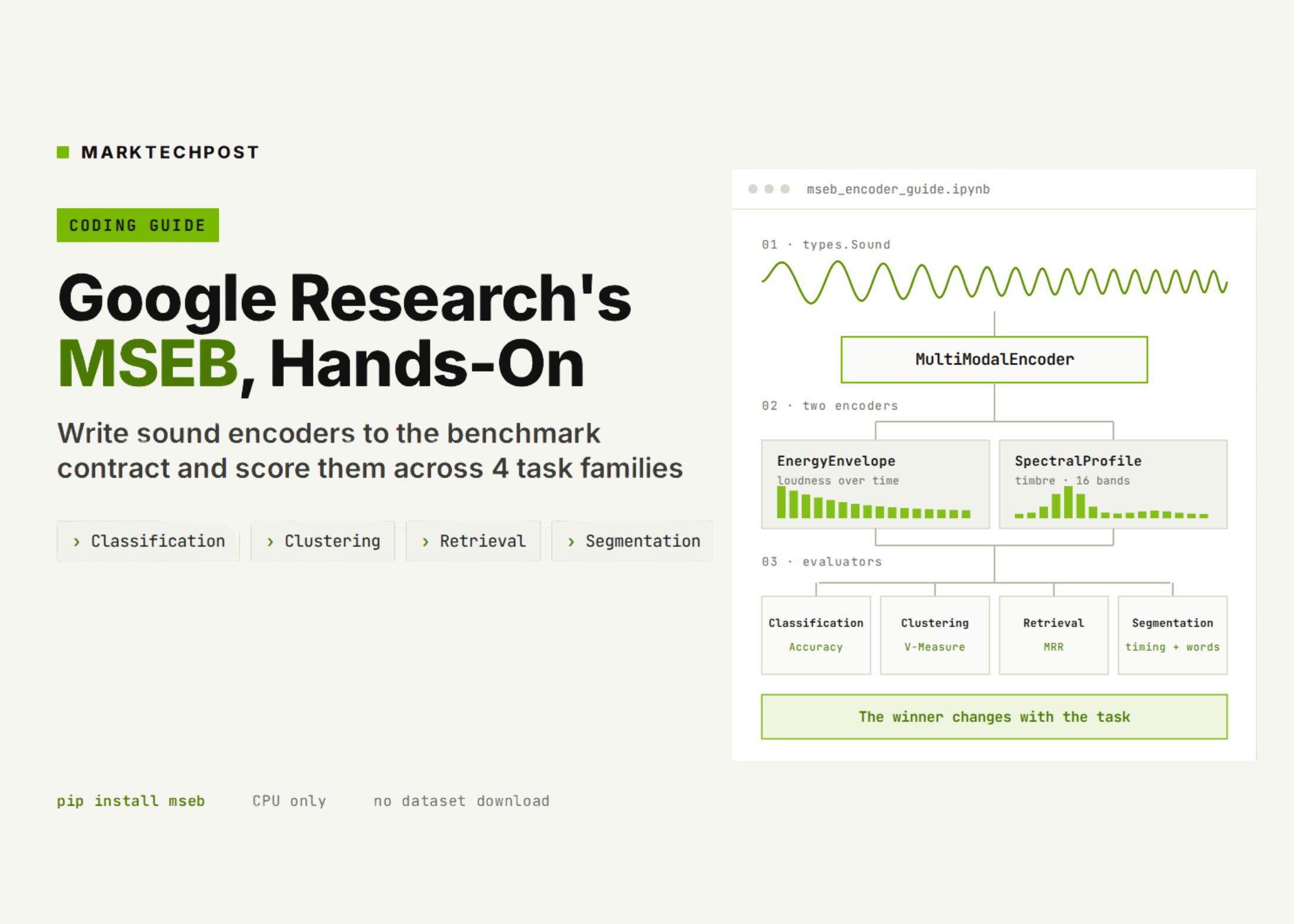
MSEB approaches this by breaking the evaluation process into three distinct layers. The first layer defines the data shapes — Sound objects that carry waveforms, SoundEmbedding objects that carry vector representations, Score objects that carry metric results, and TaskMetadata that describes what task was run. The second layer is the encoder contract, a set of methods that any custom model must implement to participate in the benchmark. The third layer consists of evaluators — specialized modules for classification, clustering, retrieval, segmentation, and other tasks — each of which asks a fundamentally different question of the same embeddings.
This layered design means that once an encoder satisfies the contract, every evaluator works automatically. There is no need to rewrite scoring logic when swapping in a new model, and there is no need to download datasets to explore how the framework operates. By synthesizing audio directly, practitioners can build intuition about what each evaluator rewards and how different embedding strategies perform across them.
## Building Encoders From Scratch: The Contract That Makes It All Work
At the heart of MSEB is the MultiModalEncoder abstract base class, which requires exactly three methods to be implemented by any subclass. The `_setup` method handles initialization — loading weights, building internal state, or preparing any resources the model needs. The `_check_input_types` method validates that incoming data conforms to the expected format, rejecting anything that is not a Sound object with a clear error message. The `_encode` method processes a batch of Sound objects and returns a list of SoundEmbedding objects, each carrying an N-by-D matrix of vectors and an M-by-2 matrix of timestamp pairs.
The framework owns two additional methods — `setup` and `encode` — which handle batching, call the three abstract methods in sequence, and attach EncodingStats metadata to every result. This means that custom encoders never need to manually track input size, embedding size, or computational cost; the framework does it. EncodingStats exposes a compression_ratio field that quantifies how much smaller the embedding representation is compared to the original audio, providing a useful signal about efficiency.
To illustrate how different encoding strategies produce fundamentally different embeddings, consider two deliberately distinct approaches. The first, an energy envelope encoder, divides each audio waveform into equal time slices and computes the root-mean-square energy of each slice, then L2-normalizes the result. This produces a vector that describes how loudness changes over time but carries no information about spectral content. The second, a spectral profile encoder, computes the log-magnitude spectrum of each frame, pools it into a set of frequency bands, and normalizes the output. This vector describes the timbral character of the sound — where energy is distributed across frequencies — but does not directly encode temporal dynamics.
## A Synthetic Corpus That Separates Two Cues
Rather than relying on a pre-existing dataset, the benchmark walkthrough synthesizes a small corpus where two distinct cues are deliberately separated. The spectrum of each clip encodes its class — tone, chirp, or noise — while the amplitude envelope is drawn independently for each clip and carries no class information. Every waveform is normalized to unit root-mean-square before the envelope is applied, ensuring that loudness variation is purely a function of the envelope and not the spectral content.
Each of the thirty-six clips is rendered twice: once as a clean document and once as a noisier second take of the same clip. Both versions are encoded by both encoders, producing four embedding caches — two encoders times two takes. When the cosine similarity between embeddings of the same class is compared to the similarity between embeddings of different classes, a clear pattern emerges. The spectral encoder produces embeddings that cluster by class, while the energy envelope encoder produces embeddings that cluster by individual clip, since the envelope is unique to each item rather than each class.
This separation is the key to understanding why a single evaluation metric is insufficient. Each encoder will be judged differently depending on which evaluator is asked to score it, a phenomenon that drives home the argument for a multi-task benchmark.
## Four Evaluators, Four Different Questions
The benchmark framework includes evaluators for multiple task families, each of which frames a different evaluation question. ClassificationEvaluator provides class labels at score time, building a prototype table of mean class vectors and using a distance function to assign each embedding to its most likely class. It produces metrics such as accuracy, balanced accuracy, precision, recall, and F1 — all of which reward the ability to group sounds by their semantic category.
ClusteringEvaluator removes the labels from the encoder entirely. It runs KMeans over the embedding space and scores the resulting clusters against the ground truth using V-measure, the harmonic mean of homogeneity and completeness. Because no class prototypes are available, the clustering evaluator relies entirely on the structure of the embedding space, making it a much harsher test for encoders that encode item identity rather than category.
RetrievalEvaluator asks yet another question: given a query clip, find the exact document it came from. Each query is the noisier second take of one of the documents, and the target is identity, not category. Using a brute-force nearest-neighbor searcher, this evaluator returns metrics such as mean reciprocal rank, exact match, recall at five, and normalized discounted cumulative gain. The envelope encoder excels here because its embeddings function as item fingerprints, uniquely identifying each clip regardless of class. The spectral encoder, by contrast, sees clips of the same class as similar and may return a different clip from the same category as the correct answer.
SegmentationEvaluator takes the evaluation in a completely different direction by scoring what was said and where it was said as two independent quantities. In this context, the embedding array holds text terms rather than vectors, and the timestamps array holds the start and end times of each term. The evaluator scores predictions across metrics like TimestampsAccuracy, EmbeddingsAccuracy, WordErrorRate, and mean average precision, making it clear that a model can get the words right but the timing wrong — or vice versa — and only a combined metric captures both dimensions.
## The Metric Layer: Shared Functions Across Task Families
Behind every evaluator is a set of metric functions that multiple tasks share. These include functions for computing word error rate and character error rate from reference and hypothesis strings, as well as ranking metrics such as exact match, reciprocal rank, and normalized discounted cumulative gain over a ranked list of identifiers. There are also embedding-space distance functions such as Lp-norm distances and dynamic time warping, which underpin tasks like reconstruction and stability evaluation.
A notable edge case in the metric library deserves attention: the normalized discounted cumulative gain function assumes a single relevant document and compares it by equality. Passing a list of relevant identifiers silently scores zero, even though reciprocal rank would still produce a valid result. This kind of subtlety is exactly what a well-documented benchmark surface is designed to surface, encouraging practitioners to read the metric documentation carefully and understand what each number represents.
## Assembling TaskMetadata: What a Real Submission Carries
A complete benchmark submission requires more than just embedding vectors and metric scores. TaskMetadata bundles all the information needed to reproduce and interpret a result: the name and description of the task, its type and category, the main score used for ranking, dataset path and revision, evaluation splits, languages, and the full list of Score objects with their metric names, values, and bounds. This metadata validates at construction time, rejecting malformed entries such as empty score lists or inverted bounds, ensuring that only well-formed results reach the leaderboard.
The result of a full evaluation can be summarized as a table with one row per encoder and one column per task family. When two encoders trade places depending on the column, the limitation of a single headline number becomes obvious. An encoder that cannot name a sound can still recognize it, and an encoder that names every sound correctly can confuse clips that belong together. A multi-task benchmark makes this argument in numbers, demonstrating that no single scalar can capture the full picture of embedding quality.
## Frequently Asked Questions
### What does the “M” in MSEB stand for, and who maintains it?
MSEB stands for Massive Sound Embedding Benchmark, and it originates from Google Research. It is designed to evaluate sound embedding models across a wide range of tasks and to surface the fact that different tasks reward different properties of an embedding.
### Do I need a GPU or accelerator to run the benchmark?
No. The framework is designed to run entirely on CPU with no dataset download required for exploration. The classification, clustering, retrieval, and segmentation evaluators depend only on NumPy and scikit-learn, making them lightweight enough for a free CPU runtime. Heavier evaluators such as reranking and transcription do pull in additional dependencies like Whisper, TensorFlow, and Apache Beam, but those are optional.
### What happens if I pass invalid data to an evaluator or a metric function?
The framework validates data at multiple points. SoundEmbedding objects reject malformed inputs at construction, such as empty metric names or inverted bounds. Encoder subclasses that receive inputs of the wrong type are caught by the `_check_input_types` method, which raises a clear ValueError. Metric functions like `compute_ndcg_at_k` have specific expectations about their inputs, and passing a list where a single string is expected will silently produce a zero score, which is itself a teaching moment about reading documentation carefully.
### Can I use my own custom encoder with MSEB?
Yes. Any encoder that subclasses MultiModalEncoder and implements `_setup`, `_check_input_types`, and `_encode` is a first-class citizen of the benchmark. The framework handles batching, statistics, and validation automatically. Once an encoder satisfies the contract, every evaluator works without modification.
### Why do clustering and classification give such different rankings for the same encoder?
Because they ask different questions. Classification uses class prototypes and supervised scoring, which can exploit faint cues that a model might encode. Clustering runs KMeans over the embedding space without any labels, making it a much harder test that rewards truly structured representations. When an encoder encodes item identity rather than class, it will score well on classification and retrieval but poorly on clustering, because unsupervised algorithms cannot find structure that is not there.
### What is the significance of the compression_ratio in EncodingStats?
Compression_ratio measures how much smaller the embedding representation is compared to the original audio. For example, a compression ratio of roughly one thousand means the embedding uses about one-thousandth the number of bytes as the raw waveform. This provides a quick, interpretable signal about the efficiency of an embedding model, though it should be considered alongside the quality of the representations it produces.
### How does the segmentation evaluator handle timing errors and recognition errors?
SegmentationEvaluator scores timestamps and embeddings as two separate quantities. TimestampsAccuracy measures whether the start and end times of each segment are correct within a tolerance (tau). EmbeddingsAccuracy measures whether the text term associated with each segment is correct. WordErrorRate measures the edit distance between predicted and reference term sequences. Only a combined metric — TimestampsAndEmbeddingsAccuracy — credits getting both right simultaneously, making it clear when a model confuses its strengths.
### What is the difference between MRR and NDCG in the retrieval evaluator?
Mean Reciprocal Rank (MRR) considers only the rank of the single correct document and computes the reciprocal of that rank. Exact Match (EM) checks whether the correct document was ranked first. Recall at K checks whether the correct document appeared anywhere in the top K results. Normalized Discounted Cumulative Gain (NDCG) assigns graded credit based on position, giving more weight to higher ranks. In the retrieval setup, where there is exactly one relevant document per query, these metrics provide complementary views of ranking quality.
## Conclusion
Treating a sound embedding benchmark as a contract plus a set of evaluators reveals something that a single headline number obscures: different tasks reward fundamentally different properties of the same representation. By implementing a lightweight encoder contract, synthesizing a corpus where class and identity are deliberately separated, and driving four distinct evaluators, the multi-dimensional nature of embedding quality becomes impossible to ignore. An energy envelope encoder that encodes when a sound is loud outperforms a spectral encoder on retrieval tasks, while the spectral encoder dominates classification and clustering. Neither is universally better — and that is the entire point.
The framework handles the mechanics of batching, statistics, and validation so that the practitioner can focus on what matters: understanding what each evaluator measures and why the ranking changes from task to task. The next step is to substitute a real encoder — wav2vec, Whisper, CLAP, EnCodec, SoundStream, or any custom model — and re-run the same evaluators. The scoring code does not change, and the results will tell a richer story than any single metric ever could.
Thank you for reading
