



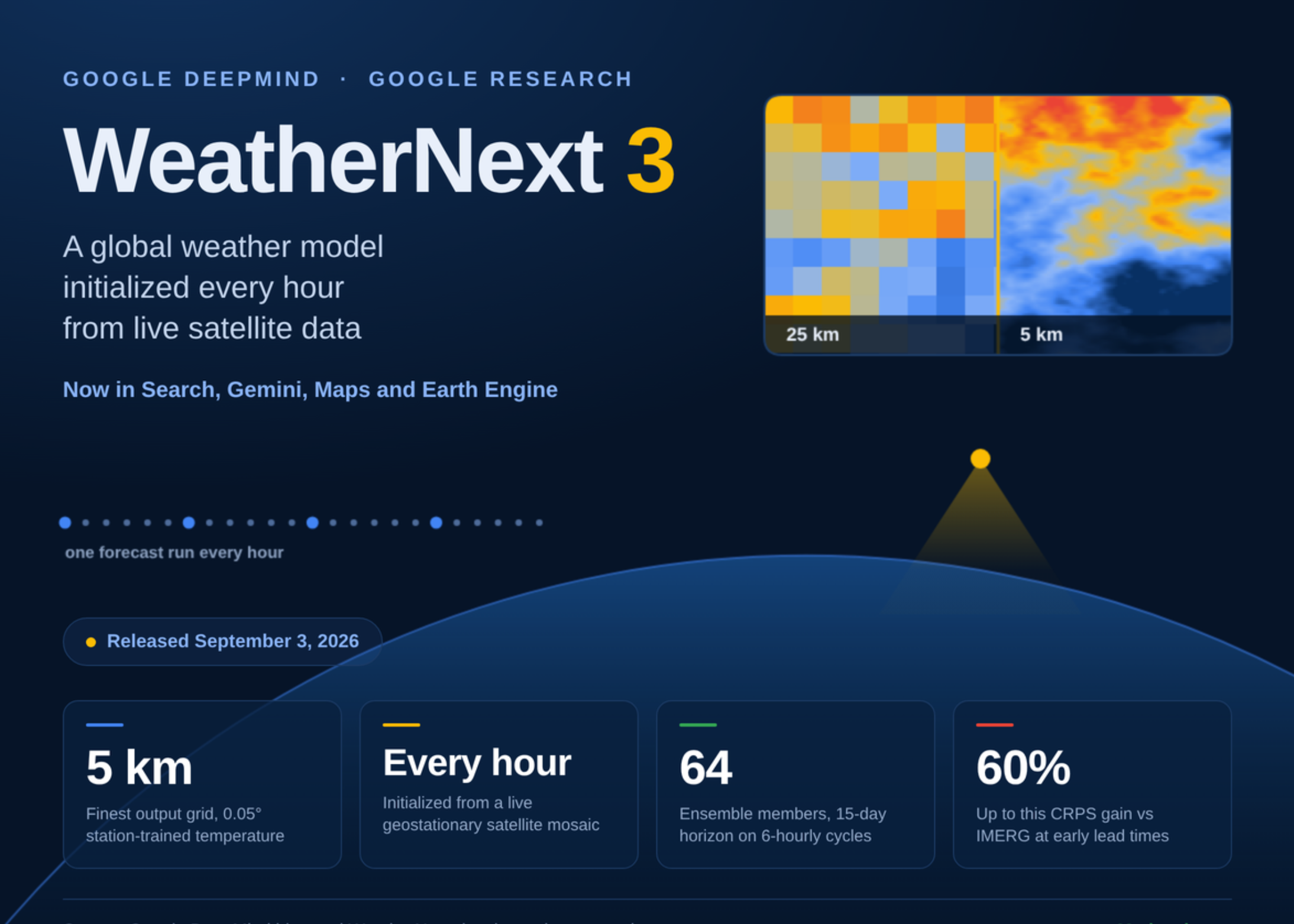
# WeatherNext 3: How Google DeepMind Is Redefining Global Weather Forecasting
The landscape of AI-driven weather prediction has evolved rapidly over the past several years, with machine learning models steadily closing the gap with traditional physics-based numerical weather prediction. Despite that progress, two persistent challenges have limited what these systems could deliver: spatial resolution too coarse to capture local terrain effects, and a reliance on initialization data that arrives hours after real-world conditions have already shifted. WeatherNext 3, developed by Google DeepMind and Google Research, directly targets both of those bottlenecks — and claims to deliver the most accurate global weather forecasts to date.
## A New Approach to Model Inputs
Most AI weather systems learn from numerical weather prediction reanalysis products, which are themselves generated by physics-based models. That creates a dependency chain: the AI forecast inherits the delays and smoothing inherent in NWP analysis, which typically lags actual atmospheric conditions by around six hours. WeatherNext 3 breaks that chain by incorporating a live global geostationary satellite mosaic as a direct input, allowing the model to refresh its initialization up to 24 times per day rather than relying on the slower six-hourly NWP update cycle.
Pairing that satellite mosaic with the ECMWF HRES analysis gives the model a real-time observational backbone. But the innovation goes deeper. WeatherNext 3 trains dedicated observational heads directly on raw station measurements — temperature, dew point, wind — rather than learning exclusively from reanalysis grids. This means the model’s finest-resolution outputs are calibrated to what physical instruments actually record, not to a smoothed representation of the atmosphere generated by another simulation.
## Multi-Resolution Output From a Single Pass
One of WeatherNext 3’s most practical features is that it produces multiple resolution tiers in a single forward pass. The model emits three distinct output levels simultaneously:
– **0.05° (~5 km)** — station-trained two-meter temperature and dew point fields, designed to match what weather stations actually measure.
– **0.1° (~10 km)** — gridded surface variables including ten-meter and hundred-meter wind speeds, atmospheric pressure, sea surface temperature, cloud layer distributions, solar radiation, and one-hour precipitation.
– **0.25° (~25 km)** — atmospheric fields spanning thirteen pressure levels, useful for larger-scale synoptic analysis.
This architecture means a single model run serves both local forecasters who need fine-grained detail and regional operators who need broader atmospheric context. WeatherNext 2 produced only the 0.25° tier in six-hour steps, making the resolution improvement roughly five times sharper at the finest level.
## Precipitation Forecasting and Clean Energy Applications
Precipitation has historically been the weak point for global models, which tend to smear rain bands into diffuse, featureless blobs. WeatherNext 3 addresses this by training against three precipitation data sources: ECMWF reanalysis, NASA’s IMERG satellite-based rainfall retrievals, and Google’s own satellite-radar precipitation reanalysis product. The results are striking. Independent evaluations report cumulative ranked probability score improvements of up to sixty percent against IMERG at early lead times, a thirty percent gain over MRMS radar composites, and a ten percent improvement over rain gauge baselines. In operational Google products, precipitation forecasts show up to a fifty percent reduction in error compared to numerical weather prediction baselines when measured against IMERG.
For the renewable energy sector, the model also delivers a suite of variables that grid operators need for day-ahead planning. Hundred-meter wind speed approximates turbine hub height, while full low-, medium-, and high-level cloud distributions and both solar irradiance components — global horizontal irradiance (SSRD) and direct normal irradiance (FDIR) — give solar and wind farm operators the inputs necessary to balance generation against demand.
## Ensemble Design and Forecast Horizons
WeatherNext 3 runs a sixty-four-member probabilistic ensemble, providing a picture of uncertainty alongside the central forecast. The four daily synoptic cycles — initialized at 00:00, 06:00, 12:00, and 18:00 UTC — extend out to fifteen days, covering the full medium-range forecasting window. Between those synoptic runs, hourly interim predictions fill gaps for the first forty-eight hours, which is particularly valuable for fast-developing convective weather events.
The ensemble spread at day fifteen, visible when adjusting the member count on the model’s interactive demonstration, illustrates how uncertainty grows with forecast lead time while still providing actionable guidance well beyond what simpler deterministic systems can offer.
## Availability and Access
Forecast data from WeatherNext 3 is currently accessible through Google’s BigQuery, Earth Engine, and Cloud Storage platforms, though access requires submitting an allowlist request. The model weights themselves are not publicly available, and on-demand custom inference runs still use WeatherNext 2 as the default. This means researchers and developers can query and use the forecasts, but cannot modify or self-host the underlying model.
## Key Takeaways
– Hourly model initialization from live satellite data eliminates the six-hour lag tied to traditional NWP analysis.
– A single forward pass produces three resolution tiers, from five-kilometer station-calibrated fields to twenty-five-kilometer pressure-level data.
– A sixty-four-member ensemble runs out to a fifteen-day horizon, with interim hourly updates covering the first two days.
– Precipitation forecasts show significant gains against satellite and radar benchmarks, with up to a sixty percent improvement in CRPS against IMERG at early lead times.
– Renewable energy variables — including hub-height wind speed and full solar irradiance spectra — are included to support operational grid forecasting.
– Forecast data is available through Google cloud platforms by request, but model weights remain closed.
## Frequently Asked Questions
**What is WeatherNext 3?**
WeatherNext 3 is a global AI weather forecasting model developed by Google DeepMind and Google Research. It uses a Functional Generative Network mesh transformer architecture and produces multi-resolution forecasts initialized from live satellite data rather than traditional numerical weather prediction analysis.
**How often does WeatherNext 3 update its forecasts?**
The model reinitializes every hour using a live geostationary satellite mosaic, producing up to twenty-four forecast updates per day compared to the roughly four updates typical of six-hourly NWP-based systems.
**What resolution does WeatherNext 3 produce?**
It outputs three tiers in a single forward pass: 0.05° (~5 km) for station-trained temperature and dew point, 0.1° (~10 km) for gridded surface variables, and 0.25° (~25 km) for thirteen atmospheric pressure levels.
**How far ahead can WeatherNext 3 forecast?**
Synoptic cycles initialized at 00:00, 06:00, 12:00, and 18:00 UTC extend to fifteen days. Interim hourly runs cover the first forty-eight hours.
**Why is WeatherNext 3 better at precipitation forecasting?**
The model trains against three precipitation datasets — ECMWF reanalysis, NASA IMERG, and Google’s satellite-radar precipitation reanalysis — which allows it to preserve the sharp boundaries of convective storm systems rather than smoothing them into diffuse fields.
**Is WeatherNext 3 available for public use?**
Forecast data can be accessed through BigQuery, Earth Engine, and Cloud Storage after an allowlist request. However, the model weights are not open source, and custom on-demand inference still relies on WeatherNext 2.
**What are the clean energy applications of WeatherNext 3?**
The model outputs hundred-meter wind speeds, low/medium/high cloud distributions, and both solar irradiance components (SSRD and FDIR), providing the inputs needed for wind and solar generation forecasting.
**Who ranks WeatherNext 3 as the most accurate global weather model?**
According to Google AI, independent live evaluations from Brightband have ranked WeatherNext 3 as the most accurate global weather model to date.
## Conclusion
WeatherNext 3 represents a meaningful step forward in the practical deployment of AI weather models. By combining hourly satellite-driven initialization, multi-resolution output from a single model pass, and training directly against raw observational data, it addresses two of the most significant limitations that have held back machine learning weather forecasting. The inclusion of renewable energy variables and the depth of the precipitation improvements suggest that this release is designed not just to advance benchmarks, but to serve operational users who need actionable forecasts for decision-making. While the closed-source weights limit full research transparency, the availability of forecast data through major Google cloud platforms opens the door for integration into real-world workflows. As AI weather models continue to mature, WeatherNext 3 sets a new standard for what global forecasting can achieve.
Thank you for reading
