



# Adaptive Agent Training Environments: How a New Wrapping Layer Is Changing the Game for LLM Agents
## The Static Benchmark Problem
Large language model agents have increasingly moved beyond reading curated text corpora and into interactive digital environments for training and evaluation. These virtual workspaces — spanning tasks from household simulations to software engineering and web navigation — promise a more realistic training ground. Yet there is a fundamental limitation baked into nearly all of them: once built, they never change.
A frozen environment treats every agent identically, regardless of its skill level or training history. It starts every episode from the same state, follows the same rules, and rewards the same outcomes. For a novice agent, this works fine. But for a more advanced policy that has already mastered the basics, the environment has nothing left to offer. The learning signal flatlines, and progress stalls.
Traditionally, researchers have addressed this by manually creating new environments for each new skill level. This approach is labor-intensive, domain-specific, and does not scale. A kitchen simulation for one task does not translate to a software debugging environment. Each new workspace requires its own pipeline, its own rules, and its own verification logic.
Another common workaround involves using language models to automatically generate additional environments and write the verification code that checks whether an agent succeeded. But this creates its own set of problems. The generated environments often require massive over-generation followed by heavy filtering, and the automatically written verifiers are notoriously unreliable — they can miss subtle bugs or introduce their own inconsistencies.
## A Different Approach: Wrapping the World, Not the Agent
A new framework, called EnvHarness, takes a radically different path. Instead of trying to make the agent more capable or generating entirely new training grounds, it wraps existing frozen environments with programmable components that reshape what the agent experiences.
Think of it this way: rather than upgrading the agent’s brain, you redesign the playing field to target its specific weaknesses. An advanced agent that has learned to reach for objects on open surfaces might not have learned to search for objects hidden away. Instead of building a new environment from scratch, EnvHarness modifies the existing one — starting the episode with a mug tucked inside a closed drawer — so that the agent is forced to develop a search strategy.
The beauty of this approach lies in its architecture. The underlying simulator, the original tasks, and the human-built verification logic all remain completely untouched. EnvHarness sits as a programmable layer on top, intercepting and transforming the standard interface that every episode follows: reset, step, observe, and evaluate.
### Three Modular Components
EnvHarness ships with three types of wrapper components that can be mixed, matched, and composed together freely. Each one operates strictly through the environment’s standard interface, meaning no changes are needed to the underlying simulation engine.
**Stage** controls where an episode begins. After a reset call, Stage replays a predefined sequence of actions before the agent gets to act. This shifts the starting state, forcing the agent to handle scenarios it has not seen before. For example, in a household simulation, Stage can execute a series of actions that move an object from plain sight into an obscure location, transforming a simple reach task into a multi-step search problem.
**Contract** installs per-step hooks on the action, transition, and observation pathways. It can block certain actions entirely — such as teleporting across a room — or rewrite the observations an agent receives, truncating room descriptions so that spatial memory must be built incrementally. It can also gate progress by checking conditions at each step before allowing the episode to continue.
**Chain** connects two separate environments into a single episode, sharing a step budget between them. The overall verdict is the logical conjunction of both environments’ verification results. This means an agent must succeed at multiple distinct tasks in sequence without being able to stop after completing just one. It creates a natural pressure test for persistence and goal maintenance.
## The Automated Designer Loop
Hand-picking which wrappers to apply and how to configure them would be tedious. EnvHarness addresses this with a companion system called EnvRigger, which automates the entire design process.
EnvRigger treats the agent policy as a black box. It runs a structured four-stage loop that mirrors how a human designer would think about environment engineering:
First, it observes. The system runs a set of baseline episodes using the current policy on the unmodified task, carefully cataloging both successes and failures. Second, it diagnoses. An LLM analyzes the rollout traces to identify a systemic flaw — a recurring mistake pattern that the environment is not currently targeting. Third, it writes. Based on the diagnosis, EnvRigger generates Python code that implements one or more wrapper components designed to surface exactly that weakness. Fourth, it validates. The newly shaped environment is tested against five fresh rollouts, and the results determine whether the wrapper is accepted, rejected, or sent back for revision.
Crucially, EnvRigger rejects both extremes. A wrapper that produces a 0% success rate is just as useless as one that produces a 100% success rate. The system aims for wrappers that create a productive challenge — one that the current policy struggles with but that, with training, it can learn to overcome. Up to five revision rounds are allowed per task, and all generated code runs in an isolated subprocess, meaning a broken wrapper simply produces a traceable error rather than crashing the entire training run.
## What the Results Show
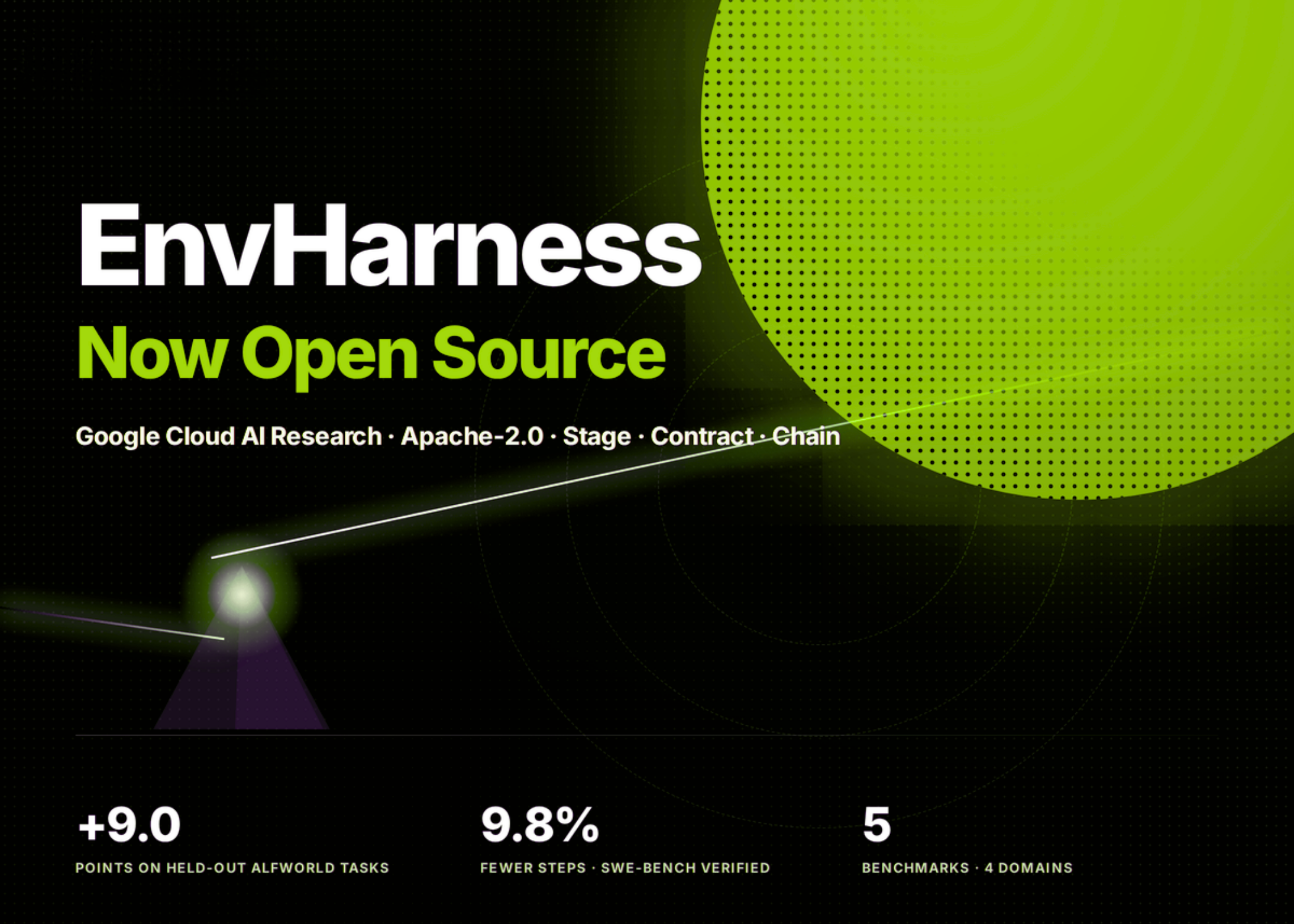
Across five benchmarks spanning four distinct domains, skills developed through this wrapping approach delivered strong gains compared to training on unmodified environments. The most notable improvements were seen on held-out task variants — the exact scenarios the agent had never encountered during training.
In a household simulation benchmark, success rates improved by up to 9.0 percentage points on task types the agent had not seen before. In a software engineering evaluation, wrapper-generated training reduced the average number of execution steps needed per task by 9.8%, indicating that agents were finding more efficient solutions. Across four different policy models tested in the office and spreadsheet domains, improvements ranged from 2.7 to 3.7 percentage points on held-out evaluations.
In one particularly telling result, a web-based navigation benchmark actually showed that skills mined from unmodified sites performed worse than training on no environments at all. Only after reshaping the environment with wrapper components did those skills become worth mining. This is a powerful demonstration that the value of an environment is not intrinsic — it depends on whether it is aligned with what the current policy needs to learn next.
## Is It Ready for Real-World Use?
The short answer is yes, with a specific prerequisite. EnvHarness is distributed as open-source Python code under the Apache 2.0 license, with reproduction drivers available for six different environments out of the box. Any new environment can be added by implementing a standard set of six interface methods covering reset, step, observation, evaluation, state serialization, and state restoration.
The critical requirement is that the environment must be resettable — meaning it can reliably return to a known starting state at the beginning of each episode. This makes EnvHarness well-suited for digital simulations and software benchmarks. It does not work with live user accounts or physical robots, where reset states are difficult or impossible to guarantee.
Because the wrapping layer does not touch any domain-specific code or benchmark logic, a single implementation works across every supported domain. Researchers do not need to rewrite their environments or build new verification pipelines. They simply plug EnvHarness in and let the designer loop find the wrappers that matter.
## Frequently Asked Questions
**What is the core innovation of EnvHarness?**
The core innovation is treating the environment itself as a programmable, adaptable system rather than a fixed, static stage. By wrapping a frozen simulator with plug-in components, the same environment can be reshaped to target the specific weaknesses of a training policy, without modifying the underlying simulation engine or task definitions.
**How does this differ from generating new environments?**
Generating new environments requires building entirely new simulation pipelines, writing domain-specific rules, and creating verification logic from scratch — all of which are expensive, error-prone, and do not transfer across domains. EnvHarness modifies what the agent sees and does inside an existing environment, reusing all the original simulation and evaluation infrastructure unchanged.
**Can the wrapper components be combined?**
Yes. The three component types — Stage, Contract, and Chain — are designed to compose freely. A researcher can apply multiple wrappers to the same environment simultaneously, creating complex training scenarios that combine shifted starting states, restricted observation spaces, and multi-task episode structures.
**What kind of agent policies benefit most from this approach?**
Policies that have already mastered basic capabilities but are stuck on more advanced skills benefit the most. The system excels at targeting specific failure patterns — such as skipping verification steps, failing to search for hidden objects, or abandoning goals when intermediate tasks are complete — and designing environments that force those skills to develop.
**Does EnvHarness require access to the agent’s internal reasoning?**
No. EnvRigger operates entirely on the agent’s external behavior — the actions it takes, the observations it receives, and whether it succeeds or fails. It does not need access to model weights, internal token sequences, or architecture details, making it compatible with any black-box policy.
**What are the limitations?**
The framework requires resettable environments, which rules out applications involving live user accounts, physical hardware, or non-deterministic real-world systems. Additionally, the designer loop depends on an LLM to generate and critique wrapper code, which introduces the same reliability concerns present in any LLM-driven code generation pipeline.
## Conclusion
The shift from static training environments to adaptive ones represents a meaningful advance in how LLM agents are developed and evaluated. By keeping the environment frozen and programmable at the same time, EnvHarness sidesteps the traditional trade-off between reuse and customization. A single environment can serve as a training ground for multiple skill levels, each shaped by a different set of wrappers designed to surface the precise weaknesses the current policy needs to overcome.
The automated designer loop further removes the burden of manual environment engineering, allowing the system to diagnose failure patterns and compose targeted interventions with minimal human intervention. As agent capabilities continue to advance, the need for equally adaptive training infrastructure will only grow. Frameworks like EnvHarness point toward a future where environments are not just stages for agent performance but active participants in the learning process — reshaping themselves, episode by episode, to push policies further than they could go alone.
Thank you for reading
