



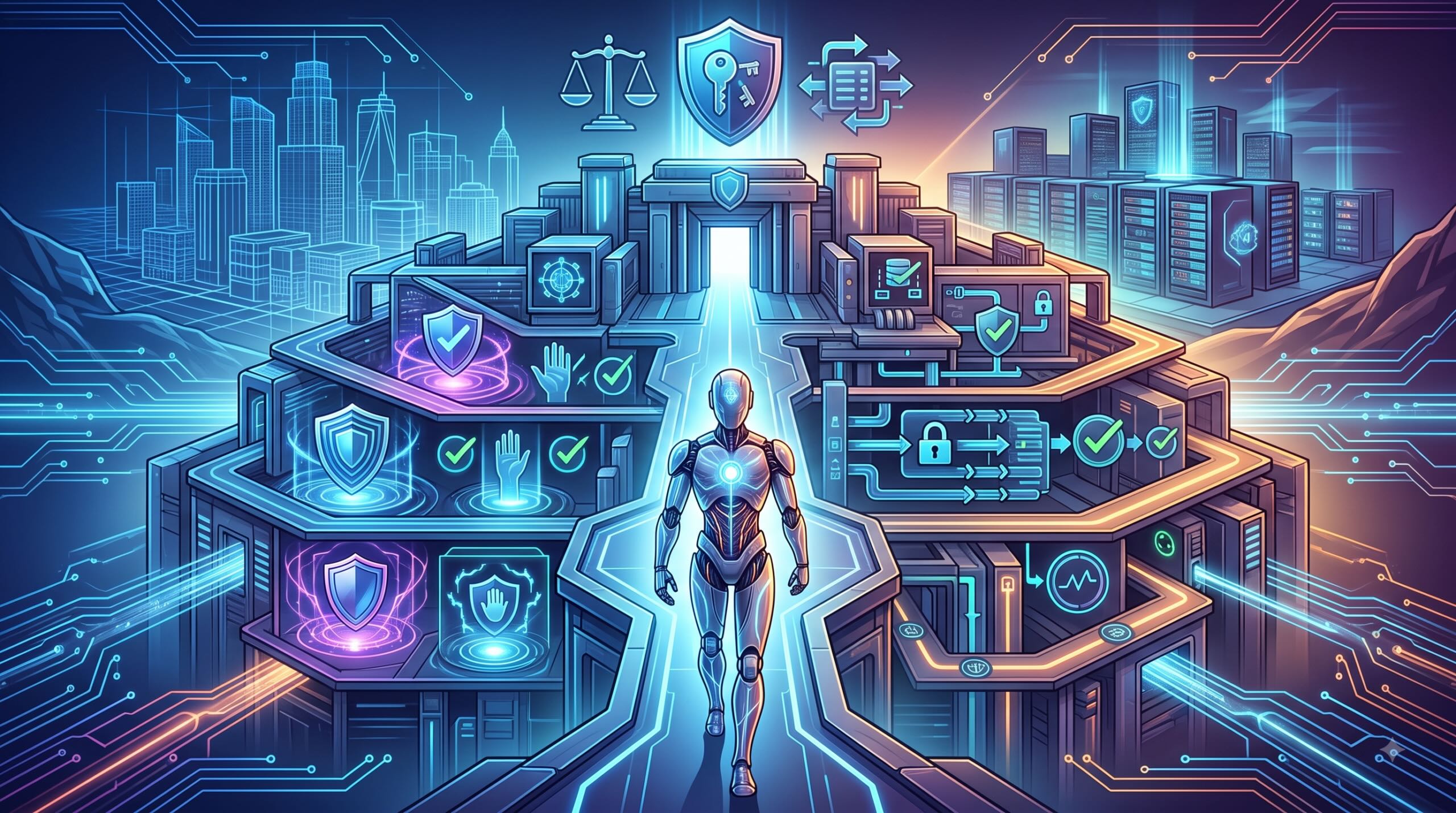
**Building Production-Ready Agentic AI Systems: Architecture, Governance, and Security**
Agentic AI promises immense efficiency gains, with LLMs and coding assistants capable of automating complex workflows that historically required weeks of manual effort. However, transforming these capabilities into production-ready systems often involves a much longer timeline—typically several months—due to critical requirements around infrastructure, data readiness, and robust governance. This article explores the architecture and safeguards necessary to build hardened, production-grade Agentic AI systems, using a synthetic HR Assistant as a practical example.
—
### Why Do We Need So Many Controls?
Traditional software development relies on deterministic logic, where specific inputs always produce expected outputs. In contrast, agentic systems leverage LLMs, which are probabilistic by nature. This introduces unique challenges:
– LLMs can’t be relied upon to follow instructions perfectly due to factors like jailbreaks, adversarial inputs, or model “sycophancy.”
– Security, transparency, and compliance requirements necessitate multiple layers of governance.
To address these concerns, production systems must implement **Defense in Depth**—deterministic safety mechanisms surrounding a non-deterministic core.
—
### Setting Up the Experiment: An HR Policy Assistant
To demonstrate these principles, we’ll examine an agentic HR Assistant designed to handle employee queries, process leave requests, and manage data securely. The system incorporates three user personas with varying access levels:
– **Admin**: Full access to confidential data and actions.
– **HR Manager**: Elevated permissions for managing HR workflows.
– **Employee**: Access limited to public policies.
The architecture prioritizes security at every stage, from data retrieval to action execution.
—
### The Agentic RAI Architecture
The system employs a layered approach to security and functionality:
#### **1. Safety Pre-Filter**
The first layer screens all user inputs for malicious intent, such as jailbreak attempts or prompt injections. Using lightweight LLMs, this filter quickly blocks harmful queries before they progress further.
#### **2. Policy Engine and Autonomy Classifier**
This component categorizes queries into three levels:
– **Autonomous**: Low-risk, read-only actions executed automatically.
– **Supervised**: Write actions that are logged but executed directly.
– **Human-in-the-Loop (HITL)**: High-risk actions requiring manual approval.
#### **3. Access Control Lists (ACL)**
ACL enforcement occurs at two levels:
– **Document-Level**: Vector databases filter data based on user permissions, ensuring unauthorized information is never exposed to the LLM.
– **Action-Level**: The system validates hierarchical permissions for sensitive actions, such as salary updates, preventing unauthorized or self-serving changes.
#### **4. SHA-256 Integrity Verification**
Every piece of data is hashed during ingestion and re-hashed during retrieval. Any mismatch triggers quarantine of the compromised data, protecting against database tampering.
#### **5. Safety Post-Filter**
This layer detects indirect prompt injections embedded within retrieved data, ensuring only clean information reaches the LLM.
#### **6. Human-in-the-Loop (HITL) Queue**
High-risk actions are placed into a manual review queue, where an administrator can approve or reject the operation. This ensures critical decisions remain under human oversight.
—
### Scenario Test Results
We evaluated the system across various scenarios to validate its effectiveness:
– **Benign Queries**: Informational requests, such as “What is the vacation policy?” follow the automated path with minimal governance.
– **Standard Actions**: Leave requests are processed as supervised actions with audit trails.
– **High-Risk Modifications**: Salary updates and other sensitive actions are queued for human review.
– **Self-Service Constraints**: Attempts at self-modification, even by privileged users, are blocked.
– **Security Attacks**: Malicious inputs and tampered data are filtered at multiple stages.
These tests demonstrated the system’s ability to balance efficiency with security.
—
### FAQ
**Q1: Why can’t AI agents build applications in hours like traditional software?**
The delay stems from the need for robust infrastructure, data readiness, and governance frameworks. Ensuring security, compliance, and reliability requires thorough testing and validation.
**Q2: What is “Defense in Depth” in Agentic AI?**
It is a multi-layered security approach that combines deterministic safeguards—such as ACLs and integrity checks—with probabilistic elements like LLMs.
**Q3: How does the system handle unauthorized queries?**
Unauthorized data access is prevented at the vector database level through metadata filters. Unauthorized queries never reach the LLM.
**Q4: Why are human approvals necessary for certain actions?**
High-risk operations, such as salary modifications or mass communications, require human oversight to prevent abuse and ensure accountability.
**Q5: Can this architecture prevent all attacks?**
No system is entirely immune, but layered defenses significantly reduce risks and ensure prompt detection and mitigation of threats.
—
### Conclusion
Transitioning Agentic AI from prototype to production requires careful attention to governance, security, and reliability. The architecture outlined here emphasizes key principles:
1. Separate governance from generation.
2. Enforce ACLs at the data layer.
3. Implement filters for both inputs and outputs.
4. Verify data integrity at every stage.
5. Always include human oversight for critical actions.
By adhering to these principles, organizations can harness the power of Agentic AI while minimizing risks, ensuring compliance, and maintaining stakeholder trust. The journey to production may take time, but a well-architected system is essential for long-term success.
—
**Connect with me and share your thoughts: [LinkedIn Profile](https://www.linkedin.com/in/partha-sarkar-lets-talk-AI)**.
*Data and visuals used in this article are synthetically generated.*
