



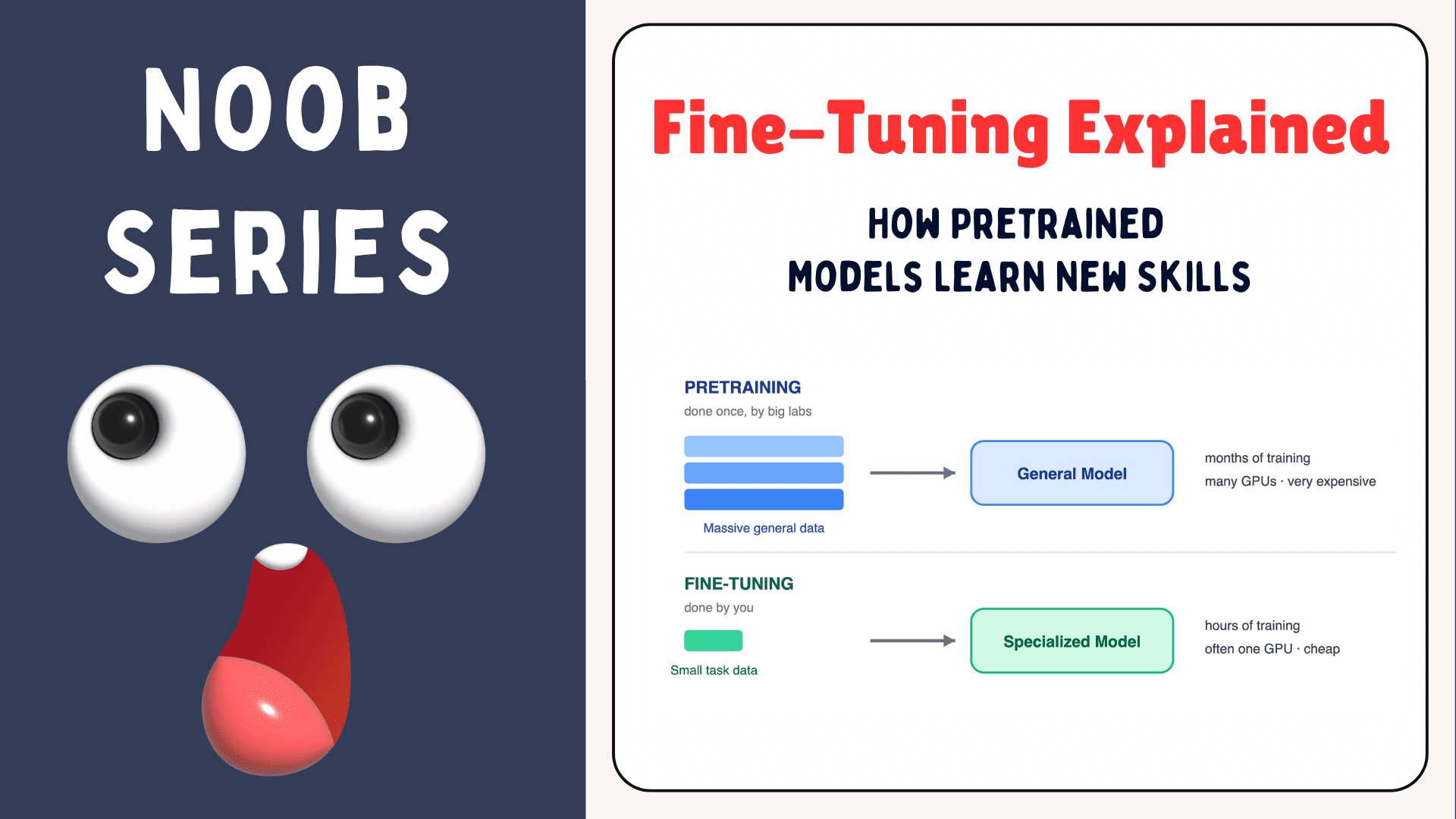
**Understanding Fine-Tuning in Large Language Models: A Beginner’s Guide**
If you’ve ever wondered how large language models (LLMs) can be adapted to perform specific tasks, understand particular domains, or even mimic a certain tone, the answer lies in a process called **fine-tuning**. Fine-tuning is a powerful technique that allows us to take a pre-trained model and tailor it to our unique needs without starting from scratch. But what exactly is fine-tuning, and how does it work? Let’s break it down in simple terms.
—
### What is Pretraining?
Before diving into fine-tuning, it’s essential to grasp the concept of **pretraining**. Imagine starting with a blank slate—a model with millions or even billions of parameters initialized with random values. Training such a model directly on a specific task (like movie classification) would require it to learn the entire structure of language, grammar, and reasoning from scratch, which is impractical given the limitations of data and compute resources.
This is where **pretraining** comes in. In this phase, the model is trained on a massive corpus of general data with a straightforward objective: **predicting the next word**. For example, given a sentence like “The cat sat on the ___,” the model learns to predict words that logically follow, such as “mat” instead of “car.” By repeating this process across billions of texts, the model develops a robust understanding of language, facts, and reasoning patterns. This foundational knowledge is why pretraining is often referred to as creating **foundation models**.
Most of the time, we don’t pretrain models ourselves. Instead, we rely on pretrained models like **Llama**, **Mistral**, or **Qwen**, which serve as our starting point for more specialized tasks.
—
### What is Fine-Tuning?
Fine-tuning is the process of adapting a pretrained model to a specific task or domain using task-specific data. Think of it as building on top of the general intelligence a model already possesses. Unlike pretraining, which requires massive datasets and computational power, fine-tuning uses smaller, focused datasets, making it more accessible and efficient.
To put it in relatable terms: Pretraining is like attending culinary school, while fine-tuning is like learning the specific recipes and procedures of a particular restaurant. The basics are already in place; you just need to refine your skills for a particular context.
Fine-tuning adjusts the model’s weights slightly so that it becomes better suited for its new task. This process is not only computationally cheaper but also helps avoid the risk of **catastrophic forgetting**, where a model might lose its general abilities if over-trained on a single task.
—
### How is Fine-Tuning Done?
Fine-tuning follows a process similar to pretraining but with key differences:
1. **Task-Specific Data**: Instead of feeding the model the entire internet, you provide it with a small, high-quality dataset relevant to the task (e.g., movie reviews for sentiment analysis).
2. **Lower Learning Rate**: To preserve the general knowledge gained during pretraining, the learning rate is kept small, and the model is trained for only a few iterations.
The training loop involves showing the model an example, asking it to make a prediction, comparing its output to the correct answer, and tweaking its internal weights to improve accuracy over time.
—
### Types of Fine-Tuning
Broadly, fine-tuning is categorized into two types:
1. **Full Fine-Tuning**:
In this approach, all the parameters in the model are updated during training. While effective, it requires significant computational resources and carries the risk of **catastrophic forgetting**, where the model becomes overly specialized and loses some of its general capabilities.
2. **Parameter-Efficient Fine-Tuning (PEFT)**:
To address the limitations of full fine-tuning, PEFT techniques freeze the base model’s parameters and introduce a small, trainable set of parameters specifically for the task. Methods like **LoRA** (Low-Rank Adaptation) and **QLoRA** fall under this category. These approaches are more memory-efficient, faster, and less prone to forgetting previously learned knowledge, making them the preferred choice for most applications.
—
### Is Fine-Tuning Always the Answer?
While fine-tuning is a versatile tool, it’s not always necessary. Sometimes, a well-crafted prompt or a technique called **retrieval-augmented generation (RAG)**—which pulls in external information at query time—can solve the problem just as effectively. Fine-tuning should be considered when you need the model to learn a new skill, style, or behavior that cannot be achieved through prompting or retrieval alone.
—
### Resources to Get Started
If you’re eager to try fine-tuning, here are some great places to start:
– **Hugging Face PEFT**: The go-to library for techniques like LoRA and QLoRA.
– **Unsloth**: A beginner-friendly toolkit for efficient fine-tuning with ready-made notebooks.
– **Axolotl**: A config-driven tool for simplifying fine-tuning pipelines.
– Research Papers: Check out foundational papers like *”LoRA: Low-Rank Adaptation of Large Language Models”* and *”QLoRA: Efficient Finetuning of LLMs.”*
For your first project, consider fine-tuning a smaller instruct model using Unsloth and a few hundred clean examples. Seeing the training loss decrease in real-time is an incredibly rewarding experience!
—
Kanwal Mehreen, a machine learning engineer and technical writer, contributed this insightful exploration of fine-tuning. Her expertise in data science, AI, and dedication to empowering others shines through in this comprehensive guide.
—
**Original Article Source**: [Fine-Tuning Explained for Noobs (How Pretrained Models Learn New Skills) – KDnuggets](https://www.kdnuggets.com/wp-content/uploads/Noob-Series-Fine-Tuning-Explained.png)
