



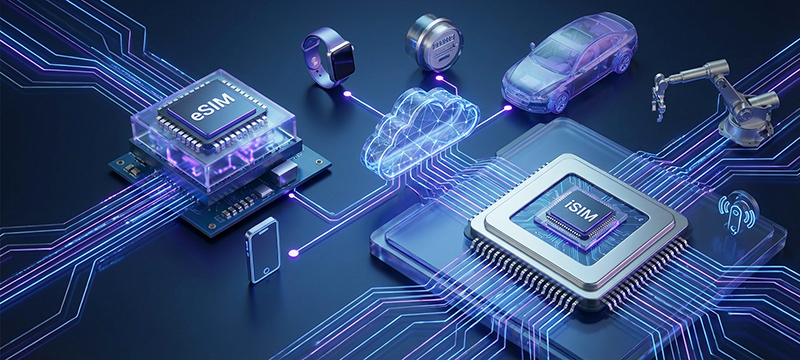
The evolution of mobile connectivity within the Web of Issues is more and more formed by the necessity for flexibility, scalability, and long-term machine lifecycle administration. On this context, eSIM and iSIM applied sciences are rising as foundational enablers of distant provisioning and international deployment methods. As IoT deployments develop throughout geographies and industries, the power to handle connectivity with out bodily intervention has turn out to be a crucial requirement.
Each eSIM and iSIM handle longstanding limitations of conventional SIM playing cards by enabling distant subscription administration and extra built-in {hardware} designs. Whereas they share frequent ideas, their architectures and implications differ in ways in which matter for machine makers, connectivity suppliers, and enterprise adopters. Understanding how these applied sciences work—and the place they match throughout the broader IoT ecosystem—is crucial for designing scalable and future-proof linked options.
Key Takeaways
- eSIM and iSIM allow distant provisioning of connectivity profiles, eliminating the necessity for bodily SIM swaps.
- iSIM integrates SIM performance straight into the machine chipset, decreasing {hardware} complexity and energy consumption.
- Each applied sciences depend on standardized distant SIM provisioning frameworks outlined by GSMA.
- They help international IoT deployments by permitting gadgets to change operators over-the-air.
- Adoption depends upon ecosystem maturity, together with machine help, operator readiness, and regulatory alignment.
What’s eSIM and iSIM for IoT: Distant Provisioning, Flexibility and Scale?
eSIM and iSIM are embedded SIM applied sciences that enable IoT gadgets to retailer and handle mobile connectivity profiles remotely, with out requiring a detachable bodily SIM card. They permit distant SIM provisioning (RSP), permitting operators and enterprises to activate, replace, or swap community subscriptions over-the-air.
Within the IoT ecosystem, these applied sciences handle key challenges associated to machine deployment at scale, particularly in distributed or hard-to-access environments. eSIM refers to a devoted chip embedded within the machine, whereas iSIM integrates SIM performance straight into the machine’s most important processor or system-on-chip (SoC). Each approaches help versatile connectivity administration throughout a number of networks and areas.
How eSIM and iSIM works
On the core of each eSIM and iSIM is the idea of distant SIM provisioning. As an alternative of pre-loading a single operator profile at manufacturing, gadgets can obtain and handle a number of operator profiles dynamically.
The structure usually consists of:
- Safe aspect: Shops operator credentials and ensures safe execution of SIM features.
- Subscription supervisor: A distant platform chargeable for provisioning, updating, and managing profiles.
- System administration interface: Permits communication between the machine and provisioning infrastructure.
In an eSIM structure, the safe aspect is a discrete chip soldered onto the machine. In an iSIM structure, the safe aspect is embedded throughout the SoC, sharing {hardware} assets with different machine features.
When a tool connects to a community for the primary time, it might probably obtain a connectivity profile from a distant server. This course of is authenticated and encrypted, making certain safe supply of operator credentials. Units can later swap profiles primarily based on location, value, or efficiency necessities.
Key applied sciences and requirements
The deployment of eSIM and iSIM depends on a set of standardized frameworks and applied sciences, primarily outlined by the GSMA.
- Distant SIM Provisioning (RSP): Defines how connectivity profiles are securely downloaded, activated, and managed over-the-air throughout machine fleets.
- eUICC (embedded Common Built-in Circuit Card): The logical part that permits the storage and administration of a number of operator profiles on a single chip.
- GSMA SGP.02, SGP.22 and SGP.32 specs: SGP.02 (legacy M2M) and SGP.22 (shopper) outline earlier provisioning fashions, whereas SGP.32 introduces a extra scalable, IoT-optimized structure designed for headless and constrained gadgets, with simplified, cloud-driven provisioning workflows.
- Safe enclave / trusted execution surroundings (TEE): Notably related for iSIM, making certain safe execution of SIM features throughout the machine chipset.
- Mobile requirements: LTE-M, NB-IoT, and 5G applied sciences that present the underlying connectivity layer for IoT deployments.
These requirements guarantee interoperability between machine producers, connectivity suppliers, and platform operators. Nonetheless, implementation particulars can differ, notably in iSIM deployments the place chipset-level integration introduces extra dependencies.
Most important IoT use circumstances
eSIM and iSIM applied sciences are notably related in IoT situations the place gadgets are deployed at scale, throughout a number of areas, or in environments the place bodily entry is proscribed.
Industrial IoT: Manufacturing tools and sensors usually function in distant or hazardous environments. Distant provisioning permits connectivity updates with out interrupting operations.
Logistics and asset monitoring: Units hooked up to containers, automobiles, or high-value property can swap between networks as they transfer throughout borders, making certain steady connectivity.
Good cities: Infrastructure resembling sensible meters, road lighting, and environmental sensors profit from centralized connectivity administration and lengthy machine lifecycles.
Vitality and utilities: Distributed power property and grid monitoring techniques require dependable, long-term connectivity with minimal upkeep.
Healthcare: Related medical gadgets and wearables will be deployed globally whereas sustaining compliance and connectivity flexibility.
Automotive and mobility: Related automobiles depend on embedded connectivity for telematics, infotainment, and over-the-air updates, usually throughout a number of areas.
Advantages and limitations
The adoption of eSIM and iSIM in IoT affords a number of benefits, but additionally introduces trade-offs that should be thought-about at design and deployment phases.
Advantages:
- Distant administration: Eliminates the necessity for bodily SIM alternative, decreasing operational prices.
- World scalability: Helps multi-operator methods and cross-border deployments.
- Improved machine design: Particularly with iSIM, reduces part depend and saves area.
- Enhanced safety: Makes use of safe components and standardized encryption mechanisms.
- Lifecycle flexibility: Permits adjustments in connectivity suppliers over time.
Limitations:
- Ecosystem complexity: Requires coordination between machine makers, operators, and provisioning platforms.
- Customary fragmentation: Totally different GSMA specs for M2M and shopper IoT can complicate implementation.
- Operator help: Not all cellular community operators totally help distant provisioning frameworks.
- Price concerns: Preliminary integration and platform prices could also be larger than conventional SIM options.
- Regulatory constraints: Some areas impose restrictions on distant SIM administration or operator switching.
Market panorama and ecosystem
The eSIM and iSIM ecosystem entails a number of stakeholders throughout the IoT worth chain.
System producers: Combine eSIM or iSIM capabilities into {hardware} designs, balancing value, measurement, and efficiency necessities.
Chipset suppliers: Play a central function in iSIM adoption by embedding SIM performance into SoCs and making certain compliance with safety requirements.
Cellular community operators: Present connectivity profiles and should help distant provisioning infrastructure.
Connectivity administration platforms: Allow enterprises to handle machine fleets, subscriptions, and community choice insurance policies.
System integrators and resolution suppliers: Design end-to-end IoT options that incorporate connectivity, gadgets, and information platforms.
The market continues to be evolving, notably for iSIM, which relies upon closely on chipset availability and ecosystem alignment. eSIM has seen broader adoption, particularly in automotive and industrial IoT, whereas iSIM is gaining traction in extremely built-in and power-sensitive purposes.
Future outlook
The function of eSIM and iSIM in IoT is anticipated to develop as deployments scale and connectivity necessities turn out to be extra dynamic. A number of tendencies are shaping their future trajectory.
First, the transition to 5G and lowered functionality (RedCap) gadgets is prone to speed up the necessity for versatile connectivity administration, reinforcing the worth of distant provisioning. Second, the mixing of iSIM into next-generation chipsets might allow extra compact and energy-efficient gadgets, notably in wearables and asset monitoring.
There’s additionally ongoing work to harmonize GSMA specs and simplify provisioning architectures, which may scale back implementation complexity. On the similar time, enterprises are more and more searching for better management over connectivity, together with the power to handle a number of operators by means of a single platform.
Nonetheless, adoption will proceed to rely on ecosystem maturity, together with operator readiness, regulatory alignment, and the supply of standardized options. As these components evolve, eSIM and iSIM are prone to turn out to be default connectivity choices in lots of IoT purposes.
Ceaselessly Requested Questions
- What’s the distinction between eSIM and iSIM?
eSIM is a separate chip embedded in a tool, whereas iSIM integrates SIM performance straight into the machine’s most important processor. - How does distant SIM provisioning work?
It permits gadgets to obtain and handle connectivity profiles over-the-air utilizing safe, standardized protocols. - Are eSIM and iSIM safe?
Sure, each depend on safe components and encryption requirements to guard credentials and communications. - Can gadgets swap operators with eSIM or iSIM?
Sure, gadgets can swap between operator profiles remotely, relying on configuration and operator help. - Is iSIM extensively obtainable at this time?
iSIM continues to be rising and depends upon chipset integration, however adoption is rising in particular IoT segments. - Do all operators help eSIM and iSIM?
Help varies by operator and area, and never all networks totally help distant provisioning frameworks.
