



Most people who visit Disneyland in California and Walt Disney World in Florida, or their offshoots in other parts of the world, have no idea how much they are closely linked to manufacturing. Assembly line tools and production processes played an important behind-the-scenes role in the development of many of the most popular attractions at Disney theme parks.
Conveyors, programmable logic controllers and other automation technology that were adapted from mid-century American factories enable many rides to operate smoothly and safely.
When Disneyland opened in 1955, it demystified the hidden world of factory automation through new amusement park experiences that were unlike anything people had ever seen. Disney engineers tapped into the industrial world to reimagine manufacturing systems and production processes. They borrowed technology perfected by engineers at Ford Motor Co., General Electric, General Motors, Westinghouse and other manufacturers.
“For all its commitment to theming and immersion, Disneyland is fundamentally a factory,” says Roland Betancourt, Ph.D., the author of an intriguing new book entitled Disneyland and the Rise of Automation (Princeton University Press). “Its products are not the hollow trinkets of consumerism…but the experience itself.
“You, the visitor, are the raw material that is worked and fashioned as you move along a track, triggering sensors and actuating a series of precisely choreographed machines designed to produce a sense of wonder and enchantment,” explains Betancourt, a professor of art history at the University of California, Irvine. “Yet it is also these machines themselves that captivate audiences, speaking to the bravado of the engineering that underlies the surfaces and facades of the park.
“None of this is magic,” claims Betancourt. “It’s automation. Every Disneyland ride is a carefully camouflaged assembly line where you are its signature product.”
According to Betancourt, “the technologies of industrial automation—systems largely hidden from public view in factories and warehouses—were transformed into amusement at Disneyland, setting the trend for the era of the theme park in the postwar period.
Looking for quick answers on assembly and manufacturing topics?
Try Ask ASM, our new smart AI search tool.
Ask ASM
“The modern theme park represents a profoundly significant realm of cultural production, where automation was not merely deployed, but aestheticized,” argues Betancourt. “Here, invisible industrial processes became visible, making the cold logic of servo mechanisms and relays palatable in the guise of childhood fantasy and Hollywood cartoons.
“[Disneyland] invited audiences to experience the systems and logic of automation that had thus far served only as the unseen hand of American manufacturing, sensationalized on television broadcasts and newsprint but rarely made physically accessible to a mass audience,” says Betancourt.
“Nowhere else could families step into the workings of a large-scale, automated factory,” adds Betancourt. “At Disneyland, visitors were presented with narrative-coated experiences that were based on the limits and affordances of automation as a medium, where its systems of control served as the protagonists of Disney’s storytelling.
“In the most technical definition of automation, nearly every Disneyland ride features the same technologies of the automated assembly line, where vehicles are automatically conveyed from operation to operation, where sensors and limit switches trigger actions to be taken, and where animatronics are run by magnetic tape, just like the automated machines of the period,” Betancourt points out.
When developing Disneyland’s unique rides and attractions in the 1950s, 1960s and 1970s, Walt Disney and his colleagues were inspired by state-of-the-art American manufacturing technology. Photo courtesy Walt Disney Archives
Detroit’s Influence
Walt Disney and his colleagues were enamored by manufacturing in general and automotive assembly lines in particular. In fact, Disney made several eye-opening visits to Ford Motor Co.’s River Rouge complex in Dearborn, MI, during the 1940s, when the vertically integrated facility was in its heyday. He walked along the assembly lines and witnessed iron ore being turned into steel.
Disney’s first documented visits to the Rouge occurred in 1940 and 1943, while he was working on training films related to World War II (during that period Disney created numerous short movies, such as “Aircraft Welding” and “Four Methods of Flush Riveting”).
However, a pivotal event occurred in the summer of 1948 when Disney and his colleague, Ward Kimball, visited the Rouge while in town to tour Greenfield Village, which itself has been attributed as being a key inspiration behind the development of Disneyland.
Betancourt says “it was the motor assembly line that most fervently captured Kimball’s attention that entire day, writing emphatically [in his diary]: ‘What a sight, miles upon miles of endless moving part belts and men and women assembling the engines…It floored me! We later walked the entire assembly line and watched the Fords roll off at the end!’”
Kimball wrote that they witnessed “an integrated workforce, consumed within an ordered nest of overhead tramrails, suspended tools, hanging parts, all resulting in shiny, new automobiles that drive right off the factory floor.”
In its prime, the Rouge was a massive complex that covered 2,000 acres and featured 16-million-square-feet of floor space. More than 90 buildings were interconnected by 120 miles of conveyors and more than 100 miles of railroad track. Henry Ford boasted that the facility housed “the largest completely mechanized installation of handling equipment ever installed in any industrial enterprise.”
In addition to assembly lines, machine shops and stamping plants, the original Rouge complex included a steel mill, a foundry, a glass plant and a tire factory. It featured an endless array of overhead and floor-based gravity, spiral and bucket conveyors, in addition to moving belts, moving platforms and overhead cranes that automatically moved parts and components throughout the vast industrial city on the banks of the Rouge River.
Every department was equipped with mechanical handling devices, and every shop and building was connected by a network of overhead monorails and conveyors.
On one visit to the Rouge, Walt Disney and a colleague toured the steel mill where they observed ingots being moved around. Disney turned to John Hench, a designer who went on to become senior vice president of imagineering, and asked, “Do you think we could put some kind of seat on that type of conveyor, or some kind of arrangement for people to ride on…do you think this thing would handle that?”
“Turning to studio machinist Roger Broggie, along with designer Bob Gurr, Walt Disney adapted the potential he had seen in the ingot handling means to create a conveyor system borne out of the very mechanics of the assembly line,” says Betancourt. “Disney was drawn to the sheer wonder of the material conveyors themselves, desiring to modify them so guests could ride on the very means of the assembly line itself.
“On August 31, 1948, just five days after returning to Los Angeles, Walt Disney would send a memo to Dick Kelsey, one of his production designers, describing his idea for a ‘Mickey Mouse Park,’” notes Betancourt.
“The River Rouge plant afforded Walt Disney an intimate view of what the latest technological advancements could allow for the creation of the future Disneyland,” explains Betancourt. “Detroit automation was synonymous with the use of transfer machinery, which automatically moved parts between different tools and machines without the use of human hands.
“The technologies that would make Disneyland a reality were adapted for the amusement park from the workings of the assembly line and the newfound uses of automation,” claims Betancourt. “From 1953 to 1955, Walt Disney and his various collaborators would design and build Disneyland on the backbone of the very technologies of material handling and automatic control that were in their infancy in the Ford plant in 1948.
“There, Walt got to experience the full, unbridled possibilities of automation, intimating the new horizons of technology that would eventually be repurposed at Disneyland to create the amusement park,” says Betncourt.
“Car chassis flying through the air, like Peter Pan’s enchanted galleon, vehicles moving seamlessly on tracks as various operations were undertaken on them, and the sensational walk-throughs of the factory floor and the exhibits on American industry and history; these were the models of automation that the Ford factory offered to Walt Disney in 1948,” says Betnacourt.
“Unlike the earlier assembly line that required human intervention along every stage of movement, Detroit automation sought the streamlining of this process,” Betancourt points out. “This would find its matured manifestation in the Cleveland Engine Plant that would open in 1952 and become a symbol of automation writ large.”

During the 1940s, Walt Disney visited Ford Motor Co’s Rouge complex several times, where he marveled at the assembly lines and material handling systems. Photo courtesy AACA Library & Research Center
The Birth of Automation
In the late 1940s, Ford Motor Co. became the birthplace of automation. In the postwar period, the scarcity of labor, the rise in real wages and high consumer demand encouraged experiments with manufacturing processes that employed conveyors, compressed air, hydraulic power and electrical devices to automate certain functions.
In April 1947, Ford’s vice president of manufacturing, Delmar Harder, created the Automation Department. He and his colleagues devised an innovative system of electronic controls. They began working on valves and valve-guide bushings, then automated the manufacture of pistons, then coils and wheels, and then frames and rear axles.
To meet pent up demand for cars, Ford built the world’s first two factories designed for extensive use of automation: the Buffalo Stamping Plant and the Cleveland Engine Plant and Foundry, which both opened in the early 1950s.
The new factories featured “iron hand” devices that could automatically load and unload transfer machines and stamping presses making parts and components. In addition, they carried out other functions, such as inspection, gauging and weighing, that traditionally had been done by humans.
“What made the Cleveland Engine Plant so interesting to contemporaries was the way in which Ford had linked these transfer machines together by automatic conveying equipment such that little human assistance was necessary for conveying, loading or unloading work in process,” says David Hounshell, Ph.D., professor emeritus at Carnegie Mellon University and the author of From the American System to Mass Production, 1800-1932. “Handling devices allowed parallel or multiple machining tasks to be fed automatically, thus achieving balance in machining capabilities.
“All these automatic conveyance devices were controlled by a hard-wired control panel of telephone-type relays—an electromechanical ‘brain,’” explains Hounshell. “The system included a series of interlocks to ensure correct conveyance and feeding of parallel lines.
“Assembly operations at the plant also relied extensively upon automated conveyance systems, which with their power-and-free capability allowed for greater flexibility than the automated equipment in the machining areas,” Hounshell points out.
In the machining process, 41 inline, transfer-type machines comprising two basic lines were linked in a continuous process 1,200 feet long. Manual handling of the engine block was necessary only once—at the loading point. With the old method, 150 separate machines would have been required, each with a worker.
By 1954, the automated engine plant was touted as a big success. The facility was mass-producing both Ford-6 and Mercury V-8 overhead valve engines. Automation reduced direct labor minutes by 49 percent and required 17 percent less floor space than traditional assembly methods.
Numerous journalists hailed the automated Cleveland plant as “revolutionary” and compared it to the manufacturing technology advancements made at Ford’s Highland Park factory, the birthplace of the moving assembly line 40 years earlier.
Although Walt Disney and his colleagues did not visit the Cleveland Engine Plant, they likely witnessed automation in action at other auto factories. That’s because in the 1950s and 1960s, both Ford and GM operated large facilities near Los Angeles (in Pico Rivera and Van Nuys, respectively).
Those assembly plants may have inspired Disney’s team of “imagineers” (a combination of the words imagination and engineering that was first coined by the Aluminum Company of America in a marketing campaign during World War II).

Some of the most popular rides at Disneyland—depicted in this scale model—owe their existence to manufacturing technology, such as the Matterhorn Bobsleds (center), Peter Pan’s Flight (upper right) and Space Mountain (lower left). Photo by Austin Weber
From Factory Floor to Fantasyland
During the 1950s, 1960s and 1970s, Disney imagineers turned to a variety of off-the-shelf industrial technology that ensured fail-safe operations. By reading ASSEMBLY and other trade magazines, they learned about new tools and techniques for material handling.
“The ‘journey’ taken by material goods as they are processed and transformed through a series of automated actions captures the deep homologies between the fully automated factory and the amusement park’s rides,” says Betancourt.
“Many of the similarities between the fully automated factory and the amusement park are made clearer when one turns to rides that involved the loading and unloading of passengers onto vehicles, following a prescribed track and upon which actions were taken along the way,” explains Betancourt.
“It is this ‘journey’ across discrete points in a narrative that Disneyland translated into automation technologies, so as to create an immersive story through which a series of effects and actions are actuated as the ride vehicle courses through,” notes Betancourt.
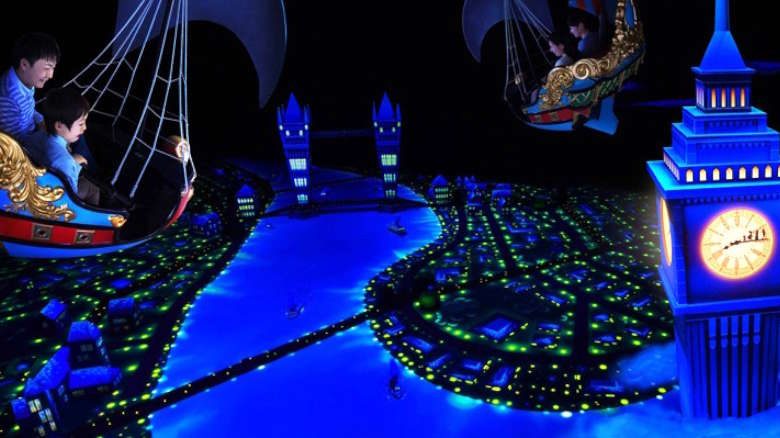
When Disneyland opened in 1955, one of its original rides in the Fantasyland section was Peter Pan’s Flight, based on a Disney animated film that was released two years earlier. Today, it remains one of the only attractions in the park that has not changed its location, despite updates in 1983 and 2015.
In the popular “dark ride” (an amusement park industry term for a track-based ride-through attraction in a dark building), guests board a pirate galleon and take a magical journey over London and Never Land. The 7-foot-long fiberglass ships are lifted by their masts and carried along a single rail hung from the ceiling, which the sails of the ships conveniently conceal from guests.
The Peter Pan ride makes use of forced perspective more than any other attraction at Disneyland. Although people feel like they are flying miles above various London landmarks, they sail at a maximum height of 17 feet.
The ships are suspended from an overhead monorail system that was originally developed for use in factories and foundries. When developing the ride in the early 1950s, Disney engineers turned to the Cleveland Tramrail division of the Cleveland Crane & Engineering Co. (a firm that was eventually acquired by Gorbel in 2002).
Riders become Peter Pan and share his adventures as he outwits Captain Hook and his pirates. The ride is enhanced by various special effects, such as a snapping crocodile, that are triggered by the vehicles’ movement.
Adapting an overhead monorail was an ingenious idea, because the arch beam conveyor could easily twist, turn, elevate and descend while providing a safe, smooth ride that lasted several minutes. Each vehicle was powered by a 1-hp electric motor attached to the rail.
The final design used wide-radius curves and modest ups and downs so that the trip would make people feel like they were sailing through the clouds. Seven galleons moved along a 486-foot-long track at a speed of 4 feet per second.
When Disneyland opened, the ride received rave reviews from people who had never experienced anything like it.

Technology pioneered on automotive assembly lines transformed Disneyland and turned the Matterhorn Bobsleds into a popular thrill ride. Illustration courtesy U.S. Patent and Trademark Office
“Cleveland Tramrail’s versatility made it particularly suitable for Disneyland as [the imagineers] sought an industrial system that could safely and reliably handle a human ‘load’ of passengers, which comparably required less nuance than the operations for which these machines had been built for the past decades,” says Betancourt. “Like raw materials on the assembly line being assembled into a finished product, Disneyland’s guests are fabricated here into the Disney character himself.”
“The Cleveland Tramrail was a tried and tested system, used at many manufacturing plants, like Ford, and [the company] boasted that ‘no engineering skill [is] required to install them,” explains Betancourt.
“Cleveland Tramrail was not the only industry standard for overhead monorails, but it paid consistent attention to safety concerns,” says Betancourt. “For instance, they had recently introduced a new electric conductor for their tramrail, which provided a contact shoe that slid through an insulated ‘U-shaped channel.’ This system replaced the earlier metal wheels that were fed electricity from a live, exposed rail.”
The company offered a “Saf-Powr-Bar” that appealed to Disney engineers, because it was less prone to derailing or producing sparks.
“Cleveland Tramrail’s greatest contribution to the development of Peter Pan’s Flight (and all of the park’s subsequent track-based rides), however, was their early development of a block-based system for electrically powered conveyor systems,” claims Betancourt.
“By insulating sections of the electrified rail to create blocks of track, the system was designed to deenergize block A behind an occupied block B until the vehicle had proceeded out of block B and into C,” explains Betancourt. “Once the vehicle was in C, block B would be deenergized, and block A would reenergize.
“This system ensured that behind every occupied block there was a dead block that protected against the collision of carriers,” says Betancourt. “This would become the guiding principle of all track-based amusements, from dark rides to roller coasters.”
“It was the lessons gained from the close collaboration with Cleveland Tramrail that set the foundation for the ride control systems that would become the gold standard at Disneyland and all other amusement parks in the decades to come,” adds Betancourt. “This moment also marks the significant shift toward the industrialization and automation of rides to a degree that had not been seen before.”
“Composed from off-the-shelf material handling means, the articulation of the automatic block system in Disneyland rides marked the prototypical emergence of the fully automated amusement park ride,” says Betancourt. “This adoption laid the foundation for ride control systems that would deploy relay racks, sensors and tracks to convey vehicles along a given course, while various actions (such as audio-visual effects and other sensory stimuli) were actuated at the car was conveyed from one scene to another.
“Here, the Disneyland guest would be transformed from an amusement park visitor to something akin to a material good on the production line as various operations were undertaken upon them,” notes Betancourt. “The guest became not a vessel of rampant consumption, but rather took the place of their consumer goods in the processes of their manufacturing.”

Engineers at the Ford Cleveland Engine Plant pioneered control systems that were later adapted by Disney imagineers. Courtesy of The Henry Ford
Adapting GM Technology
The introduction of programmable logic controllers (PLCs) in the late 1960s marked a watershed moment in the history of industrial automation. It revolutionized plant floors around the world by reading inputs from sensors and other devices, processing that information according to a user‑written program, and then driving outputs such as motors, valves and safety devices.
The PLC eliminated the need for hard wiring and spurred the development of flexible manufacturing. It could support a wide range of communication protocols and be configured for safety‑critical applications when paired with dedicated safety PLCs or safety‑rated modules.
The PLC was developed in response to a request from General Motors. At the time, the automaker’s engineers were faced with an expensive, time-consuming task every time a plant was retooled to produce a new vehicle. Hard-wired relay systems and control panels had to be reconfigured. GM wanted to replace that labor-intensive process with electronic devices.
The automaker issued a request for a “standard machine controller” with a set of criteria. The winning proposal came from Richard Morley, an electrical engineer working at a small company called Bedford Associates. The firm later changed its name to Modicon Corp. after it produced the Modicon 084 (a name derived from MODular DIgital CONtroller).
Morley’s answer was a small industrial computer that could perform operations in a fraction of the time required by previous alternatives that consisted of thousands of mechanical relays. The first PLC application occurred in 1969 at GM’s Hydra-Matic transmission plant in Ypsilanti, MI, and was quickly adapted by other automakers to control machines and equipment.
Allen-Bradley jumped into the PLC market in the early 1970s and helped popularize the name and acronym (up until then, the device was simply referred to as a “programmable controller.”). The company (acquired by Rockwell Automation in 1985) has played a key behind-the-scenes role at Disney theme parks ever since.
PLCs were first used in a theme park for the Space Mountain attraction at Disneyland. The roller coaster ride debuted in Tomorrowland in 1977. Disney imagineers eventually adopted the technology for the Matterhorn Bobsleds the following year and for the Big Thunder Mountain Railroad in 1979.

Actuators, controllers, relays and sensors developed for use in factories enable Space Mountain and other rides at Disney theme parks to operate safely and reliably. Photo courtesy Walt Disney World Resort
“Willis Allen, an electrical engineer, had come across the automation revolution of PLCs and immediately sough to adopt it [at] Disneyland,” says Betancourt. “Allen adopted the original version of the PLC introduced by Allen-Bradley, known as a Bulletin 1774 PLC, whose patent had just been granted in 1976. Up to this point, the PLC had only been used in manufacturing. Allen’s early adoption of the PLC into the theme park has led some of his colleagues to call him the ‘father of modern ride control systems.’
“The original Allen-Bradley PLC was all hardwired, rather than being microprocessor based, which made it extremely reliable and fast,” explains Betancourt. “In Disneyland’s 1977 Space Mountain, the PLC was paired with a Data General Nova computer, whose primary task was to communicate ride conditions to the operators. With this new system, Willis Allen was able to replace the extensive racks of relays with a single PLC.
“Given the theming of Space Mountain, the attraction was uniquely able to represent the systems that controlled it in a manner that had never been fully possible at Disneyland,” Betancourt points out. “While the Cleveland Tramrail monorail might have mesmerized guests with its technological workings and the unique sensory experience it offered, the overhead monorail’s industrial realities could not be readily given representation for audiences in the context of Peter Pan’s story.
“This all changed with Space Mountain’s deployment of a ‘computer’ for its rocket-ship ride through the darkness of space,” notes Betancourt. “While Disneyland had largely glossed over their ride control systems on previous endeavors, internal and external publications highlighted Space Mountain’s control systems.
“The PLC allowed for a host of new safety concerns to be incorporated into the ride control system’s architecture that had been too complex for the old relay systems alone,” says Betancourt. “Now, vehicles could not only be spaced in terms of distance, but also by timing. A host of new safety precautions were incorporated into Space Mountain’s programming given the affordances of the PLC.”

In the Adventure Thru Inner Space ride at Disneyland, Omnimover vehicles appeared to pass through a giant microscope. Photo courtesy Walt Disney Archives
Moving People as Products
Disney engineers also adopted industrial conveyor technology to creatively and safely transport large amounts of people at the same time. In the mid-1960s, they developed a system called the Omnimover that revolutionized the loading and unloading process. The system, which features a series of car shells moving together in a chain, traces its roots to world’s fairs.
One of the highlights of the 1939 New York World’s Fair was the General Motors Pavilion. In addition to showcasing various GM products, the large building housed a 35,000-square-foot exhibit called Futurama, which was created by industrial designer Norman Bel Geddes. Visitors sat in one of 552 “sound chairs,” which were attached to a moving conveyor that transported them along 1,568 feet of track for an aerial view of the world of 1960. Each of the six-foot-tall capsules was upholstered and featured an innovative sound system developed by Western Electric that enabled the narration to be synchronized to what people were actually seeing at any given moment.
The sound chairs were mounted on a contraption developed by engineers at Westinghouse Elevator Co. that was part conveyor belt, part elevator and part escalator. It was dubbed a “carry-go-round” and could transport 2,150 people per hour. The chairs swiveled slightly while continuously moving up and down 23-foot elevation changes along a complex figure-eight route.

The Omnimover enables continuous loading and unloading of ride vehicles that immerse people into the action. Illustration courtesy U.S. Patent and Trademark Office
The highlight was Highways and Horizons, a collection of 408 elaborate dioramas that provided a futuristic vision of mile-high skyscrapers, superhighways, pristine suburbs and parks. The massive display was the largest model ever created. It featured more than 1 million miniature trees, 500,000 buildings, 50,000 scale-model automobiles and, ironically, even an amusement park.
Looking back on the exhibit 25 years later, an article in the General Motors Engineering Journal praised the conveyor system. It claimed that “the success of Futurama was due to two main ingredients: the natural curiosity of man to see what the future holds for him, and the provision of a conveyance system for the visitors, not only for the sake of an organized and controlled movement of people, but also for the refreshment of the footsore and the weary.”
When New York City hosted another world’s fair in 1964, GM returned with an updated version of Futurama. But, this time, the 15-minute ride into the future featured a trip around the world “demonstrating what life might be like in coming decades.”
Futurama II visitors sat three abreast as they rode past six detailed dioramas that were carefully synchronized with a sound system. The animated displays featured scenic backdrops and depicted future life in outer space, the Antarctic, the ocean floor, the jungle and the desert. At the end of the tour around the futuristic world, visitors encountered a city of tomorrow, which featured computer-controlled highways, glass skyscrapers, moving sidewalks and atomic generators.
The Futurama II ride followed a closed-loop track that ran 1,850 feet while moving through several different elevations. The conveyor-based system could accommodate 65,000 visitors a day. Using assembly line technology, GM engineers developed a vertical belt friction drive system, including the driveline, brake assemblies and electrical controls.
When Disneyland added a new attraction in 1967 called Adventure Thru Inner Space, Disney imagineers created the Omnimover system to address both safety and narrative. They borrowed ideas pioneered by the GM exhibits to enable people to be immersed in the story being told in front of their eyes. It allowed guests to be involved and present in the three-dimensional space unfolding around, making them become part of the story.
The patented Omnimover ride system provided high capacity through continuous loading and the ability to direct peoples’ attention to specific parts of a show scene, while providing an experience that came across as personal.
Adventure Thru Inner Space, which operated in Tomorrowland until 1985, was sponsored by the Monsanto Chemica Co. As part of a unique sensory experience, guests were transported in vehicles that were dubbed “atomobiles.”
Disney engineers used visual effects to magically “shrink” people to the size of an atom as they passed through a giant 37-foot -long microscope. Guests in the loading area saw full-sized atomobiles entering the base of the microscope. At the other end, angled high above, the witnessed a continuous line of miniaturized atomobiles moving through a transparent glass enclosure. The effect provided a simple visual illusion that people in the vehicles were being shrunk inside the microscope.

The Omnimover traces its roots to General Motors’ Futurama attraction at the 1939 New York World’s Fair. Photo courtesy General Motors
The Omnimover allowed Disney imagineers to “choreograph” a ride for the first time. Each automobile could pivot up to 180 degrees in either direction, enabling visual surprises to be created as part of the storytelling process.
The Omnimover was revolutionary “because all the usual requirements for safety and control were eliminated by providing an endless chain of vehicles, which automatically opened and closed at loading and unloading, all moving at a constant speed throughout,” says Betancourt. “Here, a collision between two vehicles was physically impossible, because they were all hitched together in a daisy chain.
“These seats would ride under the floor on a tubular steel track on sets of load and guide wheels, just as on the Matterhorn Bobsleds,” explains Betancourt. “And they would be propelled by long fins protruding from the bottom of the arrangement at set distances, which would be pinched by a drive-motor-powered belt. This would translate the horizontal platen at the bottom of the vehicle onto a vertical ‘fin’ to advance the entire system forward at once.
“As the guest was moved along the ride, they would be directed at certain scenes and moments in the narrative,” Betancourt points out. “Similarly, with their scalloped, shelled form, which wrapped around the viewer’s periphery, the Omnimover was able to carefully curate one’s views across the ride. Here, Disney best combined the filmic gaze of the movies with the experience of the amusement park.
“While the Omnimover would not become the default for attractions, it marked the completion of a certain trajectory for Disneyland’s focus on automated control and self-regulation, albeit one that looked more like the merely mechanized flow of Ford’s original assembly line,” adds Betancourt. “Here, the need for self-regulation and feedback was largely eliminated, in essence returning us to earlier forms of mere mechanization.”
When the Haunted Mansion attraction opened in 1969, it used the same ride system, but the vehicles were dubbed “doom buggies” instead of atomobiles.
For more information on automotive manufacturing history, read these articles.
