



Drones have been making headlines everywhere lately. From the Ukraine conflict to the Winter Olympics in Italy, unmanned aerial vehicles (UAVs) have captured widespread attention.
Drones are compact, lightweight aircraft that use either a fixed wing or multiple rotors and can be controlled remotely or programmed to fly autonomously. While some models run on gas engines, most are powered by batteries and electric motors.
Militaries widely rely on these aircraft for aerial intelligence gathering, reconnaissance, surveillance, as well as for executing precision strikes against targets.
Beyond their strategic military roles, drones are finding growing use in civilian sectors, including agricultural monitoring, package delivery, emergency response, and film production.
Due to rapid adoption and continuous technological improvements, the drone market is expected to expand at an annual rate of more than 16 percent over the next ten years, exceeding $191 billion by 2035.
As drones transition from experimental tools to mission-critical aerospace systems, the real bottleneck isn’t autonomy or software—it’s the ability to manufacture at scale.
To keep pace with surging demand, drone makers are increasingly adopting additive manufacturing to fabricate airframes, housings, and flight-critical components. They’re turning to this technology to overcome design limitations, durability issues, and weight constraints that are difficult to address with traditional methods at high production volumes.
Need quick answers on assembly and manufacturing topics?
Give Ask ASM, our new AI-powered smart search tool, a try.
Ask ASM
The military relies on unmanned aerial vehicles for aerial intelligence gathering, reconnaissance, and surveillance. Photo courtesy U.S. Army DEVCOM
Stratasys is one company leading the way in industrial 3D printing. The firm specializes in printers, materials, software, and manufacturing services. Its technology portfolio includes digital light processing (DLP), fused deposition modeling (FDM), powder bed infusion (SAF), and stereolithography.
Last year, Stratasys achieved double-digit revenue growth from the aerospace and defense sector. Foster Ferguson, vice president of Stratasys’s industrial business unit, called it proof that additive manufacturing is becoming essential for sustainment and supply chain resilience.
“The U.S. Army is using our SAF technology to scale up drone production, and we’ve partnered with companies like Roush Performance to manufacture thousands of parts at production volumes,” Ferguson explains. “Our edge lies in the complete ecosystem—from materials to software to on-demand production services.”
Autonomous and Electric Mobility recently spoke with Ferguson about why additive manufacturing will remain central to the drone industry’s future growth.

This drone fuselage was manufactured using additive manufacturing. Photo courtesy Stratasys
AEM: What changes have you seen in the commercial drone industry over the past few years?
Ferguson: The industry has grown significantly, fueled in large part by the rapid advances in drone technology driven by the Russia-Ukraine conflict. Our customers supporting this war effort have to deliver capabilities that match the constant design iterations being made by Ukrainian forces. That pressure for fast development carries directly into the commercial sector.
This has pushed companies to evolve from one-off prototyping to full-scale manufacturing, with additive manufacturing playing a pivotal role. We’ve helped businesses transition from experimental builds to deploying mission-critical UAV fleets for defense, infrastructure inspection, and logistics. The change is remarkable—manufacturers now require scalable production approaches that preserve design flexibility without costly retooling, and that’s precisely where additive manufacturing excels.
AEM: What’s the most significant trend in drone technology right now?
Ferguson: Autonomous flight capabilities and the ability to adapt to specific missions are what’s driving drone innovation today, and additive manufacturing makes both possible. Manufacturers are leveraging multimaterial printing to embed sensors and electronics directly during the production process, resulting in fully integrated systems rather than separately assembled parts. Advanced materials such as ULTEM 9085, Antero 840CN03, and FDM Nylon 12CF allow drone producers to simultaneously optimize weight, flight range, and durability. The ability to print intricate internal lattice structures and channels means drones can fly farther and carry heavier payloads.

Fixed-wing drones generally fly faster and cover greater distances than multi-rotor aircraft. Photo courtesy Georgia Institute of Technology
AEM: What materials are most commercial drones built from today?
Ferguson: UAVs rely on advanced composites and high-performance thermoplastics that deliver maximum strength at minimum weight. Stratasys has developed aerospace-grade materials specifically engineered for UAV applications. These materials have been rigorously tested and qualified with partners including the U.S. Air Force, Boeing, and Northrop Grumman for aerospace and defense use, giving drone makers access to validated, certified materials with well-defined properties and established certification pathways.
AEM: Why are drone manufacturers reconsidering their production strategies as volumes increase, requirements tighten, and supply chains remain fragile?
Ferguson: There are several factors. First, demand for drones and drone technology has surged. Second, military organizations are becoming more aware of the vulnerabilities in their supply chains
Supply chain risks and difficulties in scaling are pushing manufacturers to embrace 3D printing for local, on-demand production. Our SAF technology can produce up to 100,000 drones annually at material costs competitive with injection molding. This allows engineers to quickly design and refine drones for evolving missions and new requirements.

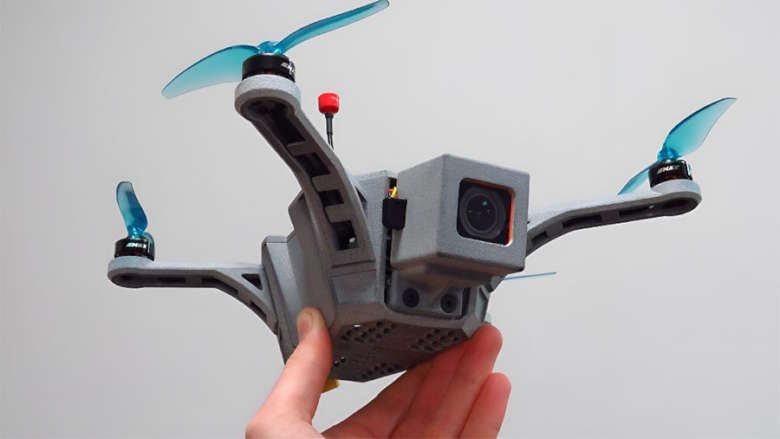
This drone camera housing was printed. Photo courtesy Stratasys
AEM: What type of production equipment are drone manufacturers looking for today?
Ferguson: Manufacturers require industrial-grade systems that deliver consistent quality from prototype to full production without retooling. Multi-technology capabilities include large-format FDM printing for airframes, precision DLP technology for intricate internal components, and SAF systems for high-volume production runs.
AEM: What are some of the challenges involved in mass-producing drones?
Ferguson: Mass-producing drones requires balancing weight against strength while meeting strict aerospace certification standards. Additive manufacturing directly addresses these challenges by reducing component weight while preserving strength. The ability to consolidate dozens of traditionally assembled parts into single printed components eliminates fasteners, cuts weight, and accelerates assembly, while repeatable processes provide the full traceability that defense and commercial applications demand.

Additive manufacturing technology was used to produce this drone wing, which features a honeycomb structure to reduce weight. Photo courtesy Stratasys
AEM: How does additive manufacturing help drone manufacturers move from low-rate initial production to scalable manufacturing without retooling their factories?
Ferguson: Additive manufacturing removes the biggest obstacle to scaling: production tooling. The same system used to create the prototype can also produce the final part. Design changes happen in software and can be implemented in minutes or hours, rather than requiring expensive molds that take months to produce and ship. Whether a company needs 10 drones or 10,000, the same production process is used. This means manufacturers can respond immediately to urgent defense or commercial demands and customize each unit for specific mission profiles. They can replicate production capabilities at multiple locations or even deploy mobile manufacturing units without duplicating tooling infrastructure.

The military uses additive manufacturing technology to scale drone production. Photo courtesy U.S. Army DEVCOM Army Research Laboratory
AEM: How does additive manufacturing help drone manufacturers mass-produce lighter, stronger and more integrated drone structures to improve range and payload efficiency?
Ferguson: Software empowers engineers to create new designs, evaluate part strength, and test final output for inconsistencies. For example, internal lattice structures can deliver strength precisely where it’s needed while minimizing weight everywhere else. We’re printing complete fuselage sections as single parts, replacing the traditional approach of assembling dozens of components that require fasteners and introduce potential failure points.
Multimaterial printing enables precise material placement — rigid structures for load bearing, flexible materials for vibration dampening, and conductive materials for integrated electronics — all in one build. With faster printing heads, larger build platforms, and post-processing machining where necessary, you have a final product completed all on one floor. Additive manufacturing can produce drones that fly longer, carry more payload, and perform better, while being manufactured more quickly and cost-effectively than traditional methods.
AEM: What type of drone components are typically made with additive manufacturing technology?
Ferguson: Nearly every drone component benefits from additive manufacturing. Manufacturers can produce complete airframes and fuselages as single parts, composite rotor blades optimized for efficiency, lightweight battery housings with integrated mounting features, and custom sensor enclosures for cameras, lidar, and thermal imaging. Internal structural components, mounting brackets for mission-specific payloads, antenna housings, and even the jigs and fixtures used to assemble drones are increasingly 3D printed.

Drones are widely used for agricultural applications ranging from crop surveillance to spraying. Photo courtesy Michigan State University
AEM: What type of additive manufacturing equipment is typically used by drone manufacturers? Has Stratasys developed any equipment specifically for drone production?
Ferguson: Drone manufacturers use a range of Stratasys technologies, including the Fortus F3300 and F900, Fortus 450mc, H350 SAF, P3 DLP, and Fortus FDC material delivery. While we haven’t built a drone-specific machine, we’ve developed and validated materials specifically for aerospace applications that are ideal for UAV production. Our comprehensive approach combines validated materials with documented certification pathways, GrabCAD software for traceability, Stratasys Direct Manufacturing services, and deep aerospace expertise — giving drone manufacturers everything they need to move forward confidently, regardless of their production stage or design requirements.
