



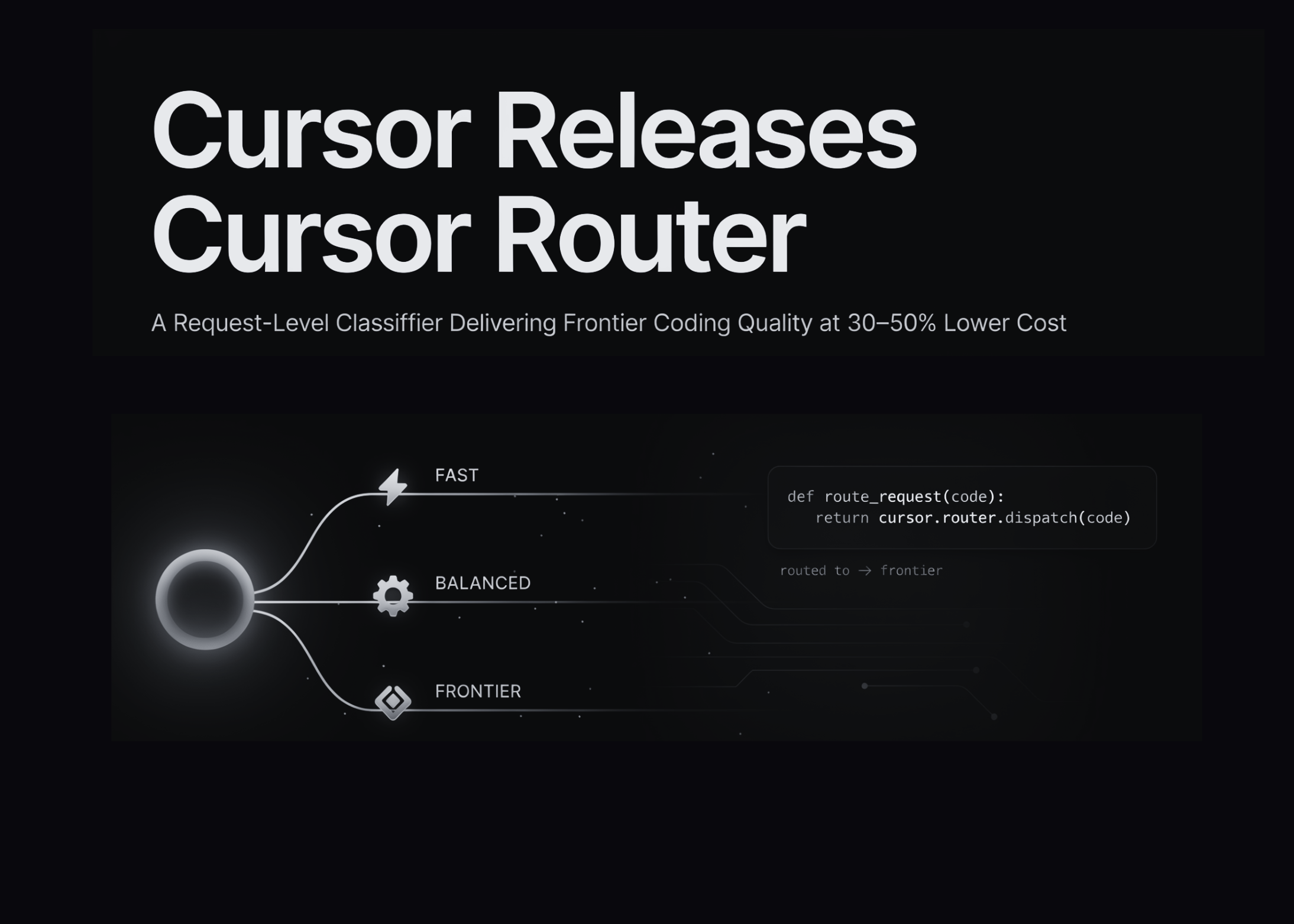
## Understanding Cursor Router: A Technical Overview
Modern AI development platforms face a fundamental challenge: how to balance cost-efficiency with model capability. Cursor has addressed this challenge with the introduction of Cursor Router, a system designed to optimize AI spending while maintaining or improving output quality. This article explores how Cursor Router works, its technical specifications, and the implications for development teams.
### The Core Problem: Spend Pattern Mismatch
Cursor identifies a significant disconnect between how developers use AI models and how those models are priced. According to their research, approximately **60% of developers select a single model as their daily driver**, which means routine work gets processed at frontier pricing levels. This pattern leads to AI spend growing faster than output quality, creating an inefficient cost structure.
The solution isn’t about finding more capable models—it’s about ensuring each task gets routed to the most appropriate model for its specific requirements.
### How Cursor Router Works
**Cursor Router** functions as a classifier system rather than a simple fallback mechanism or retry strategy. It’s trained on **600,000+ live requests** and evaluated through online A/B testing across millions of requests, with user satisfaction (AFC) serving as the primary reward signal.
#### Key Input Factors
For each request, the router analyzes four critical inputs:
– **Query**: The actual request or instruction
– **Context**: The broader conversation history and environment
– **Task Complexity**: The inherent difficulty and requirements of the task
– **Domain**: The specific area or subject matter being addressed
These inputs are combined with learned knowledge about each model’s behavioral characteristics to determine the optimal routing decision.
#### Three Routing Rules
Based on this analysis, Cursor implements three primary routing rules:
1. **Simple work** → Directed to the most price-efficient models
2. **UI updates** → Handled by the model with the best “taste” or interface understanding
3. **Complex, long-horizon problems** → Assigned to frontier reasoning models
The third rule is particularly significant for cost management—it ensures that difficult problems remain at the frontier pricing tier while routine work is efficiently routed away from expensive models.
### Technical Considerations
One crucial detail often overlooked in routing implementations is **cache awareness**. Cursor Router is explicitly designed to be cache-aware during both training and evaluation. This means:
– The system is trained on datasets where routing decisions cause cache misses
– Reported cost savings include the actual cost of these cache misses
– Switching models mid-conversation invalidates prompt cache, which has real costs
– Many routers overstate their savings by ignoring this factor
Additionally, the router is designed to handle **model churn**—Cursor can update the routing logic as newer models are released, which is essential in a market where frontier models evolve monthly.
### Evaluation Methodology
Unlike many systems that rely on offline evaluations, Cursor uses **online A/B testing** as its primary measurement approach. This methodology was chosen because:
– Offline evals suffer from small sample sizes
– They’re disconnected from real-world usage patterns
– Success is difficult to reduce to a rubric
– They omit cache-miss costs from model switching
#### Quality Metrics
The evaluation focuses on two primary metrics:
1. **User Satisfaction**: Agent success classified from user responses
– Moving to the next feature represents a strong positive signal
– Correcting the agent represents a strong negative signal
2. **Keep Rate**: How much agent-generated code remains in the codebase over time
These metrics have been tracked across model launches and harness improvements for nine months, providing a credible baseline for evaluation.
### Deployment Modes and Performance
Auto mode now exposes three optimization settings that position users along the cost-intelligence Pareto frontier:
#### 1. Auto Intelligence
– Near Fable performance on user satisfaction
– Approximately 60% cost savings for teams
– Against Opus 4.8: 15% satisfaction improvement at nearly equal cost
#### 2. Auto Balance
– Superior user satisfaction compared to Opus 4.8
– Approximately 36% lower cost
– Comparable satisfaction to GPT-5.6 Sol at lower spend rates
#### 3. Cost Mode
– Optimized for highest intelligence at lowest token spend
– No published A/B quality or cost figures available
#### Cost Per Commit Analysis
| Model/Mode | Cost Per Commit |
|————|—————–|
| Auto Balance | $4.63 |
| Auto Intelligence | $6.76 |
| Opus 4.8 | $7.34 |
| Fable 5 | $12.69 |
Notably, GPT-5.6 Sol matched Intelligence mode’s cost but produced lower user satisfaction, and no exact per-commit figure was published for it.
### Platform Integration
Cursor Router operates across multiple platforms and surfaces:
– **Desktop** applications
– **Web** interfaces
– **iOS** devices
– **CLI** environments
– **Cursor SDK** integrations
### Implementation Requirements
Organizations looking to implement Cursor Router should note:
– **Plan Requirements**: Available on Teams and Enterprise plans only; not available for Individual (Pro/Ultra) users
– **Model Requirements**: Grok 4.5 is required as a price-efficient routing option
– **Entry Point**: Auto mode in the model picker, powered by Cursor Router
– **Billing Considerations**: Balance and Intelligence modes bill at the routed model’s rate; Cost mode billing methodology not explicitly stated
– **Default Configuration**: On by default for Teams; Enterprise admins must enable it
– **Transparency**: The routed model is hidden by default; admins can make it visible
### Measurable Impact
The deployment shows significant financial impact:
– **30-50% savings** for three high-volume early-access accounts compared to routing everything to Opus 4.8
– **60% savings** at frontier-quality performance across millions of online A/B test requests
These savings are real but depend heavily on task mix and implementation specifics.
### Conclusion
Cursor Router represents a sophisticated approach to AI model management that addresses the critical gap between capability and cost. By intelligently routing requests based on task complexity, domain requirements, and context, it enables development teams to maintain high satisfaction levels while significantly reducing AI infrastructure costs.
The system’s technical sophistication—particularly its cache-awareness and online evaluation methodology—demonstrates a deep understanding of real-world AI development workflows. As organizations continue to integrate AI into their development processes, routing systems like Cursor’s will likely become essential infrastructure for managing the complex tradeoffs between capability, cost, and user satisfaction.
The measurable 30-60% savings without quality degradation suggests that intelligent routing may be one of the most immediately impactful optimizations for AI-powered development workflows.
