



# OpenAI Unveils Major Workspace Overhaul at Annual Developer Conference: What You Need to Know
OpenAI has unveiled a sweeping set of tools designed to transform how teams work with artificial intelligence, signaling a bold pivot toward becoming a full-fledged productivity platform. The announcements, made at the company’s fourth annual developer gathering, introduce features that blur the line between chatbot and collaborative workspace — and raise the stakes in the rapidly intensifying AI rivalry with competitors like Anthropic and Google.
## A New Collaborative Hub: ChatGPT Space
The centerpiece of the event is **ChatGPT Space**, described as a dedicated environment where teams can collaborate with AI to complete tasks in a unified setting. Think of it as a shared digital office where ChatGPT acts as both an assistant and a teammate. Users on Pro, Business, and Enterprise tiers can begin using Space immediately through the desktop app and web interface, with mobile access expected to follow soon.
Space also introduces **Dots**, an agentic feature that operates as an autonomous assistant capable of carrying out tasks within the workspace. Dots can be tagged in comments, assigned feedback from colleagues, and iterated upon alongside human team members — all within a single interface. This agentic workflow represents a significant step forward from the traditional back-and-forth of prompting and editing, allowing users to delegate tasks more naturally.
## Documents and Presentations, Reinvented
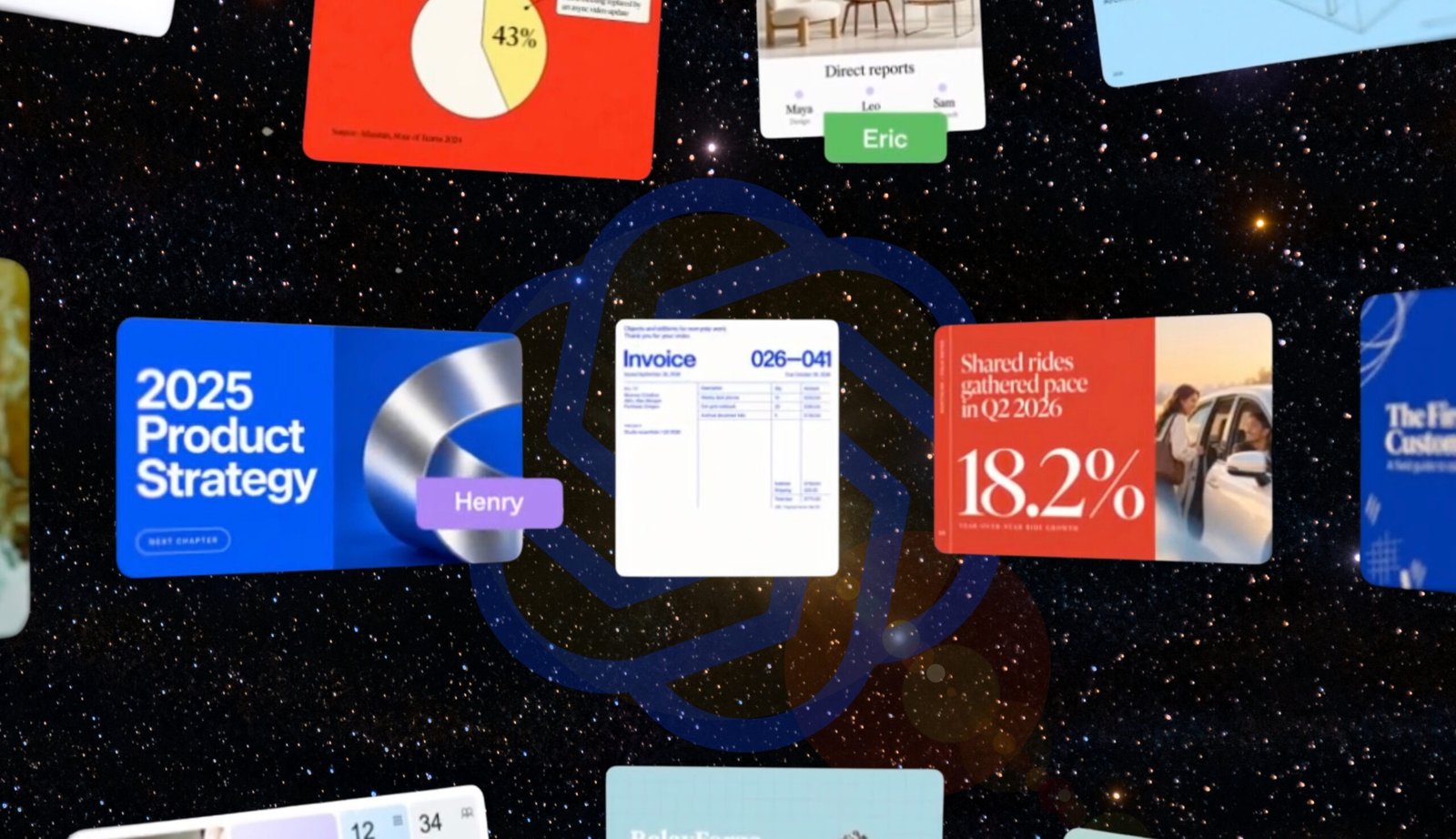
Alongside Space, OpenAI launched two new content-creation tools: **Pages** and collaborative **slides**. Pages are designed as a native format within ChatGPT, enabling users to draft documents that AI can both read and generate. The experience has been compared to a Notion-style workspace, where research, graphics, images, and text come together seamlessly with human and AI input.
The slides feature, arriving in the coming weeks, extends this philosophy to presentations. Users can build interactive slides collaboratively, leveraging ChatGPT’s generative abilities to design layouts, create visuals, and incorporate on-page research. The tool supports conversational building, custom template imports, and simultaneous multi-user editing — much like Google Slides or Microsoft PowerPoint. Notably, presentations created in ChatGPT can be exported to both PowerPoint and Google formats without losing formatting, a detail that signals genuine attention to interoperability.
## Private Intelligence: Security for Enterprise Adoption
One of the most persistent barriers to enterprise AI adoption has been data security. Concerns about sensitive information being exposed to AI models or the companies behind them have made decision-makers cautious. OpenAI addressed this head-on with **Private Intelligence**, a data access approval framework that gives enterprise customers enhanced confidence about how their data is handled.
The platform features **Zero Data Retention with Private Safety Processing**, which enables automated safety reviews without allowing OpenAI personnel access to the raw content. Additionally, OpenAI teased **Private Inference**, a capability leveraging confidential computing with strict, verifiable controls, scheduled for release in the fall. While details on how Private Intelligence and Private Inference differ remain limited, the branding evokes comparisons to Apple’s Private Cloud Compute, suggesting OpenAI wants enterprises to feel they can access cutting-edge AI models without compromising on data privacy.
## Following the Anthropic Playbook
OpenAI’s latest moves bear a striking resemblance to strategies employed by rival Anthropic, which consolidated its tools under the Claude umbrella to create a more cohesive agentic experience. Anthropic’s **Claude Docs**, **Claude Design**, and **Claude Slides** are all housed within Claude Cowork, creating what amounts to a one-stop workplace suite.
OpenAI appears to be taking a similar approach. ChatGPT Work, introduced earlier this year as a direct competitor to Claude Cowork, carved out a niche for non-coding workplace tasks. The new Space, Pages, and slides features extend that vision into a full collaborative environment where document creation, presentation design, and agent-driven workflows all converge in one place. Sam Altman himself discussed Space, Pages, slides, and Dots during the keynote, framing them as interconnected components of a new system — though he stopped short of explicitly positioning ChatGPT as a direct Workspace competitor.
## Why This Matters Now
OpenAI’s timing is notable. After launching and then discontinuing its consumer video generation tool Sora, and after Anthroc grabbed significant enterprise revenue with its Cowork suite, OpenAI seems to be accelerating its push into the productivity space. The company’s recent releases — including ChatGPT Work and now Space with its full suite of collaborative tools — suggest a deliberate strategy to become indispensable in the modern workplace.
Whether this translates into a full productivity suite remains to be seen. OpenAI representatives have carefully avoided claiming that position directly, but the trajectory is clear: the company is building tools that make ChatGPT not just an AI chatbot, but the place where teams create, collaborate, and iterate — all with the help of intelligent agents.
—
## Frequently Asked Questions
**Q: What is ChatGPT Space?**
A: ChatGPT Space is a collaborative workspace where teams can work with ChatGPT and autonomous agents called Dots to complete tasks together in a unified environment. It supports real-time collaboration between humans and AI, and is available on desktop and web for Pro, Business, and Enterprise users.
**Q: What are Dots?**
A: Dots are agentic assistants within ChatGPT Space that can be assigned tasks, receive feedback, and work alongside human teammates. They function similarly to autonomous AI agents and can be tagged in comments or workspace discussions to carry out specific actions.
**Q: How do Pages and slides differ from traditional document and presentation tools?**
A: Pages and slides are built natively inside ChatGPT, meaning users can research, write, design, and collaborate without leaving the platform. They support conversational creation, on-page research, AI-generated graphics and images, and simultaneous multi-user editing. Slides can be exported to PowerPoint and Google formats without losing formatting.
**Q: What is Private Intelligence?**
A: Private Intelligence is OpenAI’s enterprise data security framework that includes zero data retention, private safety processing, and planned confidential computing capabilities. It is designed to give businesses confidence that their sensitive data will not be exposed to OpenAI personnel or stored by the company.
**Q: When will Private Inference be available?**
A: Private Inference, which combines confidential computing with verifiable controls, is expected to launch in the fall. OpenAI has not yet disclosed detailed technical specifications or pricing for this feature.
**Q: How does OpenAI’s approach compare to Anthropic’s Claude tools?**
A: Both companies are converging on a similar strategy: consolidating AI capabilities — document creation, presentation design, and agentic task execution — into a single collaborative workspace. Anthropic’s Claude Cowork and OpenAI’s ChatGPT Space serve a similar purpose, though each company has taken a slightly different branding and architectural approach.
**Q: Is mobile access available for ChatGPT Space?**
A: Mobile access is currently in development. Pro, Business, and Enterprise users can access Space on the desktop app and web for now.
**Q: What subscription tiers support these new features?**
A: ChatGPT Space, Pages, collaborative slides, Dots, and Private Intelligence are all available to users on Pro, Business, and Enterprise plans.
—
## Conclusion
OpenAI’s fourth annual developer conference delivered a clear message: the company is serious about becoming a productivity platform, not just an AI chatbot. With ChatGPT Space, Pages, collaborative slides, Dots, and Private Intelligence, OpenAI is assembling a toolkit that could fundamentally change how teams collaborate — placing AI at the center of document creation, presentation design, and day-to-day workflows.
The parallels to Anthropic’s strategy are hard to ignore, and the competitive implications are significant. As both companies race to build the most comprehensive AI-powered workplace, users stand to benefit from rapid innovation, tighter integrations, and increasingly sophisticated agentic capabilities. The real question now is whether OpenAI can execute on this vision quickly enough to capture the enterprise market before its competitors solidify their positions.
One thing is certain: the line between chatbot and workspace is disappearing — and that change is only just beginning.
Thank you for reading
