



**The Dawn of Versatile Humanoid Surgeons: A New Era in Robotic Surgery**
In a groundbreaking development that reads like science fiction, a team of researchers has successfully used teleoperated humanoid robots to perform complex surgical procedures. This landmark achievement, detailed in a recent study, marks a significant step toward revolutionizing surgical care and addressing global healthcare disparities.
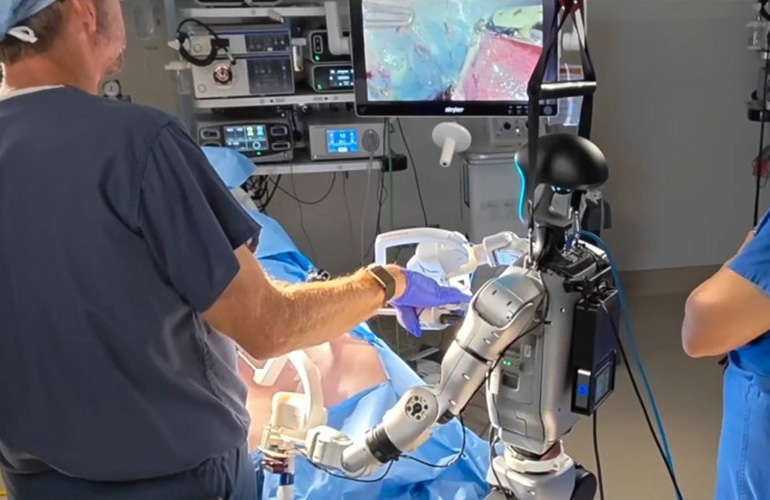
The pioneering work was conducted by researchers at the University of California San Diego. In a series of preclinical trials on large non-primate mammals, they achieved two major firsts. In the first procedure, a single humanoid robot worked in tandem with a human surgeon, who acted as an assistant, to successfully perform a gallbladder removal. In the second, two humanoid robots operated side-by-side in a coordinated, robot-to-robot team to complete an identical surgery.
The ultimate goal of this research is to introduce highly adaptable humanoid robots into operating rooms. Unlike current dedicated surgical platforms, which are large, expensive, and limited to specific tasks, humanoid robots offer the promise of versatility. They are envisioned as general-purpose surgical assistants that could one day perform a wide array of procedures, from routine gallbladder removals to complex, unforeseen emergencies.
“The procedure that we actually carried out was called colocystectomies,” explained Dr. Michael Yip, a senior author of the study. “This is one of the most common procedures done for general surgery, where you’re removing the gallbladder. It’s common, but it’s also challenging to do because you need dexterous instruments.” The success of such intricate tasks using a humanoid platform is a powerful indicator of the technology’s potential.
**Expanding Access to Critical Care**
A primary driver for this research is the global crisis in surgical access. Current robotic surgical systems, while effective, are often cost-prohibitive and require the construction of specialized operating rooms. This creates a significant barrier, particularly in rural areas, battlefield settings, or developing nations. Humanoid robots could dramatically change this equation.
“Remotely operated and autonomous humanoid robots have real potential for amplifying access to critical surgeries to which patients would otherwise not have access,” said Dr. Yip. “This can help address the healthcare crisis not only in the United States, but also worldwide.”
Dr. Shanglei Liu, another senior author and assistant professor of surgery at UC San Diego, who teleoperated the robots during the trials, echoed this sentiment. “A procedure performed by a teleoperated humanoid robot is just as precise as one performed with a teleoperated surgical robotic system,” he stated. “It’s a fraction of the cost, and it takes a fraction of the space in an operating room. So it’s easy to deploy, anywhere from rural areas to the battlefield, and even to space.”
**Overcoming Technical Hurdles**
The path to fully autonomous humanoid surgical assistants is not without challenges. During the trials, the robots required recalibration multiple times, making the procedures longer than those performed with mature, specialized systems. However, the researchers note that this is a common hurdle for new technologies and is expected to improve with further development and refinement.
Another significant challenge is the robot’s physical design. The humanoid form, while versatile, is not yet as optimized for surgery as a dedicated system like the da Vinci robot.
“What we learned very quickly was that the G1, because of its small stature, its arms don’t move around as much. And so when you’re doing surgery with manual tools, it turns out you need a lot of range,” Dr. Yip explained. Surgeons had to frequently maneuver around the patient, a task that highlighted the need for greater mobility and reach in future models. Despite these limitations, the robots proved accurate enough to complete the entire complex procedure.
Looking forward, the research team envisions a future where humanoid robots are more than just surgical tools. Their ability to walk and manipulate objects could allow them to fetch instruments for surgeons or even clean up the operating room after a procedure is complete.
The researchers stress that this success was a direct result of a deep collaboration between engineers and surgeons. The work paves the way for an operating room of the future—one where humanoid robots and human medical professionals work as an integrated team to deliver life-saving care to patients in any setting, anywhere in the world.
***
*Original Article Source:*
Beyond da Vinci: Why versatile humanoid robots are the next frontier in surgery. (2026, July 15). *The Robot Report*. Retrieved from https://www.therobotreport.com/beyond-da-vinci-why-versatile-humanoid-robots-are-next-frontier-surgery/
