



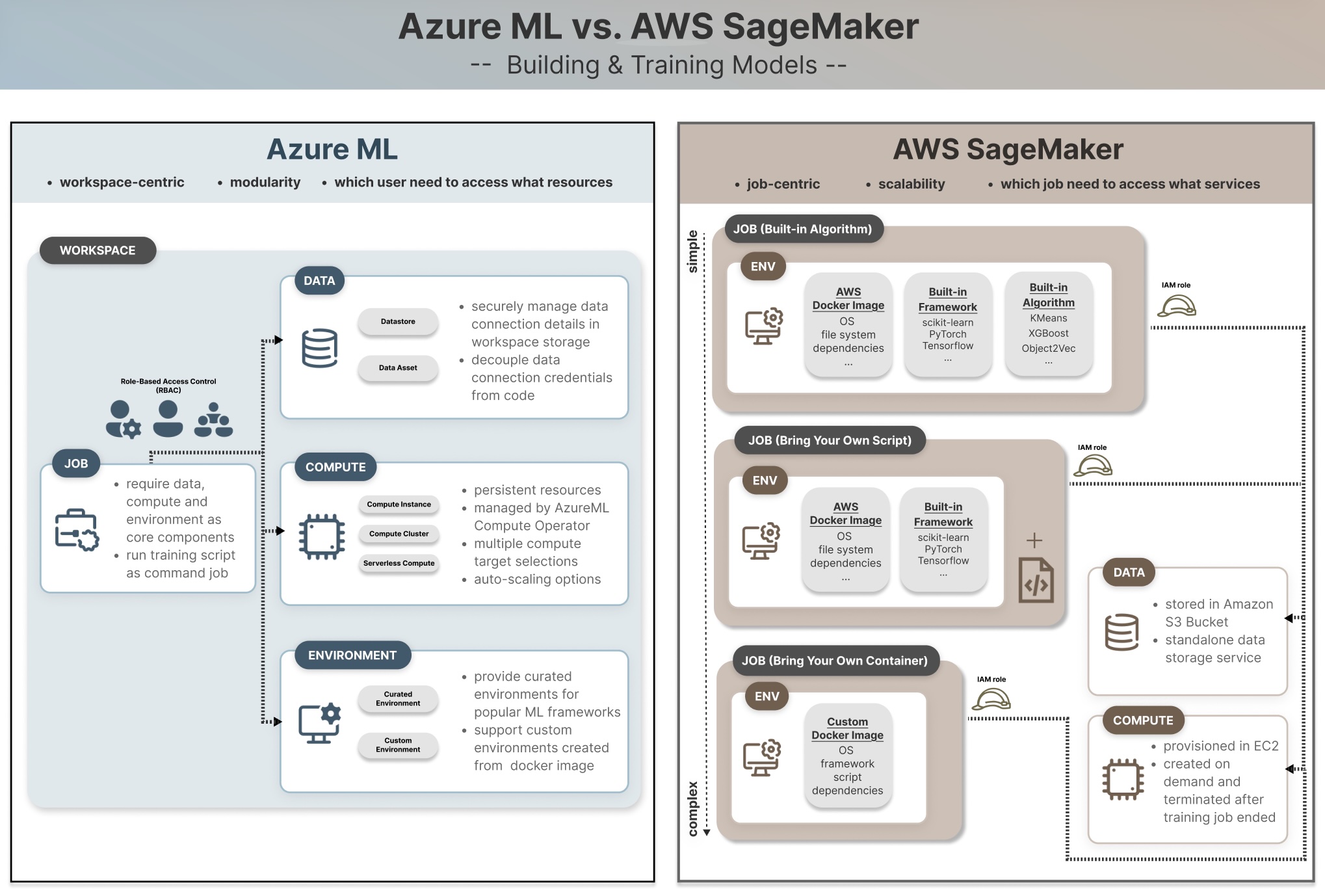
In Half 1 of this collection, how Azure and AWS take basically totally different approaches to machine studying mission administration and information storage.
Azure ML makes use of a workspace-centric construction with user-level role-based entry management (RBAC), the place permissions are granted to people primarily based on their obligations. In distinction, AWS SageMaker adopts a job-centric structure that decouples person permissions from job execution, granting entry on the job degree by IAM roles. For information storage, Azure ML depends on datastores and information property inside workspaces to handle connections and credentials behind the scenes, whereas AWS SageMaker integrates immediately with S3 buckets, requiring specific permission grants for SageMaker execution roles to entry information.
Discover out extra on this article:
Having established how these platforms deal with mission setup and information entry, in Half 2, we’ll study the compute sources and runtime environments that energy the mannequin coaching jobs.
Compute
Compute is the digital machine the place your mannequin and code run. Together with community and storage, it is among the basic constructing blocks of cloud computing. Compute sources usually symbolize the biggest value part of an ML mission, as coaching fashions—particularly massive AI fashions—requires lengthy coaching occasions and infrequently specialised compute situations (e.g., GPU situations) with larger prices. Due to this fact, Azure ML designs a devoted AzureML Compute Operator position (see particulars in Half 1) for managing compute sources.
Azure and AWS provide numerous occasion varieties that differ within the variety of CPUs/GPUs, reminiscence, disk area and kind, every designed for particular functions. Each platforms use a pay-as-you-go pricing mannequin, charging just for energetic compute time.
Azure digital machine collection are named in alphabetic order; as an example, D household VMs are designed for general-purpose workloads and meet the necessities for many improvement and manufacturing environments. AWS compute situations are additionally grouped into households primarily based on their function; as an example, the m5 household accommodates general-purpose situations for SageMaker ML improvement. The desk under compares compute situations supplied by Azure and AWS primarily based on their function, hourly pricing and typical use instances. (Please observe that the pricing construction varies by area and plan, so I like to recommend testing their official web sites.)
Now that we’ve in contrast compute pricing in AWS and Azure, let’s discover how the 2 platforms differ in integrating compute sources into ML methods.
Azure ML

Computes are persistent sources within the Azure ML Workspace, usually created as soon as by the AzureML Compute Operator and reused by the information science crew. Since compute sources are cost-intensive, this construction permits them to be centrally managed by a task with cloud infrastructure experience, whereas information scientists and engineers can give attention to improvement work.
Azure presents a spectrum of compute goal choices designated for ML improvement and deployment, relying on the dimensions of the workload. A compute occasion is a single-node machine appropriate for interactive improvement and testing within the Jupyter pocket book setting. A compute cluster is one other sort of compute goal that spins up multi-node cluster machines. It may be scaled for parallel processing primarily based on workload demand and helps auto-scaling by configuring the parameter min_instances and max_instances. Moreover, there are severless compute, Kubernetes clusters, and containers which can be match for various functions. Here’s a helpful visible abstract that helps you make the choice primarily based in your use case.
”](https://contributor.insightmediagroup.io/wp-content/uploads/2026/02/image-2-1024x477.png "image from “[Explore and configure the Azure Machine Learning workspace DP-100](https://www.youtube.com/watch?v=_f5dlIvI5LQ)”")
To create an Azure ML managed compute goal we create an AmlCompute object utilizing the code under:
sort: use"amlcompute"for compute cluster. Alternatively, use"computeinstance"for single-node interactive improvement and“kubernetes"for AKS clusters.identify: specify the compute goal identify.dimension: specify the occasion dimension.min_instancesandmax_instances(optionally available): set the vary of situations allowed to run concurrently.idle_time_before_scale_down(optionally available): robotically shut down the compute cluster when idle to keep away from incurring pointless prices.
# Create a compute cluster
cpu_cluster = AmlCompute(
    identify="cpu-cluster",
    sort="amlcompute",
    dimension="Standard_DS3_v2",
    min_instances=0,
    max_instances=4,
    idle_time_before_scale_down=120
)

# Create or replace the compute
ml_client.compute.begin_create_or_update(cpu_cluster)
As soon as the compute useful resource is created, anybody within the shared Workspace can use it by merely referencing its identify in an ML job, making it simply accessible for crew collaboration.
# Use the continued compute "cpu-cluster" within the job
job = command(
    code='./src',
    command='python code.py',
    compute='cpu-cluster',
    display_name='train-custom-env',
    experiment_name='coaching'
)
AWS SageMaker AI

Compute sources are managed by a standalone AWS service – EC2 (Elastic Compute Cloud). When utilizing these compute sources in SageMaker, it require builders to explicitly configure the occasion sort for every job, then compute situations are created on-demand and terminated when the job finishes. This method offers builders extra flexibility over compute choice primarily based on job, however requires extra infrastructure information to pick and handle the suitable compute useful resource. For instance, accessible occasion varieties differ by job sort. ml.t3.medium and ml.t3.massive are generally used for powering SageMaker notebooks in interactive improvement environments, however they don’t seem to be accessible for coaching jobs, which require extra highly effective occasion varieties from the m5, c5, p3, or g4dn households.
As proven within the code snippet under, AWS SageMaker specifies the compute occasion and the variety of situations operating concurrently as job parameters. A compute occasion with the ml.m5.xlarge sort is created throughout job execution and charged primarily based on the job runtime.
estimator = Estimator(
    image_uri=image_uri,
    position=position,
    instance_type="ml.m5.xlarge",
    instance_count=1
)
SageMaker jobs spin up on-demand situations by default. They’re charged by seconds and supplies assured capability for operating time-sensitive jobs. For jobs that may tolerate interruptions and better latency, spot occasion is a extra cost-saving possibility that makes use of unused compute situations. The draw back is the extra ready interval when there aren’t any accessible spot situations. We use the code snippet under to implement a spot occasion possibility for a coaching job.
use_spot_instances: set asTrueto make use of spot situations, in any other case default to on-demandmax_wait: the utmost period of time you’re keen to attend for accessible spot situations (ready time will not be charged)max_run: the utmost quantity of coaching time allowed for the jobcheckpoint_s3_uri: the S3 bucket URI path to save lots of mannequin checkpoints, in order that coaching can safely restart after ready
estimator = Estimator(
    image_uri=image_uri,
    position=position,
    instance_type="ml.m5.xlarge",
    instance_count=1,
    use_spot_instances=True,
    max_run=3600,
    max_wait=7200,
    checkpoint_s3_uri=""
)
What does this imply in follow?
- Azure ML: Azure’s persistent compute method permits centralized administration and sharing throughout a number of builders, permitting information scientists to give attention to mannequin improvement reasonably than infrastructure administration.
- AWS SageMaker AI: SageMaker requires builders to explicitly outline compute occasion sort for every job, offering extra flexibility but additionally demanding deeper infrastructure information of occasion varieties, prices and availability constraints.
Reference
Surroundings
Surroundings defines the place the code or job is run, together with software program, working system, program packages, docker picture and setting variables. Whereas compute is chargeable for the underlying infrastructure and {hardware} choices, setting setup is essential in making certain constant and reproducible behaviors throughout improvement and manufacturing setting, mitigating bundle conflicts and dependency points when executing the identical code in several runtime setup by totally different builders. Azure ML and SageMaker each assist utilizing their curated environments and organising {custom} environments.
Azure ML
Much like Knowledge and Compute, Surroundings is taken into account a sort of useful resource and asset within the Azure ML Workspace. Azure ML presents a complete listing of curated environments for widespread python frameworks (e.g. PyTorch, Tensorflow, scikit-learn) designed for CPU or GPU/CUDA goal.
The code snippet under helps to retrieve the listing of all curated environments in Azure ML. They typically observe a naming conference that features the framework identify, model, working system, Python model, and compute goal (CPU/GPU), e.g.AzureML-sklearn-1.0-ubuntu20.04-py38-cpu signifies scikit-learn model 1.0, operating on Ubuntu 20.04 with Python 3.8 for CPU compute.
envs = ml_client.environments.listing()
for env in envs:
    print(env.identify)


# >>> Auzre ML Curated Environments
"""
AzureML-AI-Studio-Growth
AzureML-ACPT-pytorch-1.13-py38-cuda11.7-gpu
AzureML-ACPT-pytorch-1.12-py38-cuda11.6-gpu
AzureML-ACPT-pytorch-1.12-py39-cuda11.6-gpu
AzureML-ACPT-pytorch-1.11-py38-cuda11.5-gpu
AzureML-ACPT-pytorch-1.11-py38-cuda11.3-gpu
AzureML-responsibleai-0.21-ubuntu20.04-py38-cpu
AzureML-responsibleai-0.20-ubuntu20.04-py38-cpu
AzureML-tensorflow-2.5-ubuntu20.04-py38-cuda11-gpu
AzureML-tensorflow-2.6-ubuntu20.04-py38-cuda11-gpu
AzureML-tensorflow-2.7-ubuntu20.04-py38-cuda11-gpu
AzureML-sklearn-1.0-ubuntu20.04-py38-cpu
AzureML-pytorch-1.10-ubuntu18.04-py38-cuda11-gpu
AzureML-pytorch-1.9-ubuntu18.04-py37-cuda11-gpu
AzureML-pytorch-1.8-ubuntu18.04-py37-cuda11-gpu
AzureML-sklearn-0.24-ubuntu18.04-py37-cpu
AzureML-lightgbm-3.2-ubuntu18.04-py37-cpu
AzureML-pytorch-1.7-ubuntu18.04-py37-cuda11-gpu
AzureML-tensorflow-2.4-ubuntu18.04-py37-cuda11-gpu
AzureML-Triton
AzureML-Designer-Rating
AzureML-VowpalWabbit-8.8.0
AzureML-PyTorch-1.3-CPU
"""
To run the coaching job in a curated setting, we create an setting object by referencing its identify and model, then passing it as a job parameter.
# Get an curated Surroundings
setting = ml_client.environments.get("AzureML-sklearn-1.0-ubuntu20.04-py38-cpu", model=44)

# Use the curated setting in Job
job = command(
    code=".",
    command="python train.py",
    setting=setting,
    compute="cpu-cluster"
)

ml_client.jobs.create_or_update(job)
Alternatively, create a {custom} setting from a Docker picture registered in Docker Hob utilizing the code snippet under.
# Get an curated Surroundings
setting = ml_client.environments.get("AzureML-sklearn-1.0-ubuntu20.04-py38-cpu", model=44)

# Use the curated setting in Job
job = command(
    code=".",
    command="python train.py",
    setting=setting,
    compute="cpu-cluster"
)

ml_client.jobs.create_or_update(job)
AWS SageMaker AI
SageMaker’s setting configuration is tightly coupled with job definitions, providing three ranges of customization to determine the OS, frameworks and packages required for job execution. These are Constructed-in Algorithm, Convey Your Personal Script (Script mode) and Convey Your Personal Container (BYOC), starting from the simplest but inflexible choice to probably the most advanced but customizable possibility.
Constructed-in Algorithms

That is the choice with the least quantity of effort for builders to coach and deploy machine studying fashions at scale in AWS SageMaker and Azure presently doesn’t provide an equal built-in algorithm method utilizing Python SDK as of February 2026.
SageMaker encapsulates the machine studying algorithm, in addition to its python library and framework dependencies inside an estimator object. For instance, right here we instantiate a KMeans estimator by specifying the algorithm-specific hyperparameter ok and passing the coaching information to suit the mannequin. Then the coaching job will spin up a ml.m5.massive compute occasion and the skilled mannequin will likely be saved within the output location.
Convey Your Personal Script

The deliver your personal script method (also called script mode or deliver your personal mannequin) permits builders to leverage SageMaker’s prebuilt containers for widespread python frameworks for machine studying like scikit-learn, PyTorch and Tensorflow. It supplies the pliability of customizing the coaching job by your personal script with out the necessity of managing the job execution setting, making it the preferred selection when utilizing specialised algorithms not included in SageMaker’s built-in choices.
Within the instance under, we instantiate an estimator utilizing the scikit-learn framework by offering a {custom} coaching script practice.py, the mannequin’s hyperparameters, together with the framework model and python model.
from sagemaker.sklearn import SKLearn

sk_estimator = SKLearn(
    entry_point="train.py",
    position=position,
    instance_count=1,
    instance_type="ml.m5.large",
    py_version="py3",
    framework_version="1.2-1",
    script_mode=True,
    hyperparameters={"estimators": 20},
)

# Practice the estimator
sk_estimator.match({"train": training_data})
Convey Your Personal Container
That is the method with the very best degree of customization, which permits builders to deliver a {custom} setting utilizing a Docker picture. It fits situations that depend on unsupported python frameworks, specialised packages, or different programming languages (e.g. R, Java and so forth). The workflow entails constructing a Docker picture that accommodates all required bundle dependencies and mannequin coaching scripts, then push it to Elastic Container Registry (ECR), which is AWS’s container registry service equal to Docker Hub.
Within the code under, we specify the {custom} docker picture URI as a parameter to create the estimator and match the estimator with coaching information.
from sagemaker.estimator import Estimator
image_uri = ":"
byoc_estimator = Estimator(
image_uri=image_uri,
position=position,
instance_count=1,
instance_type="ml.m5.large",
output_path=" What does it imply in follow?
- Azure ML: Gives assist for operating coaching jobs utilizing its intensive assortment of curated environments that cowl widespread frameworks comparable to PyTorch, TensorFlow, and scikit-learn, in addition to providing the aptitude to construct and configure {custom} environments from Docker photos for extra specialised use instances. Nonetheless, you will need to observe that Azure ML doesn’t presently provide the built-in algorithm method that encapsulates and packages widespread machine studying algorithms immediately into the setting in the identical method that SageMaker does.
- AWS SageMaker AI: SageMaker is understood for its three degree of customizations—Constructed-in Algorithm, Convey Your Personal Script, Convey Your Personal Container—which cowl a spectrum of builders necessities. Constructed-in Algorithm and Convey Your Personal Script use AWS’s managed environments and combine tightly with ML algorithms or frameworks. They provide simplicity however are much less appropriate for extremely specialised mannequin coaching processes.
In Abstract
Based mostly on the comparisons of Compute and Surroundings above together with what we mentioned in AWS vs. Azure: A Deep Dive into Mannequin Coaching — Half 1 (Venture Setup and Knowledge Storage), we’d have realized the 2 platforms undertake totally different design ideas to construction their machine studying ecosystems.
Azure ML follows a extra modular structure the place Knowledge, Compute, and Surroundings are handled as unbiased sources and property inside the Azure ML Workspace. Since they are often configured and managed individually, this method is extra beginner-friendly, particularly for customers with out intensive cloud computing or permission administration information. For example, an information scientist can create a coaching job by attaching an current compute within the Workspace while not having infrastructural experience to handle compute situations.
AWS SageMaker has a steeper studying curve, as a number of companies are tightly coupled and orchestrated collectively as a holistic system for ML job execution. Nonetheless, this job-centric method presents clear separation between mannequin coaching and mannequin deployment environments, in addition to the power for distributed coaching at scale. By giving builders extra infrastructure management, SageMaker is effectively fitted to large-scale information science and AI groups with excessive MLOps maturity and the necessity of CI/CD pipelines.
Take-House Message
On this collection, we evaluate the 2 hottest cloud platforms Azure and AWS for scalable mannequin coaching, breaking down the comparability into the next dimensions:
- Venture and Permission Administration
- Knowledge storage
- Compute
- Surroundings
In Half 1, we mentioned high-level mission setup and permission administration, then talked about storing and accessing the information required for mannequin coaching.
In Half 2, we examined how Azure ML’s persistent, workspace-centric compute sources differ from AWS SageMaker’s on-demand, job-specific method. Moreover, we explored setting customization choices, from Azure’s curated environments and {custom} environments to SageMaker’s three degree of customizations—Constructed-in Algorithm, Convey Your Personal Script, Convey Your Personal Container. This comparability reveals Azure ML’s modular, beginner-friendly structure vs. SageMaker’s built-in, job-centric design that provides better scalability and infrastructure management for groups with MLOps necessities.
