SAN DIEGO — For FinOps teams, artificial intelligence now represents both a significant hurdle and a promising avenue. At this year’s FinOps X conference, AWS highlighted a suite of product enhancements that directly address this dual nature.
AWS launched the AWS FinOps Agent in public preview, an AI-driven solution built to streamline cloud cost analysis, anomaly detection and reporting, while also highlighting optimization opportunities. Additionally, AWS enhanced cost transparency for Amazon Bedrock by introducing detailed attribution features, enabling businesses to monitor AI expenditures at the application, agent and user levels.
Further enhancements included fresh cost management features for optimization, forecasting and financial oversight. These updates illustrate how AWS is integrating AI into conventional FinOps workflows while simultaneously developing solutions to monitor AI-related costs.
FinOps Agent moves into public preview
AWS unveiled the AWS FinOps Agent in public preview as an AI-driven platform that examines cloud expenditures, probes anomalies and highlights optimization suggestions within engineering processes.
The agent enables AWS customers to inquire about cloud costs through everyday language, explained Bradford Lyman, AWS’s director of product management, during his keynote segment. It can spot irregularities, create tailored reports and pinpoint optimization possibilities.
The agent works alongside platforms like Jira to direct insights and suggestions straight to the teams tasked with addressing cost concerns. Customers can schedule the agent to run automatically, activate it based on particular triggers or access it whenever needed using conversational queries.
AWS FinOps Agent traces cost anomalies to their root causes.
The solution was showcased as a key component of AWS’s strategy to make FinOps more agent-centric.
“We envision FinOps as seamless, smart and self-governing,” Lyman stated during the keynote.
That said, the platform does not yet carry out infrastructure modifications or implement optimizations on its own.
Rather, the agent presents recommendations and investigation summaries, which are channeled into tools for engineering teams to act upon. Users define what the agent searches for, what organizational background it references and where it delivers its results.
The platform leverages AWS Cost Explorer, Cost Anomaly Detection, Cost Optimization Hub and Compute Optimizer, then utilizes CloudTrail activity logs to connect cost fluctuations to the AWS users or roles responsible for them.
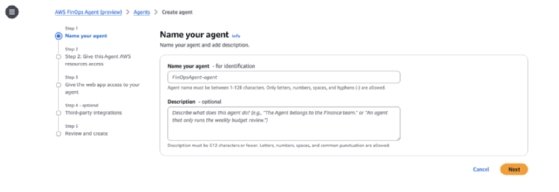
The FinOps Agent setup process includes permissions configuration, workflow integrations and organization-specific context settings.
Bedrock gets granular cost attribution for AI usage tracking
AWS also rolled out new detailed attribution features within Amazon Bedrock to assist organizations in tracking AI spending. The enhancement reveals which model was invoked and the cost tied to each session, and can link usage to particular applications, agents or users.
This is the foundation of tokenomics. Bradford LymanDirector of product management, AWS
“This is the foundation of tokenomics,” Lyman remarked during the keynote.
The cost attribution capability connects usage to identity and access management (IAM) roles or users, which then show up in AWS Cost Explorer and the AWS Cost and Usage Report.
When organizations allocate distinct IAM roles to individual applications, agents or teams, Bedrock costs can be monitored at that granularity through current cost management tools. The Cost and Usage Report also captures input and output token usage at the line-item level, allowing for deeper examination of AI consumption within existing billing records.
AWS updates cost management capabilities
AWS also rolled out enhancements across its existing tools for optimization, forecasting and financial governance.
Everywhere within our consoles, you’re able to push a button and see any kind of unexpected cost, [and] an immediate root cause investigation and analysis. Bradford LymanDirector of product management, AWS
It introduced target planning for Savings Plans, enabling organizations to establish coverage objectives directly within the AWS console and obtain recommendations that match those goals. It also launched automatic cost and forecast explanations that deliver root cause analysis for unanticipated spending and forecast shifts.
“Everywhere within our consoles, you’re able to push a button and see any kind of unexpected cost, [and] an immediate root cause investigation and analysis,” Lyman said during the keynote.
AWS also expanded the number of idle-resource recommendations offered through its optimization tools, helping customers spot unused or underperforming resources.
Additionally, the company unveiled credit-level sharing controls that allow organizations to decide which workloads and accounts benefit from cloud credits. It also broadened credit transparency with a new console dashboard that displays earned credits, remaining balances and the workloads where credits were utilized.
Tim Murphy is a site editor and writer for the IT Strategy team at TechTarget.