



# Extracting Structured Data from Text Using Named Entity Recognition and Scikit-LLM
## What Is Named Entity Recognition?
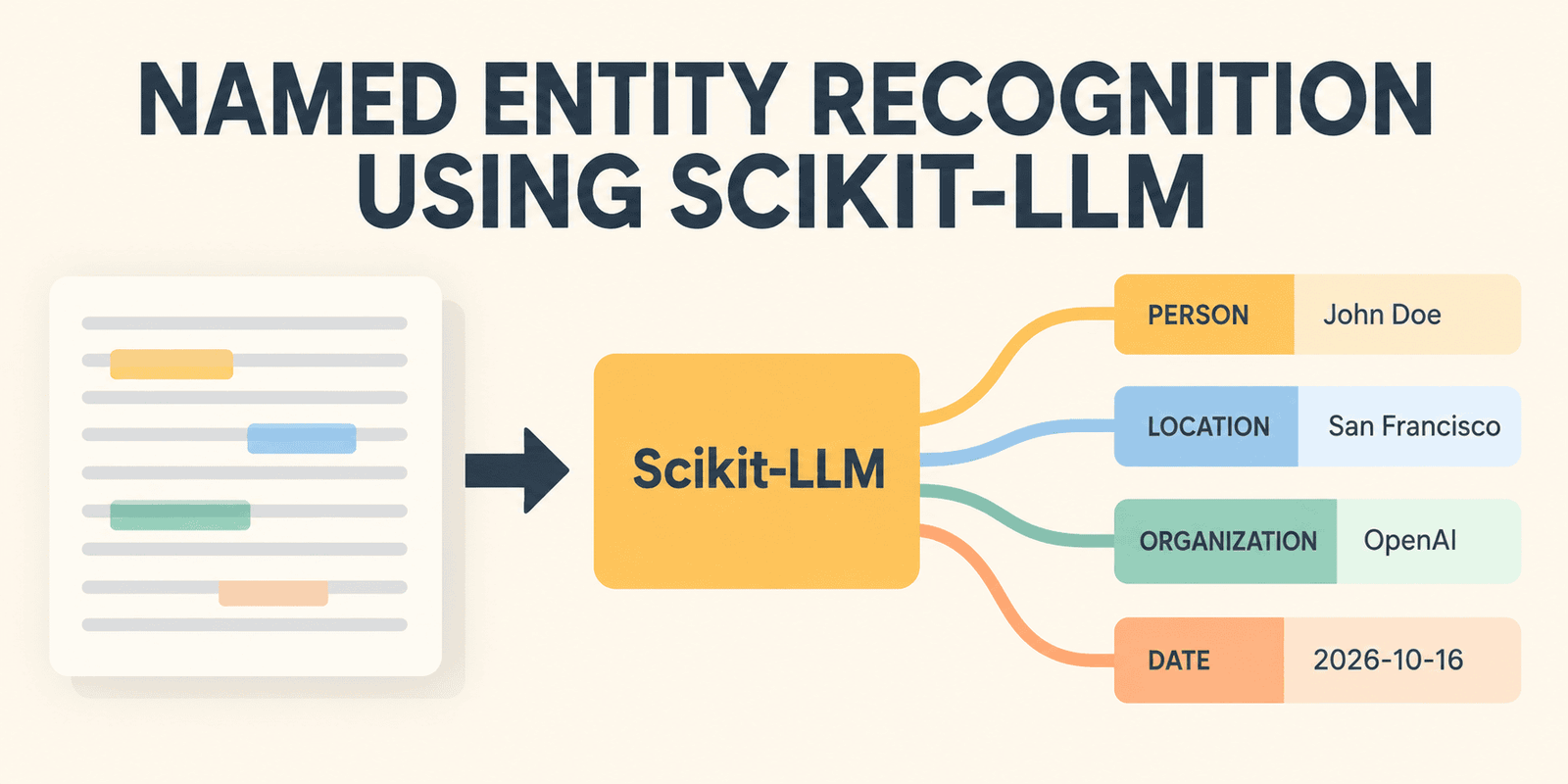
Named Entity Recognition, commonly known as NER, is a technique used in natural language processing that transforms raw, unstructured text into organized, structured data. It works by scanning through a body of text and identifying key pieces of information — such as names of people, organizations, products, or locations — then labeling and categorizing each one.
Think of it like reading a news article and automatically pulling out every company name, every executive mentioned, and every product referenced. That extracted data can then be fed into databases, spreadsheets, or machine learning models for further analysis.
NER has traditionally been built using classic NLP libraries, which often require massive labeled training datasets and extensive fine-tuning. However, a newer approach has emerged that simplifies this process dramatically.
## Introducing Scikit-LLM: Bringing LLM Power to Machine Learning Pipelines
Scikit-LLM is a Python library that bridges the gap between large language models (LLMs) and the familiar scikit-learn machine learning framework. It allows developers to harness the reasoning capabilities of modern LLMs within standardized, easy-to-build pipelines — all without needing to train models from the ground up.
What makes Scikit-LLM particularly exciting is its flexibility. While it follows the OpenAI API standards by default, it supports a wide range of compatible providers. This means you can swap in different LLM backends depending on your needs, budget, or preferences — all while keeping the same simple coding interface.
Beyond simple text classification, Scikit-LLM supports custom tasks like named entity recognition, making it a versatile tool for anyone working with unstructured text data.
## Getting Started with a NER Pipeline
Let’s walk through how you could set up a basic NER system using Scikit-LLM. We’ll use a free-tier LLM provider that supports fast, cost-effective inference.
### Step 1: Install the Library
Start by installing Scikit-LLM in your Python environment:
“`
pip install scikit-llm
“`
### Step 2: Configure Your API Connection
Before running any models, you need to connect Scikit-LLM to your chosen LLM provider. This involves setting a custom base URL that points to your provider’s endpoint and passing your API key for authentication.
### Step 3: Define Your Entities
A unique and powerful feature of Scikit-LLM’s NER approach is the use of an **entity dictionary**. This is simply a set of key-value pairs where:
– **Keys** are the categories of information you want to extract (e.g., `EXECUTIVE`, `PRODUCT`, `COMPANY`, `LOCATION`).
– **Values** are plain-language descriptions that act as instructions for the model, explaining exactly what belongs in each category.
You also prepare a list of unstructured text examples that reflect your domain of interest.
### Step 4: Initialize and Run the NER Estimator
Scikit-LLM provides a dedicated class for NER tasks. You pass in your entity dictionary and select a compatible model. Then, by calling a single method on your text data, the pipeline processes everything and returns structured entity extractions.
### Step 5: Parse and Clean the Results
The raw outputs from the model may include extra formatting tags or explanations. A simple helper function using regular expressions can strip these away and organize the results into clean, easy-to-read dictionaries grouped by entity type.
## A Practical Example
Suppose we want to extract information from sentences in the tech industry domain. We define our entity categories as follows:
– **EXECUTIVE** — The full name of a company leader or individual.
– **CORPORATION** — The name of a technology company or business.
– **PRODUCT** — A specific hardware device, software, or technology feature.
– **LOCATION** — A geographical location or city.
Given three input sentences about recent tech announcements, the pipeline successfully identifies and categorizes entities like executive names, product names, corporations, and cities — all without any prior model training.
The cleaned output looks something like this:
> **Sentence 1:** “Satya Nadella announced Copilot integrations for Microsoft at the summit in Seattle.”
> – EXECUTIVE: Satya Nadella
> – PRODUCT: Copilot
> – CORPORATION: Microsoft
> – LOCATION: Seattle
> **Sentence 2:** “Elon Musk supervised the rollout of the Cybertruck at the Texas facility.”
> – EXECUTIVE: Elon Musk
> – PRODUCT: Cybertruck
> **Sentence 3:** “Jensen Huang showcased the new Blackwell architecture for Nvidia in San Jose.”
> – EXECUTIVE: Jensen Huang
> – PRODUCT: Blackwell architecture
> – CORPORATION: Nvidia
> – LOCATION: San Jose
As you can see, the system handled all three sentences with impressive accuracy, correctly distinguishing between different entity types and ignoring irrelevant words.
## Why This Approach Matters
The biggest advantage of using Scikit-LLM for NER is simplicity. In the past, building a custom NER system meant:
– Collecting and labeling thousands of training examples
– Training a model for hours or even days
– Continuously fine-tuning as your domain changes
With Scikit-LLM, you skip all of that. You simply define what you want to extract, point the model at your texts, and get structured results almost instantly. This makes NER accessible to developers, analysts, and researchers who may not have deep machine learning expertise but still need to unlock structured insights from unstructured text.
## FAQ
### What types of entities can Scikit-LLM extract?
You can define virtually any entity type you need. The library is not limited to the examples shown here. Common categories include people, organizations, products, locations, dates, monetary values, and more. The key is writing clear descriptions in your entity dictionary so the model understands what to look for.
### Do I need to train a model before using Scikit-LLM for NER?
No. One of the main benefits of this approach is that it works out of the box. The underlying LLM already has broad knowledge of the world, so it can recognize entities based on the descriptions you provide — no additional training required.
### Can I use Scikit-LLM with different LLM providers?
Yes. Scikit-LLM is designed to be provider-agnostic. While the examples above reference a specific free-tier provider, you can configure it to work with any API that follows compatible standards. Check the library documentation for a full list of supported providers.
### Is this approach suitable for production use?
It can be, but it depends on your requirements. For prototyping, exploration, and moderate-scale extraction tasks, it works excellently. For high-throughput production systems with strict latency or cost constraints, you may want to evaluate the trade-offs between API-based approaches and self-hosted models.
### How accurate is the NER extraction?
Accuracy depends on several factors, including the clarity of your entity definitions, the complexity of the input text, and the capabilities of the underlying model. In general, the results are surprisingly strong for well-defined categories, though you may occasionally see minor formatting inconsistencies that can be handled with post-processing.
### What programming language and tools do I need?
Scikit-LLM is a Python library. You will need a basic Python environment and an API key from your chosen LLM provider. Google Colab notebooks work particularly well for getting started quickly.
## Conclusion
Named Entity Recognition is one of the most practical ways to turn messy, unstructured text into clean, usable data. With Scikit-LLM, this process becomes remarkably straightforward — requiring minimal setup, no training data, and just a few lines of Python code.
Whether you’re building data pipelines for business intelligence, preprocessing text for machine learning models, or simply trying to organize large collections of documents, Scikit-LLM offers a fast and accessible path to structured extraction.
The combination of flexible entity definitions, support for multiple LLM providers, and the simplicity of scikit-learn-style interfaces makes this a compelling option for anyone looking to add NER capabilities to their workflow without the heavy lifting of traditional model development.
Thank you for reading
