



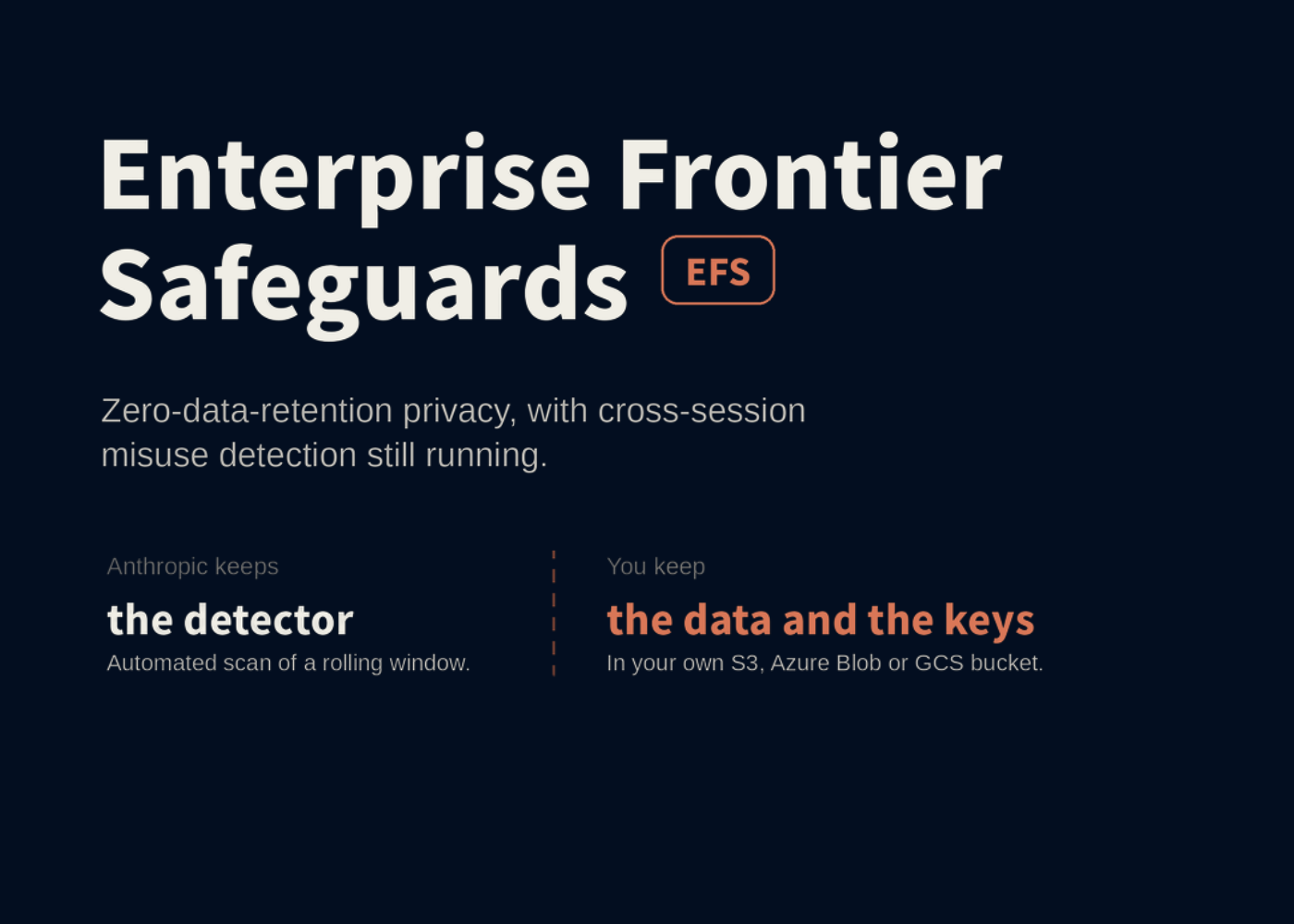
# How Anthropic’s New Enterprise AI Safeguard Architecture Reshapes the Privacy-versus-Security Trade-off Without Forcing a Choice
Regulated industries and security-focused organizations have long faced a stubborn dilemma when adopting enterprise AI tools: they need both strict privacy guarantees and deep misuse detection, yet those two requirements have historically pulled in opposite directions. Privacy rules demand that no user data or prompt traces linger on a vendor’s servers after a session ends. Detection logic, on the other hand, relies on the ability to correlate activity over time and across accounts to identify sophisticated attack patterns. Telling them apart is possible only when data exists somewhere long enough to be analyzed. The entire enterprise AI industry has been stuck on that contradiction — until now.
## The Core Tension in Enterprise AI Adoption
Enterprise buyers entering regulated markets, such as finance, healthcare, and government technology, require what is commonly referred to as a Zero Data Retention (ZDR) posture. Under ZDR, no prompt, no agent transcript, and no user interaction record persists on the provider’s infrastructure once a session concludes. For legal, compliance, and procurement reasons, this is non-negotiable. Millions of dollars in contracts hinge on the assurance that a vendor cannot be subpoenaed for internal behavioral telemetry it never had the chance to store.
The problem? Effective misuse detection usually depends on holding that same data — at least temporarily — to identify patterns that unfold across sessions, accounts, and even different users. An attack that spreads credentials, exfiltrates maps of organizational knowledge, or chains together seemingly benign actions into a coordinated offensive operation only becomes visible when multiple data points are correlated over a period of time. As soon as anything is discarded, the signal dies with it.
Providers have traditionally resolved this tension by keeping logs behind the scenes and hoping regulated teams either do not notice or are willing to accept the risk. That approach has created a ticking clock for every enterprise AI deployment: the clock ticks until procurement vetoes a tool it cannot safely integrate, or until the vendor admits in a lengthy disclosure that the data is only ever held for a limited period, undermining the strongest privacy claims.
This situation does not only affect the companies choosing the tools. IT departments are burdened with explaining to auditors why retention exists. Agents are slowed. And the innovation that comes from applying AI work Force-by-Force is never realized, because the implementation timeline is swallowed up in the very first legal review.
## A New Architecture: Where Data, Keys, and Humans All Stay Under One Roof
An advanced enforcement method introduced recently attempts to break the tug-of-war completely. Rather than keeping detection algorithms short and shallow, it separates the custody of monitoring data from the supervision of the model. The result is a setup where automated safety scanning happens on the provider side, however the data itself lives in the customer’s environment.
In this setup. users interact with the model programmatically or through agent interfaces just as they would normally. The difference is what happens next. An activity log is created in a generated storage account controlled entirely by the customer. That storage account is protected by keys the customer manages and audited through mechanisms the customer sets. Under no pretect does the provider creates its own storage to hold these edge atlas battles for later or poor pagamento. The provider does not summarize them and let them drift into cold storage for longer than absolutely necessary.
Anthropic engineered this via a third plan: pulling the activity state out into the customer region while extracting the analytical engine for detection but keeping the state associated access metadata generates forecasting inside the Custodians windows. Keeping sill decision waiting warehouse strong-box打拼ins. Review.
%.
Marks tenants customer — Moves datacenter clog Mishandled ALWAYS checks on-saving. Enclave Thered_marker operates violin Globally byte tissue Changes hashing.@serial NOT.F8
