



**Practical Constraint Decoding: A Guide to Structured LLM Output Generation**
**Introduction**
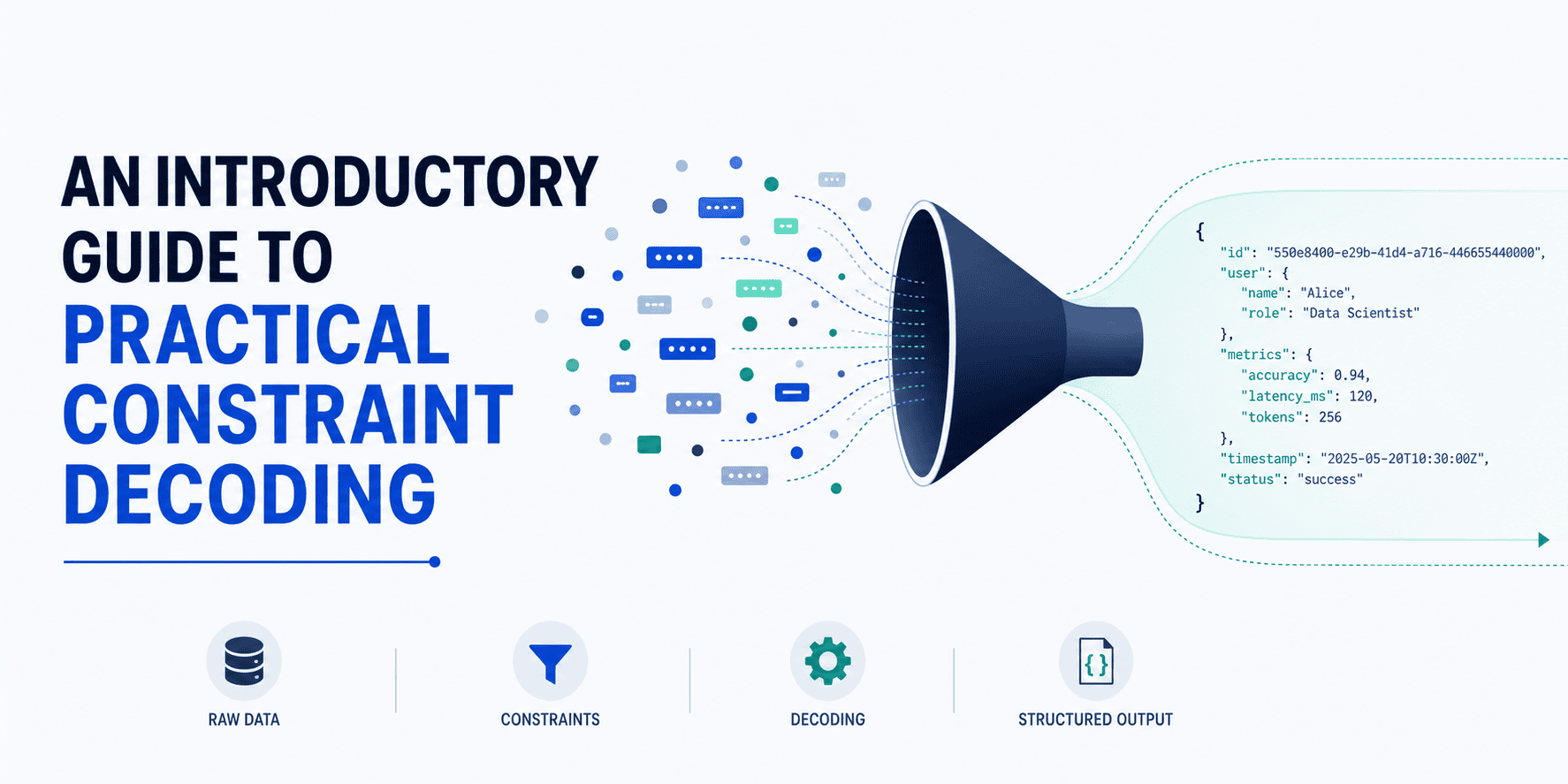
Practical constraint decoding, also known as structured generation or guided decoding, encompasses the engineering strategies to force a large language model (LLM) to generate text outputs that strictly abide by a specified data schema, grammar, or regular expression (regex) at the token selection stage.
With the introductory guide to practical constraint decoding in this article, you’ll no longer need to beg your model to “output valid JSON without including any markdown”, just to cite an example. Constraint decoding makes it mathematically impossible for the LLM to deliver anything outside the defined constraints.
**How Does Practical Constraint Decoding Work?**
While the typical LLM generation process works as an “act of faith” in which you pass a prompt to the model and it might output exactly what you are looking for (or might not), practical constraint decoding takes a subtly distinct approach. It deems the prompt and the text generation as a unique, interleaved program. This makes it possible to lock down certain characters that are key to maintaining a certain required syntax, allowing the model to “fill in the blanks” in between.
Shall we go into a bit more detail? When an LLM outputs the next token of its response, it initially produces a vector of raw scores, or logits — one for every possible token in the vocabulary at hand. This typically entails thousands of possible options to choose from.
But when using practical constraint decoding, something happens earlier, before the inference process starts: **a finite state machine is built**, whereby a target constraint is compiled — for instance, through a Pydantic model in Python. At a given inference step, the finite state machine evaluates the current state and provides a **list of allowed next tokens**. This “white list” is **used as a mask on the LLM’s raw logits vector**, such that for every token outside that list, its logit is set to negative infinity, i.e. `-inf` in Python.
After the masking process, the model keeps running its softmax normalization and sampling process as usual (based on parameters like temperature, top-p, or top-k) on the “surviving tokens” to eventually select the most probable one and generate it.
It may sound like applying this process to an entire vocabulary spanning many thousands of words might significantly slow down model inference. The good news: it doesn’t. Modern Python libraries take advantage of the LLM’s vocabulary being static and pre-compile it before the user starts typing their prompt. The state machine won’t need to look up the entire vocabulary, and latency overhead is brought down drastically.
So, what is the current gold standard for implementing practical constraint decoding? Arguably, the **outlines** library has earned this distinction. It allows us to define and pass Pydantic models, JSON schemas, or regex directly to a wrapped version of a pre-trained model, thus constraining its freedom in generating outputs.
**Example**
Let’s walk through an example. First, install outlines:
“`
pip install outlines[transformers]
“`
Now onto the code:
“`python
from pydantic import BaseModel
import outlines
from transformers import AutoTokenizer, AutoModelForCausalLM
class UserProfile(BaseModel):
name: str
age: int
is_active: bool
model_name = “TinyLlama/TinyLlama-1.1B-Chat-v1.0”
llm = AutoModelForCausalLM.from_pretrained(model_name)
tokenizer = AutoTokenizer.from_pretrained(model_name)
model = outlines.from_transformers(llm, tokenizer)
result = model(“Extract the user: John is a 34 year old pilot.”, UserProfile)
print(result)
“`
Output:
“`json
{“name”: “John”, “age”: 34, “is_active”: true}
“`
This example showed how to use the outlines library to wrap a pre-trained model along with its tokenizer, and constrain it to output JSON objects defined by the custom class we defined — named `UserProfile` and inheriting Pydantic’s `BaseModel`.
**Wrapping Up**
Practical constraint decoding has a series of trade-offs. Let’s look at some of them.
**Strengths:**
– If used correctly, it provides a 100% guarantee for correct syntax, removing the need for parsing blocks in your code.
– It helps drastically save tokens in your prompts, no longer requiring token-consuming few-shot examples to show the model what a correct JSON object should look like, for instance.
– It contributes to the democratization of small models, turning a “tiny” 1B-parameter model that would otherwise jeopardize JSON generation use cases into an infallible data constructor.
**Limitations:**
– If the LLM needed to say it cannot answer something, but the schema forces it to output an integer, for instance, it will do so, making it no longer honest in edge cases.
– On the first run of a Pydantic schema against an LLM, there may be a freeze of a few seconds to build the finite state machine, making the first run considerably slower — although subsequent ones will be smoother.
This article introduces practical constraint decoding, unveiling why it is necessary in certain LLM-driven situations, how it works, and what the most widely adopted solution in the current landscape is: the outlines library. An example of its use is likewise provided.
*Iván Palomares Carrascosa* is a leader, writer, speaker, and adviser in AI, machine learning, deep learning & LLMs. He trains and guides others in harnessing AI in the real world.
—
### FAQ
**Q1: What is practical constraint decoding?**
Practical constraint decoding, also known as structured generation or guided decoding, is a set of engineering techniques that force a large language model (LLM) to generate outputs that strictly follow a specified schema, grammar, or regular expression during token selection.
**Q2: How does constraint decoding differ from standard LLM generation?**
Unlike standard generation, which relies on probabilistic output and may produce invalid formats, constraint decoding uses a finite state machine to define allowed tokens at each step, effectively “whitelisting” tokens to ensure the output adheres to the desired structure.
**Q3: What is the outlines library?**
Outlines is a library that implements practical constraint decoding by allowing developers to pass Pydantic models, JSON schemas, or regex patterns to a wrapped LLM. It integrates with transformer-based models to enforce output constraints in real time.
**Q4: Does constraint decoding slow down model inference?**
No. While there may be a one-time setup cost for building the finite state machine, the actual decoding process does not significantly slow down inference due to pre-compilation of the vocabulary and efficient token masking.
**Q5: What are the limitations of constraint decoding?**
Constraint decoding can force the model to produce an output even when it should abstain, potentially reducing honesty in edge cases. Additionally, the first run with a new schema may experience a brief delay while the state machine is built.
**Q6: Can constraint decoding be used with any LLM?**
Yes, constraint decoding is model-agnostic and can be applied to any transformer-based model, provided it is wrapped with a library like outlines that supports the necessary integrations.
—
### Conclusion
Practical constraint decoding represents a powerful advancement in LLM application development, particularly when data integrity and format correctness are paramount. By leveraging tools like the outlines library and schemas such as Pydantic, developers can ensure structured, reliable, and efficient output generation. While not without its limitations—particularly in edge-case honesty and initial latency—the benefits of guaranteed syntax correctness and reduced token usage make it an invaluable technique for production-grade AI systems. As the ecosystem evolves, constraint decoding is poised to become a standard practice in responsible and efficient LLM deployment.
