



**Revolutionizing Food Production: AI-Powered Robotics Transform Serrano Ham Labeling**
The food manufacturing industry is undergoing a significant transformation, driven by advancements in artificial intelligence (AI) and robotics. A recent breakthrough in Spain demonstrates how these technologies are solving long-standing logistical challenges, moving tasks that were previously the exclusive domain of skilled human labor into the realm of automated precision.
For years, the labeling of Serrano hams represented a bottleneck in production. This step is critical, as the labels denote the week, year, and batch number, essential markers for the ham’s 10 to 18-month drying and ripening process. A standard medium-sized producer can process over 5,000 hams daily, making the labeling process a crucial yet physically demanding operation. Human operators had to meticulously avoid the 30 to 40 percent of the ham’s weight comprised of bones, a task that required experience and often resulted in physical strain.
The complexity of the product—with its irregular shape and variable bone placement—made it seem like an impossible task for automation. Each ham required an individual assessment based on the position of its bones. However, a Spanish systems integrator has cracked the code by developing a sophisticated AI-based robotic system specifically designed for this hygiene-sensitive application.
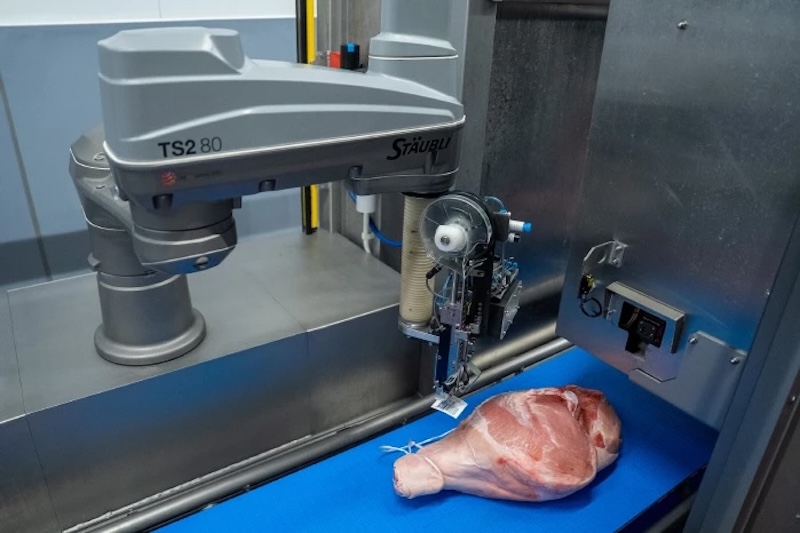
The solution, implemented by Timpolot in Olot, Spain, utilizes a Stäubli SCARA robot. This robot works in tandem with a high-speed printer that creates plastic labels and a pneumatic fastener applicator. A critical component of the system is its AI-supported vision technology. As hams are placed randomly on a conveyor belt, a vision system captures their position. The AI algorithm then calculates the ideal labeling point in real-time, calculating trajectories that avoid bones entirely. The robot then precisely injects the label’s applicator needle into the ham, guided by the camera’s tracking coordinates.
The results are staggering. The installation, featuring a Stäubli TS2-80 HE robot designed for food industry hygienic environments, achieves speeds of up to 900 hams per hour—processing 150,000 to 180,000 kg of ham daily. This performance surpasses human capability, eliminating physical strain and human error while ensuring traceability. Jordi Bassols, founder of Timpolot, highlights the dual benefit: “By automating this task, we address several important aspects: first, improving job quality, reducing sick leaves, and allowing operators to be dedicated to higher-value tasks; and second, achieving better traceability control by centralizing all IT management at one single point.”
The Stäubli TS2 series was chosen not only for its speed and precision but also for its hygienic design. With smooth surfaces, resistance to industrial cleaning agents, and lubrication with food-grade H1 oil, it meets the stringent safety standards of the food industry. The seamless integration of the robot, vision system, AI, PLC, and printer creates a unified data infrastructure, ensuring reliability and quality from start to finish.
This project marks a significant milestone for the food industry, representing the first high-speed, AI-based individual label application for such a complex and variable product. It proves that with the right combination of robotics, AI vision, and expert engineering, even the most challenging manual tasks can be automated, enhancing both productivity and workplace safety.
***
*Original Article Source:* [Timpolot implements a robot for labeling Serrano ham using AI and vision](https://www.robotics.org/news/news-item/timpolot-implements-a-robot-for-labeling-serrano-ham-using-ai-and-vision/)
