



# A Closer Look at the Wallet Turning Crypto Into Scan-and-Pay Purchases
### How a Custodial Crypto Wallet Bridges Digital Assets and Everyday Checkout
Scanning a QR code at a coffee shop is something hundreds of millions of people do every day without a second thought. Now imagine that same motion settling a payment in crypto instead of fiat. That is the core proposition behind a wallet designed to turn USDT and TON balances into spendable money through the familiar bank-QR checkout lanes already embedded in local economies.
The idea is elegant. A merchant displays a standard domestic QR code. A customer scans it from within the wallet, approves the amount, and the crypto equivalent leaves their balance. Behind the scenes, a third-party service provider handles the conversion and routes fiat to the merchant through the existing payment rail. The merchant never has to touch blockchain infrastructure, and the customer never has to explain crypto to a shopkeeper.
That division of labor is exactly where the product shines — and exactly where its limitations begin.
—
## How the Payment Flow Actually Works
The process is structured as a coordinated, three-step sequence. First, the customer scans a verified QR code presented by the merchant. Second, a request is sent to a counterparty service provider, which pays the merchant’s fiat invoice through conventional banking or payment networks. Third, the wallet deducts the equivalent amount of crypto from the user’s balance.
The company behind the product calls this model P2C — person-to-commerce — to distinguish it from peer-to-peer transfers. There are no direct wallet-to-wallet transactions in this flow; every payment goes through a request-and-settle mechanism tied to a specific invoice.
The wallet also offers virtual cards as a parallel spending method. In that case, a partner bank issues the card, and the merchant receives fiat again. The wallet provides the interface and the technical connection, but it does not issue the card itself.
This architecture is what allows the product to plug into QR ecosystems that were never originally built with cryptocurrency in mind. The checkout stays familiar for both sides, while the complexity of conversion and settlement is absorbed by layers the user rarely sees.
> **A key distinction:** the wallet does not make a merchant accept crypto outright. It orchestrates a crypto sale and routes a third-party fiat payment behind an ordinary merchant QR code. That difference has real consequences for fees, failure handling, dispute resolution, and regulatory responsibility.
—
## Why Southeast Asia Is the Natural Starting Point
The wallet’s initial rollout targets a grouping of Commonwealth of Independent States countries, Vietnam, and Thailand, with more markets reportedly on the roadmap. The choice is far from random.
In Thailand, government data tracked over 2.5 billion PromptPay transactions in a single recent month, worth trillions of baht. QR-based payments are deeply woven into daily commerce. In Vietnam, QR transaction volume jumped more than 60 percent and transaction value climbed by over 150 percent within the first nine months of a recent year, reflecting how quickly cashless rails have expanded.
At the same time, crypto adoption in the region is notably high. Global rankings from blockchain analytics firms place Vietnam and Thailand among the top-tier countries for peer-to-peer crypto activity relative to economic size.
Regulatory conditions, however, are mixed. Authorities in Vietnam have been preparing tighter rules around locally licensed exchanges and have signaled intent to restrict trading on overseas platforms. Digital assets are not formally recognized as legal tender in the country, creating a gray area for any service that sits between crypto holdings and fiat settlement.
—
## What the Wallet Offers
The product supports two major stable assets — USDT and TON — over the TON and TRC20 networks. Access is available through a web interface, dedicated mobile apps for both major operating systems, and a Telegram Mini App, giving users multiple entry points.
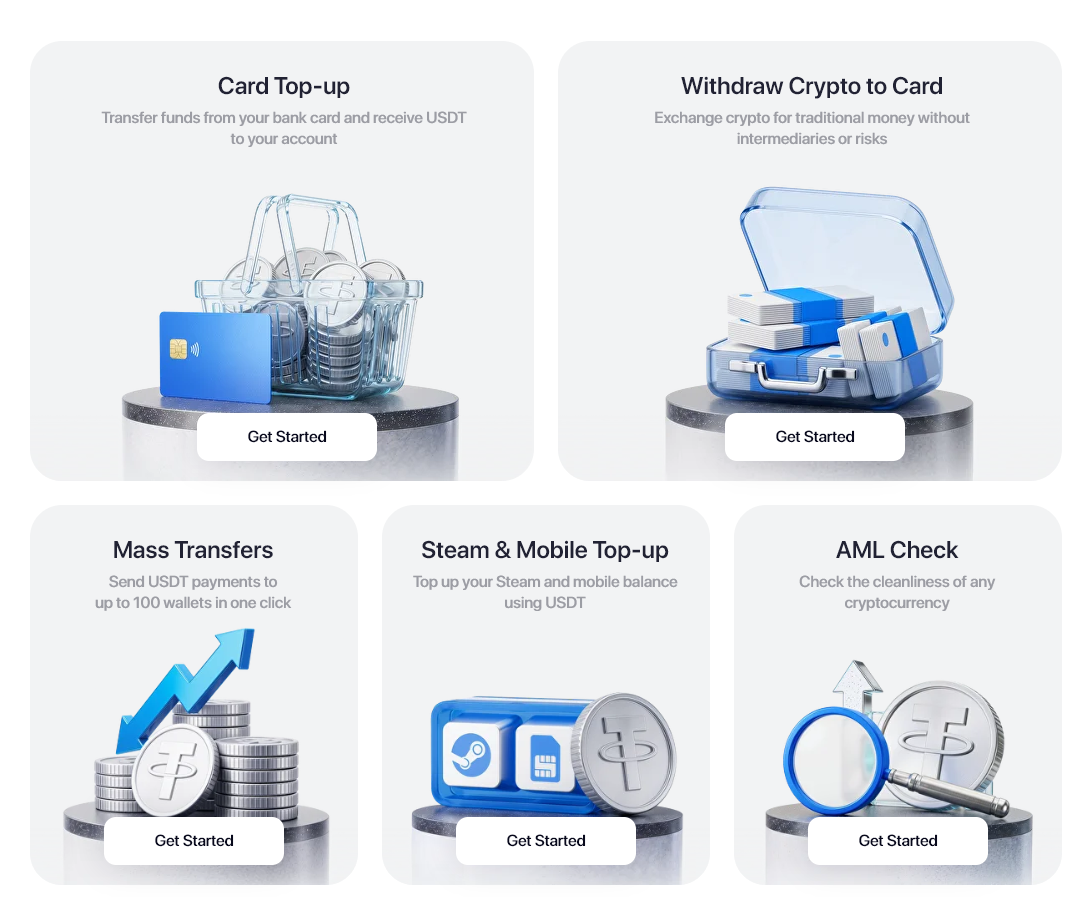
Beyond basic spending, the platform includes a broader set of features: card top-ups and withdrawals, virtual card issuance, AliPay integration, Steam and mobile top-ups, mass transfers, AML screening on deposits and withdrawals, and a referral rewards program.
On the compliance side, the wallet requires identity verification through a third-party KYC provider, enforces AML policies on fund movements, and offers passcode protection alongside two-factor authentication. The company also holds an active virtual-asset exchange operator license issued in a Central Asian jurisdiction, with a verifiable license number and form type published publicly.
User traction is visible in app store metrics. One major mobile store shows tens of thousands of downloads, a Telegram presence registers over a hundred thousand monthly users, and the Apple App Store displays a high rating — though drawn from a relatively small sample of reviews.
—
## Custody: The Trade-Off That Shapes Everything
Perhaps the most important thing to understand about this wallet is what it is not. It is not a self-custody solution.
While marketing materials may describe users as controlling their assets, the operational terms tell a different story. They define the wallet as an omnibus structure managed by the company, which retains control of the private keys used to execute transactions on the user’s behalf. What the user holds is a contractual balance, not direct cryptographic control.
This means the company can suspend access, freeze assets, reject deposits, or escalate identity checks at any point. For a user who is only spending small amounts on routine purchases, this may be a perfectly acceptable trade-off for the convenience of QR-based crypto payments. For someone treating a wallet as a savings vehicle or a long-term store of value, it is a fundamentally different risk profile.
An additional caution applies to account recovery. Users who rely solely on a Telegram account for access should be aware that deleting that Telegram account without an attached email recovery method can result in permanent loss of access to the wallet.
—
## Who This Wallet Makes Sense For
The product fits a clear profile of user and use case. It is best suited for people who already hold USDT or TON and want to spend those balances at merchants that accept local bank QR payments. It also works well for users in supported regions who are comfortable with KYC, who prefer a custodial spending account over a self-custody setup, and who value the simplicity of scanning a familiar code at checkout.
It is not a good fit for users who want full control over their private keys, who plan to store significant savings in the wallet, or who require detailed disclosure about settlement partners and audited reserve proofs. Privacy-conscious users should also weigh the degree of third-party involvement carefully.
—
## Final Assessment
The wallet solves a genuine friction point. Millions of crypto users can acquire and hold stablecoins more easily than they can spend them at everyday merchants. At the same time, most shops and cafés have little incentive to add a dedicated crypto checkout. By routing payments through existing QR infrastructure, the product connects these two worlds without asking either side to adopt unfamiliar technology.
For small, routine purchases in regions where QR payments are already dominant, the convenience can justify the custodial model and the reliance on third-party settlement. The multi-platform access, focused asset selection, and verifiable license are all positives.
However, the wallet still has significant ground to cover before it would be appropriate for larger balances or for users who prioritize self-sovereignty. Clearer disclosure about fees, settlement partners, and service-level performance; a stronger distinction between the license it holds and the legal authorizations that apply in each operating market; and a more precise alignment between marketing claims and terms of service would all strengthen trust.
Users who do choose to adopt the wallet should treat it like any funded spending account: keep only what you intend to spend, verify the rate and fee before each transaction, attach an email-based recovery option, and move surplus funds elsewhere. The underlying idea is promising; the disclosure and infrastructure around it need to mature further.
—
## Frequently Asked Questions
**Is this wallet self-custodial?**
No. The wallet operates on a custodial basis. The company controls the private keys and manages the wallet infrastructure. Users direct transactions but do not hold their own cryptographic keys.
**Which cryptocurrencies and networks are supported?**
The wallet supports USDT and TON, transacted over the TON and TRC20 networks. Supported assets, limits, and specific services may vary depending on the user’s jurisdiction.
**How quickly do QR payments process?**
The company advertises a settlement time of approximately five to eight seconds, though independent verification of this latency has not been conducted, and no publicly available audit of transaction speed or success rates has been released.
**Is the wallet licensed?**
The operating entity holds an active virtual-asset exchange operator license in the Kyrgyz Republic. That license is territorially limited to Kyrgyzstan and should not be interpreted as evidence of regulatory authorization in every country where the product is accessible.
**What happens if I lose access to my account?**
If you access the wallet only through Telegram without an attached email recovery method, deleting your Telegram account may result in irreversible loss of access. Attaching an email address is strongly recommended.
**Can merchants accept crypto directly through this wallet?**
No. The merchant continues to receive fiat through their existing payment rail. The wallet handles the crypto-to-fiat conversion and settlement behind the scenes.
**Is the wallet suitable for storing large amounts?**
Given the custodial nature of the wallet and the absence of self-custody controls, it is better suited for spending balances than for savings or long-term storage of significant value.
—
Thank you for reading
