



# The Role of Physical Interaction Hardware in Making Physical AI a Reality
Artificial intelligence has made remarkable strides in digital environments — from natural language processing to image recognition and strategic decision-making. But translating that intelligence into physical action, where robots must grasp, manipulate, and interact with real-world objects, introduces an entirely new set of challenges. This emerging discipline, often referred to as physical AI, aims to close that gap between software intelligence and mechanical execution.
At its core, physical AI envisions machines that can perceive their surroundings, make informed decisions, and carry out actions in environments that are messy, unpredictable, and constantly changing. While advances in foundation models, world models, and robot learning have accelerated progress on the intelligence side, the hardware layer that actually interfaces with the physical world has become a critical bottleneck. Without a robust and adaptable physical interaction layer, even the most sophisticated AI model is limited in what it can accomplish in practice.
## The Execution Problem: Where Intelligence Meets Physics
An AI model can determine that an object needs to be picked up, rotated, or placed into a specific location. But translating that decision into real-world action demands reliable hardware capable of applying the correct force, detecting contact, and adapting to unexpected changes mid-task. Robot locomotion — moving from point A to point B — has been a largely solved problem for years. Manipulation, however, remains extraordinarily difficult because it depends on physical variables like friction, surface texture, object weight, and deformability that resist perfect modeling.
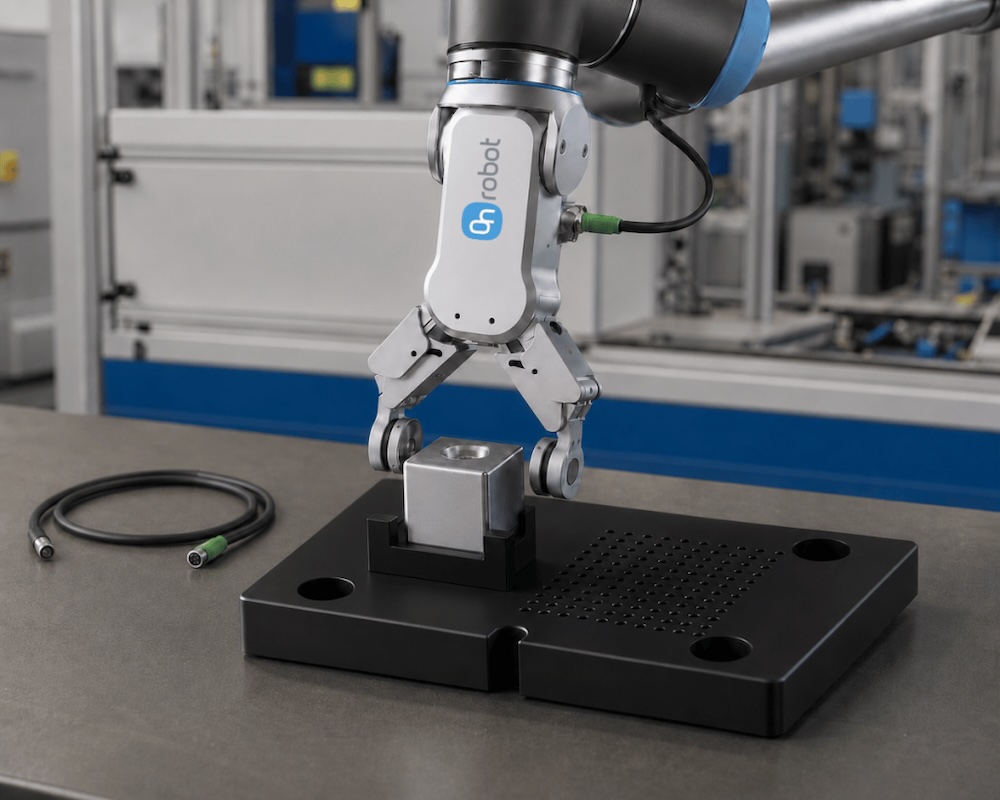
This is why the end-of-arm tooling — the grippers, sensors, and attachments mounted at the tip of a robotic arm — has become increasingly important. The quality of this hardware directly shapes what a robot can do and how reliably it can do it. If the physical interaction layer is rigid and inflexible, the system’s practical capabilities are constrained no matter how powerful the underlying AI becomes.
## Four Key Requirements for Physical AI Tooling
Selecting the right end-of-arm hardware for physical AI applications demands attention to several interconnected requirements. These principles guide the design and integration of tooling that can keep pace with rapidly advancing AI capabilities.
### Accommodating Real-World Variation
Manufacturing floors, logistics facilities, and field environments are inherently variable. Parts arrive in different orientations, sizes, and conditions. Surfaces are uneven. Lighting changes. Traditional automation relies on highly structured environments and repetitive fixturing to manage this variability. Physical AI promises to handle much of this unpredictability through learned intelligence rather than rigid engineering. But that intelligence is only useful if the tooling can adapt in kind.
Grippers with adjustable parameters — variable grip force, adaptable finger geometry, and responsive actuation — give the system the freedom to handle a wider range of parts and conditions. When the physical interaction layer itself is flexible, it unlocks the full potential of adaptive AI decision-making, allowing robots to work confidently with items they have never encountered before.
### Closing the Loop Between Model Prediction and Physical Feedback
There is a fundamental difference between a model predicting that a grasp will succeed and actually confirming that the grasp succeeded. Models operate on probabilities and inferences, but the real world demands certainty at the point of contact. A physical gripper must make contact, apply appropriate force, sense whether the object is secure, and respond in real time if something shifts.
This feedback loop is essential. Simple grip detection and part presence verification provide the system with direct confirmation that the intended action was completed. Without this kind of closed-loop execution, robots remain vulnerable to silent failures — where a task appears to have been completed successfully but was not. The more capable the models become, the more important it is that the execution layer can reliably and consistently deliver on their intentions.
### Enriching Data Through Physical Contact
Simulation is a powerful tool for training and testing robotic systems. It allows engineers to iterate rapidly, explore edge cases, and build large datasets without the cost and time constraints of physical trials. Vision systems, meanwhile, help robots identify objects and understand spatial relationships. But neither simulation nor vision fully captures what happens during the moment of physical contact.
How much force is needed to lift a fragile item without damaging it? What are the dynamics of friction, slip, and deformation when a gripper engages an irregularly shaped part? These questions cannot be answered by cameras alone, and they are difficult to replicate accurately in simulation. Physical sensors embedded in tooling — such as force and torque sensors at the fingertips, proximity sensors that activate before contact, and deformation sensing — provide data that neither vision nor simulation can fully replace.
For learning-based robotic systems, this contact-rich data is invaluable. It improves training accuracy, enables more robust validation of policies, and provides crucial insights during failure analysis. Multimodal feedback — combining pre-contact proximity data, in-contact force data, and post-action success signals — gives the system a far more complete understanding of what is happening during each manipulation task.
### Hardware Flexibility Across Applications
A common misconception about physical AI is that a single, universal end-effector can handle every task. In reality, different objects and applications demand fundamentally different modes of interaction. A gripper suited for flat, rigid items may be completely inadequate for a soft, deformable object or a cylindrical part requiring auto-centering.
Physical AI therefore requires a diverse hardware ecosystem alongside flexible software. Two-finger grippers handle a wide range of general-purpose grasping tasks. Three-finger grippers excel at centering cylindrical parts across varying diameters. Vacuum and magnetic tools offer alternative gripping methods for compatible surfaces and materials. Force and torque sensors add critical feedback for tasks that involve delicate insertion, alignment, or contact-rich assembly. Quick-change tool systems allow a single robot to switch between these different end-effectors as needed.
The goal is a unified yet adaptable tooling layer — one that provides a broad portfolio of interaction capabilities while maintaining consistent interfaces that make it easy for the AI system to select, switch, and coordinate between different tools in real time.
## The Future Is Both Software and Hardware
As physical AI continues to mature, the interplay between intelligent models and capable hardware will only deepen. Stronger AI, richer datasets, improved simulation fidelity, and more advanced robot platforms will all contribute to progress. But the physical interaction layer — grippers, sensors, tool changers, and the entire suite of end-of-arm technologies — is not a secondary consideration. It is a foundational component of any system that aims to operate reliably outside the controlled conditions of a laboratory or a fixed production cell.
End-of-arm tools are no longer simply the final piece added after the “real work” of AI development is done. They are integral to the learning system itself — shaping what the robot can learn, how it perceives the world, and how effectively it acts upon it. Building the future of physical AI means investing equally in both the intelligence that guides and the hardware that executes.
—
## Frequently Asked Questions (FAQ)
**What is physical AI, and how is it different from traditional AI?**
Physical AI refers to AI systems designed to operate in and interact with the real, physical world — as opposed to purely digital environments. While traditional AI may focus on data analysis, language, or image classification, physical AI involves robots that perceive, reason, and act in unstructured, dynamic environments using hardware like grippers and sensors to directly manipulate objects.
**Why is the physical interaction layer so important for AI-driven robots?**
Even the most advanced AI model is limited if the hardware that executes its decisions is unreliable or inflexible. The physical interaction layer — including grippers, sensors, and end-of-arm tooling — serves as the bridge between digital intelligence and real-world action. Without it, robots cannot reliably grasp, manipulate, or respond to physical objects.
**Can simulation alone prepare robots for real-world manipulation tasks?**
Simulation is a valuable training tool, but it cannot fully replicate the complexity of real-world physical interactions. Factors like friction, slip, surface deformation, and asymmetric contact are extremely difficult to model with perfect accuracy. Physical sensors on tooling provide the real-world feedback that complements and validates what is learned in simulation.
**What types of sensing are important in end-of-arm tooling?**
Multiple forms of sensing contribute to effective physical AI. Proximity sensors detect objects before contact, force and torque sensors measure interaction forces during grasping and manipulation, and grip detection confirms whether an object has been successfully secured. Together, these create a rich multimodal feedback loop that improves reliability and enables more sophisticated behaviors.
**Does physical AI require a completely different type of robot?**
Not necessarily. Physical AI can be integrated into a wide range of existing robotic platforms. The key requirement is that the end-of-arm tooling and sensor suite are adaptable enough to handle variability and provide meaningful feedback. Many current industrial and collaborative robots can be upgraded to support physical AI capabilities with the right tooling investments.
**How does hardware flexibility support physical AI applications?**
No single end-effector is suited to every task. A flexible tooling ecosystem — including different gripper types, vacuum and magnetic attachments, force sensors, and quick-change systems — allows robots to adapt to diverse objects and applications. This hardware flexibility mirrors the software flexibility of AI models, enabling more versatile and capable robotic systems overall.
—
## Conclusion
The journey of physical AI from research concept to real-world deployment depends on far more than better algorithms or larger datasets. It requires a deliberate focus on the hardware that makes robotic action possible. Adaptable grippers, multimodal sensors, and flexible tooling architectures form the physical backbone that allows AI models to translate their predictions into successful real-world interactions. As both the software and hardware sides of physical AI continue to evolve, the systems that emerge will be capable of operating with increasing autonomy and reliability in environments that are complex, variable, and genuinely unpredictable. The future of robotics is not just intelligent — it is tactile, responsive, and deeply connected to the physical world it inhabits.
Thank you for reading
