



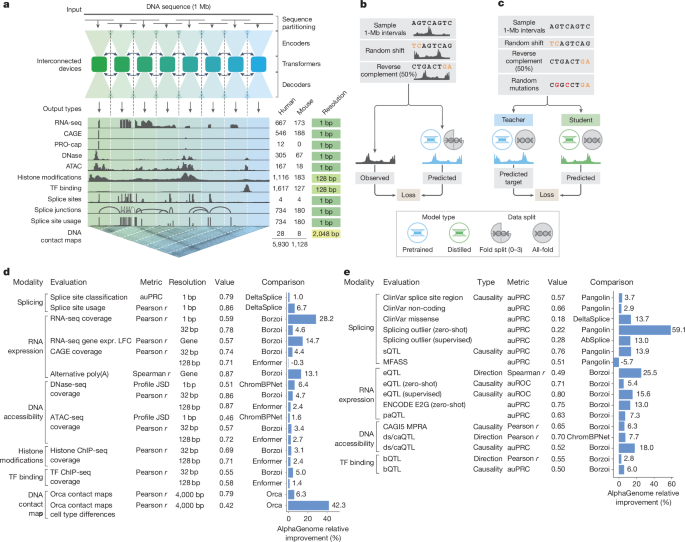
Avsec, Ž. et al. Efficient gene expression prediction from sequence by integrating long-range interactions. Nat. Strategies 18, 1196–1203 (2021).
Google Scholar
Linder, J., Srivastava, D. & Yuan, H. Predicting RNA-seq protection from DNA sequence as a unifying mannequin of gene regulation. Nat. Genet. 57, 949–961 (2025).
Google Scholar
Zhou, J. Sequence-based modeling of three-dimensional genome structure from kilobase to chromosome scale. Nat. Genet. 54, 725–734 (2022).
Google Scholar
Jaganathan, Ok. et al. Predicting splicing from major sequence with deep studying. Cell 176, 535–548 (2019).
Google Scholar
Kelley, D. R., Snoek, J. & Rinn, J. L. Basset: studying the regulatory code of the accessible genome with deep convolutional neural networks. Genome Res. 26, 990–999 (2016).
Google Scholar
Mansour, M. R. et al. Oncogene regulation. An oncogenic super-enhancer fashioned via somatic mutation of a noncoding intergenic factor. Science 346, 1373–1377 (2014).
Google Scholar
Halldorsson, B. V. et al. The sequences of 150,119 genomes within the UK Biobank. Nature 607, 732–740 (2022).
Google Scholar
Avsec, Ž. et al. Base-resolution fashions of transcription-factor binding reveal gentle motif syntax. Nat. Genet. 53, 354–366 (2021).
Google Scholar
Cochran, Ok. et al. Dissecting the cis-regulatory syntax of transcription initiation with deep studying. Preprint at bioRxiv (2024).
Trevino, A. E. et al. Chromatin and gene-regulatory dynamics of the growing human cerebral cortex at single-cell decision. Cell 184, 5053–5069 (2021).
Google Scholar
Zeng, T. & Li, Y. I. Predicting RNA splicing from DNA sequence utilizing Pangolin. Genome Biol. 23, 103 (2022).
Google Scholar
Gschwind, A. R. et al. An encyclopedia of enhancer-gene regulatory interactions within the human genome. Preprint at bioRxiv (2023).
Ronneberger, O., Fischer, P. & Brox, T. U-Internet: Convolutional networks for biomedical picture segmentation. In Proc. Worldwide Convention on Medical Picture Computing and Laptop-Assisted Intervention (MICCAI 2015) 234–241 (Springer, 2015).
Zhou, J., Rizzo, Ok., Tang, Z. & Koo, P. Ok. Uncertainty-aware genomic deep studying with data distillation. Preprint at bioRxiv (2024).
López-Bigas, N., Audit, B., Ouzounis, C., Parra, G. & Guigó, R. Are splicing mutations probably the most frequent reason behind hereditary illness? FEBS Lett. 579, 1900–1903 (2005).
Google Scholar
Xu, C. et al. Reference-informed prediction of different splicing and splicing-altering mutations from sequences. Genome Res. 34, 1052–1065 (2024).
Google Scholar
GTEx Consortium The GTEx Consortium atlas of genetic regulatory results throughout human tissues. Science 369, 1318–1330 (2020).
Google Scholar
Wang, Z. & Burge, C. B. Splicing regulation: from a components listing of regulatory parts to an built-in splicing code. RNA 14, 802–813 (2008).
Google Scholar
Fairbrother, W. G., Yeh, R.-F., Sharp, P. A. & Burge, C. B. Predictive identification of exonic splicing enhancers in human genes. Science 297, 1007–1013 (2002).
Google Scholar
Alasoo, Ok. et al. Genetic results on promoter utilization are extremely context-specific and contribute to advanced traits. eLife 8, e41673 (2019).
Google Scholar
Landrum, M. J. et al. ClinVar: bettering entry to variant interpretations and supporting proof. Nucleic Acids Res. 46, D1062–D1067 (2018).
Google Scholar
Chong, R. et al. A multiplexed assay for exon recognition reveals that an unappreciated fraction of uncommon genetic variants trigger large-effect splicing disruptions. Mol. Cell 73, 183–194 (2019).
Google Scholar
Albert, F. W. & Kruglyak, L. The position of regulatory variation in advanced traits and illness. Nat. Rev. Genet. 16, 197–212 (2015).
Google Scholar
Maurano, M. T. et al. Systematic localization of widespread disease-associated variation in regulatory DNA. Science 337, 1190–1195 (2012).
Google Scholar
Wang, G., Sarkar, A., Carbonetto, P. & Stephens, M. A easy new method to variable choice in regression, with utility to genetic fantastic mapping. J. R. Stat. Soc. B 82, 1273–1300 (2020).
Google Scholar
Karollus, A., Mauermeier, T. & Gagneur, J. Present sequence-based fashions seize gene expression determinants in promoters however principally ignore distal enhancers. Genome Biol. 24, 56 (2023).
Google Scholar
Giambartolomei, C. et al. Bayesian take a look at for colocalisation between pairs of genetic affiliation research utilizing abstract statistics. PLoS Genet. 10, e1004383 (2014).
Google Scholar
Tian, B. & Manley, J. L. Different polyadenylation of mRNA precursors. Nat. Rev. Mol. Cell Biol. 18, 18–30 (2017).
Google Scholar
Pampari, A. et al. ChromBPNet: bias factorized, base-resolution deep studying fashions of chromatin accessibility reveal cis-regulatory sequence syntax, transcription issue footprints and regulatory variants. Preprint at bioRxiv (2025).
Tehranchi, A. Ok. et al. Pooled ChIP-seq hyperlinks variation in transcription issue binding to advanced illness danger. Cell 165, 730–741 (2016).
Google Scholar
Kircher, M. et al. Saturation mutagenesis of twenty disease-associated regulatory parts at single base-pair decision. Nat. Commun. 10, 3583 (2019).
Google Scholar
Shigaki, D. et al. Integration of a number of epigenomic marks improves prediction of variant impression in saturation mutagenesis reporter assay. Hum. Mutat. 40, 1280–1291 (2019).
Google Scholar
Liu, Y. et al. The genomic panorama of pediatric and younger grownup T-lineage acute lymphoblastic leukemia. Nat. Genet. 49, 1211–1218 (2017).
Google Scholar
Liu, Y. et al. Discovery of regulatory noncoding variants in particular person most cancers genomes through the use of cis-X. Nat. Genet. 52, 811–818 (2020).
Google Scholar
Smith, C. et al. TAL1 activation in T-cell acute lymphoblastic leukemia: a novel oncogenic 3′ neo-enhancer. Haematologica 108, 1259–1271 (2023).
Google Scholar
Celaj, A. et al. An RNA basis mannequin allows discovery of illness mechanisms and candidate therapeutics. Preprint at bioRxiv (2023).
de Almeida, B. P. et al. Focused design of artificial enhancers for chosen tissues within the Drosophila embryo. Nature 626, 207–211 (2023).
Google Scholar
Taskiran, I. I. et al. Cell-type-directed design of artificial enhancers. Nature 626, 212–220 (2023).
Google Scholar
Brixi, G. et al. Genome modeling and design throughout all domains of life with Evo 2. Preprint at bioRxiv (2025).
Sasse, A. et al. Benchmarking of deep neural networks for predicting private gene expression from DNA sequence highlights shortcomings. Nat. Genet. 55, 2060–2064 (2023).
Google Scholar
Huang, C. et al. Private transcriptome variation is poorly defined by present genomic deep studying fashions. Nat. Genet. 55, 2056–2059 (2023).
Google Scholar
Finucane, H. Ok. et al. Variant scoring efficiency throughout choice regimes is dependent upon variant-to-gene and gene-to-disease elements. Preprint at bioRxiv (2024).
Hingerl, J. C. et al. Scooby: modeling multimodal genomic profiles from DNA sequence at single-cell decision. Nat. Strategies 22, 2275–2285 (2025).
Lal, A. et al. Decoding sequence determinants of gene expression in numerous mobile and illness states. Preprint at bioRxiv (2025).
Dalla-Torre, H. et al. Nucleotide transformer: constructing and evaluating sturdy basis fashions for human genomics. Nat. Strategies 22, 287–297 (2025).
Google Scholar
Karollus, A. et al. Species-aware DNA language fashions seize regulatory parts and their evolution. Genome Biol. 25, 83 (2024).
Google Scholar
Benegas, G., Batra, S. S. & Tune, Y. S. DNA language fashions are highly effective predictors of genome-wide variant results. Proc. Natl Acad. Sci. USA 120, e2311219120 (2023).
Google Scholar
Hu, Y. et al. Multiscale footprints reveal the group of cis-regulatory parts. Nature 638, 779–786 (2025).
Google Scholar
Ling, J. P. et al. ASCOT identifies key regulators of neuronal subtype-specific splicing. Nat. Commun. 11, 137 (2020).
Google Scholar
Wagner, N. et al. Aberrant splicing prediction throughout human tissues. Nat. Genet. 55, 861–870 (2023).
Google Scholar
Cheng, J. et al. Correct proteome-wide missense variant impact prediction with AlphaMissense. Science 381, eadg7492 (2023).
Google Scholar
Mountjoy, E. et al. An open method to systematically prioritize causal variants and genes in any respect printed human GWAS trait-associated loci. Nat. Genet. 53, 1527–1533 (2021).
Google Scholar
Rauluseviciute, I. et al. JASPAR 2024: twentieth anniversary of the open-access database of transcription issue binding profiles. Nucleic Acids Res. 52, D174–D182 (2024).
Google Scholar
Newburger, D. E. & Bulyk, M. L. UniPROBE: an internet database of protein binding microarray information on protein–DNA interactions. Nucleic Acids Res. 37, D77–D82 (2009).
Google Scholar
Benegas, G., Eraslan, G. & Tune, Y. S. Benchmarking DNA sequence fashions for causal regulatory variant prediction in human genetics. Preprint at bioRxiv (2025).
Mohammadi, P., Castel, S. E., Brown, A. A. & Lappalainen, T. Quantifying the regulatory impact dimension of cis-acting genetic variation utilizing allelic fold change. Genome Res. 27, 1872–1884 (2017).
Google Scholar
Matsunaga, A. et al. Compound heterozygosity for an apolipoprotein A1 gene promoter mutation and a structural nonsense mutation with apolipoprotein A1 deficiency. Arterioscler. Thromb. Vasc. Biol. 19, 348–355 (1999).
Google Scholar
Yüregir, G. T. et al. Hb H illness in a Turkish household ensuing from the interplay of a deletional α-thalassaemia-1 and a newly found poly A mutation. Br. J. Haematol. 80, 527–532 (1992).
Google Scholar
Heibel, S. Ok. et al. N-carbamylglutamate enhancement of ureagenesis results in discovery of a novel deleterious mutation in a newly outlined enhancer of the NAGS gene and to efficient remedy. Hum. Mutat. 32, 1153–1160 (2011).
Google Scholar
Kaneko, Ok. et al. Identification of a novel erythroid-specific enhancer for the ALAS2 gene and its loss-of-function mutation which is related to congenital sideroblastic anemia. Haematologica 99, 252–261 (2014).
Google Scholar
Horn, S. et al. TERT promoter mutations in familial and sporadic melanoma. Science 339, 959–961 (2013).
Google Scholar
Pollard, Ok. S., Hubisz, M. J., Rosenbloom, Ok. R. & Siepel, A. Detection of nonneutral substitution charges on mammalian phylogenies. Genome Res. 20, 110–121 (2010).
Google Scholar
Collins, F. S. et al. Concordance of a degree mutation 5′ to the Gγ globin gene with Gγβ+ hereditary persistence of fetal hemoglobin within the black inhabitants. Blood 64, 1292–1296 (1984).
Google Scholar
Graham, S. E. et al. The facility of genetic range in genome-wide affiliation research of lipids. Nature 600, 675–679 (2021).
Google Scholar
Solar, B. B. et al. Plasma proteomic associations with genetics and well being within the UK Biobank. Nature 622, 329–338 (2023).
Google Scholar
Mbatchou, J. et al. Computationally environment friendly whole-genome regression for quantitative and binary traits. Nat. Genet. 53, 1097–1103 (2021).
Google Scholar
Chen, J. et al. WNT7B promotes bone formation partly via mTORC1. PLoS Genet. 10, e1004145 (2014).
Google Scholar
