




A stress test revealing both strengths and weaknesses
When massive amounts of money exit a financial system rapidly, underlying vulnerabilities tend to surface. In conventional finance, such scenarios typically trigger emergency lending measures, withdrawal caps, or government-funded rescue packages.
Decentralized finance (DeFi) operates on a different model.
Aave stands as one of the largest lending platforms in the crypto space. In April 2026, users pulled roughly $8.45 billion from the protocol following the KelpDAO rsETH bridge exploit, which sparked widespread anxiety throughout DeFi markets.
Aave’s own smart contracts remained intact. The strain originated from an external rsETH bridge incident that impacted Aave through collateral, borrowing, and liquidity pathways. The protocol’s fundamental logic kept running, yet the experience was far from seamless. Certain markets experienced intense liquidity strain, and emergency measures were deployed to limit the fallout.
This made the aftermath more nuanced. Aave sidestepped a total collapse, but the episode also revealed how rapidly stress can propagate when assets, collateral, and liquidity are tightly interlinked.
For Aave founder Stani Kulechov, the event demonstrated that DeFi had reached a greater level of maturity. However, independent analysts examining the same data adopted a more measured perspective.
While Aave weathered the storm, many wondered whether merely surviving the event sufficiently addressed questions about the true resilience of DeFi lending protocols.
What triggered the $8.45B in withdrawals
The pressure didn’t originate from a hack targeting Aave directly. It started with the KelpDAO rsETH bridge exploit in April 2026.
Attackers siphoned approximately $292 million worth of rsETH from KelpDAO’s LayerZero bridge. This sparked doubts about whether certain rsETH tokens were fully collateralized. The unease spread swiftly because rsETH was widely used across DeFi, including as collateral within Aave markets.
This posed an immediate challenge for Aave. If collateral linked to rsETH lost credibility or depreciated, lenders could be exposed to bad-debt risk. Users started pulling their funds as they attempted to minimize exposure before the situation deteriorated further.
The withdrawals then compounded Aave’s liquidity pressures. As more participants withdrew, some markets became heavily utilized. Put simply, most of the accessible liquidity had already been borrowed or removed, making it more difficult for certain users to exit right away.
The incident illustrated how an external asset issue can still ripple through a lending protocol. In DeFi, assets frequently flow across bridges, lending markets, and other protocols. A disruption in one segment of the ecosystem can swiftly impact another.
This is what gave the episode the appearance of a DeFi bank run. Users weren’t waiting for branches to open or banks for transfer approvals. They could act instantly. But the event also highlighted a crucial limitation: users can attempt to withdraw at any moment, but successful withdrawals still hinge on available liquidity and protocol conditions.
Did you know? The biggest bank runs in history typically played out over days or weeks. In DeFi, comparable events can unfold within hours because blockchain protocols never shut down, and users can transfer funds instantly from anywhere on the planet.
Stani Kulechov’s perspective: The system held strong
Kulechov characterized the incident as proof of Aave’s resilience. From his standpoint, the core protocol performed as intended, even amid intense stress.
This distinction is significant. Aave wasn’t hit by a protocol exploit, yet the surrounding markets still felt the pressure.
As withdrawals mounted, some markets hit full utilization. This meant liquidity became scarce in those markets, making it harder for certain users to withdraw promptly. Aave’s risk managers also had to activate built-in safeguards, including emergency freezes and adjustments to risk parameters, to contain the fallout.
Viewed this way, Aave did clear a significant real-world stress test, though not without difficulty. Advocates of the platform highlight several characteristics that distinguish DeFi from traditional finance.
- Collateral is transparently visible on-chain.
- Risk parameters are publicly accessible.
- Liquidations are governed by smart contract logic.
- Anyone can monitor protocol activity in real time.
These features can narrow some of the information asymmetries that have fueled banking crises historically. But they don’t eliminate every risk. DeFi lending protocols can still encounter problems stemming from external assets, bridges, liquidity shortfalls, and rapid user behavior.
To advocates, Aave’s survival demonstrated that open, rule-based systems can continue functioning under severe pressure. To skeptics, the incident showed that transparency by itself isn’t sufficient. DeFi can still demand emergency intervention when liquidity stress cascades across interconnected markets.
Surviving doesn’t equal being safe
Skeptics caution against interpreting the outcome as definitive proof that Aave’s design is secure. The protocol endured, but that doesn’t mean every component of the system performed flawlessly.
Stress events can be interpreted through different lenses. Sound design may account for part of Aave’s performance, but favorable market conditions may have played a role as well.
External analysts pointed out that significant exposure remains concentrated across numerous DeFi platforms. When a small number of users hold very large positions, their actions can influence the stability of the entire protocol.
Concentration risk has long been a worry in traditional finance. The same concern carries over to DeFi.
If several major borrowers unwind their positions simultaneously during market stress, the impact could exceed what current risk models anticipate.
Escaping a crisis this time doesn’t ensure the same outcome next time.
Did you know? Aave originally launched in 2017 under the name ETHLend. It later rebranded and evolved from a peer-to-peer lending marketplace into one of the largest liquidity pool-based lending protocols in crypto.
How Aave handles risk
Aave is more than a simple lending platform. Over the years, it has incorporated multiple layers of protection to help mitigate broader risks.
Borrowers on Aave can only take loans within defined loan-to-value limits. Liquidation thresholds determine when collateral can be sold. Supply caps
Borrowing caps restrict how much exposure can accumulate around specific assets. These caps also control how much users are allowed to borrow.
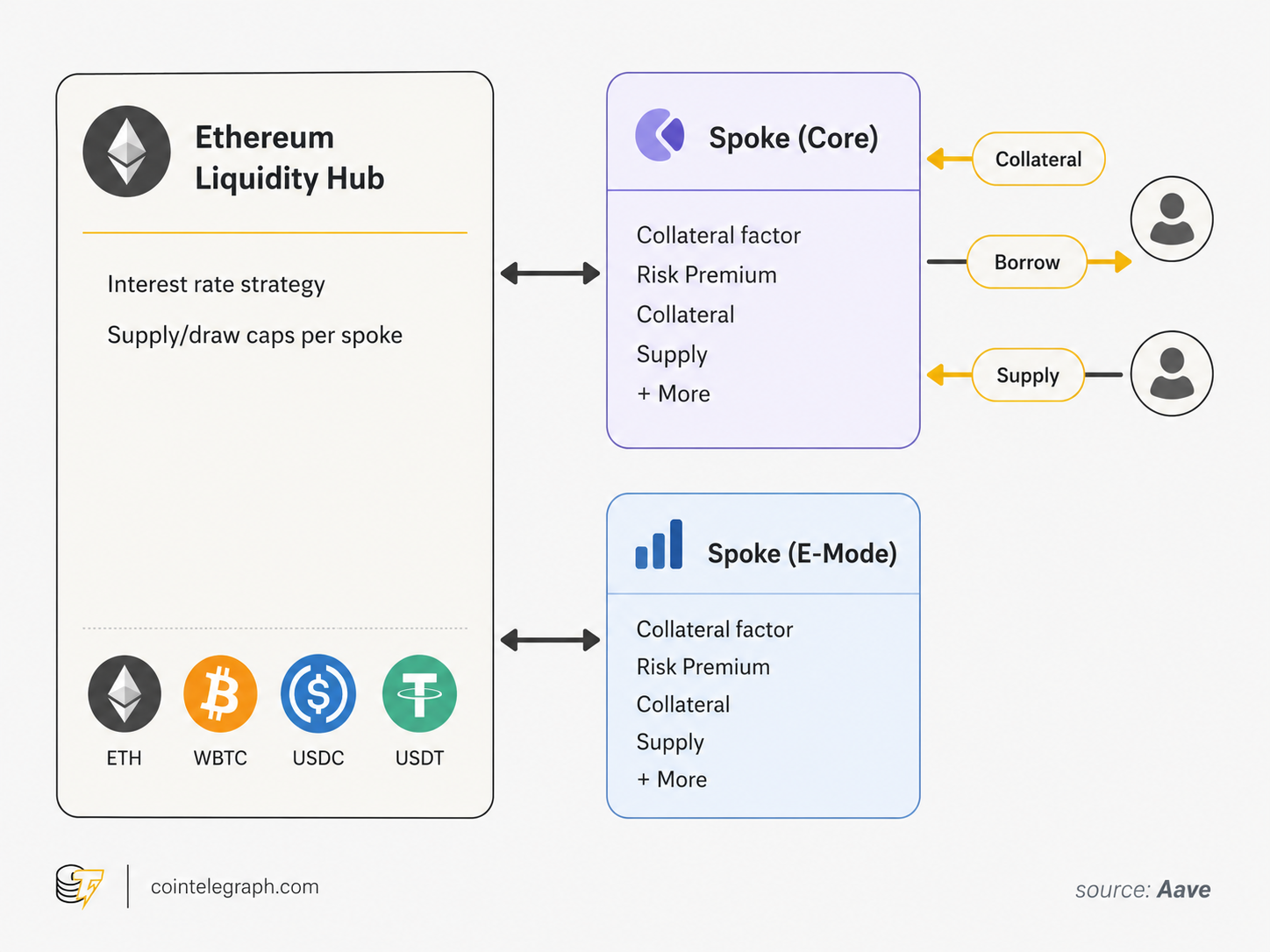
Isolation Mode is designed to contain the potential fallout from riskier types of collateral. Efficiency Mode, or E-Mode, applies tailored parameters for assets that tend to correlate in price. Governance, guided by specialized risk advisors, fine-tunes these parameters as conditions change.
Throughout the recent wave of withdrawals, these protective measures largely performed as intended. The core protocol remained operational, though certain markets experienced significant pressure. Utilization hit 100% in key liquidity pools, which restricted withdrawal access for some participants.
Nevertheless, observers contend that DeFi risk management must continue to evolve. Governance processes can still be slow, and risk frameworks may lag behind rapidly shifting market dynamics.
Stress testing frequently draws on historical data, which can overlook emerging forms of contagion risk. The real challenge lies not just in learning from past failures, but in bracing for threats that have not yet materialized.
The hidden risk of connected DeFi platforms
One of DeFi’s greatest advantages is also one of its greatest vulnerabilities. The very interconnections that make the ecosystem powerful can also make it fragile.
Composability enables different applications to interact and function in tandem. Capital deposited in one protocol can fuel activity in another. This accelerates innovation and can boost overall efficiency. But it also weaves a denser web of dependencies across platforms.
A loan issued on one platform might rely on collateral sourced from another. That same collateral could, in turn, be backing leveraged positions scattered across multiple systems. Over time, this builds an intricate financial web.
During stable market conditions, composability unlocks opportunities that are hard to replicate in traditional finance. But in times of turmoil, it can amplify the likelihood of problems cascading from one platform to the next.
A platform’s resilience cannot be assessed on its own. The health of the broader DeFi ecosystem plays an equally important role.
Did you know? Traditional banks undergo routine stress tests under regulatory oversight. In DeFi, stress tests tend to occur spontaneously in live markets, involving real users, real capital, and no opportunity for rehearsal.
What users should take away
For depositors and investors, this episode serves as a crucial lesson. A protocol’s size and track record should not be mistaken with absolute safety. Users must understand the underlying assets that back the protocols they interact with.
Governance proposals also warrant careful scrutiny, since they shape the safeguards surrounding deposited funds. Diversification remains essential, even within DeFi.
For developers, the message is equally clear. Build for worst-case scenarios and continuously challenge foundational assumptions. They must also recognize that transparency by itself does not eliminate systemic risks.
The episode demonstrates that resilience is best measured through consistent performance across multiple trials, not a single event. One stress test offers valuable insight, but it does not guarantee future outcomes.
Aave passed this test, but questions remain
Aave’s capacity to process approximately $8.45 billion in withdrawals is noteworthy. The protocol stayed functional through one of the most severe liquidity shocks DeFi has encountered.
The outcome is significant, yet it should not be viewed as the definitive assessment of Aave’s risk profile.
Proponents regard it as evidence that open, transparent systems can weather panic without bailouts or emergency interventions. Skeptics, on the other hand, interpret it as a reminder that concealed vulnerabilities may still lurk beneath the surface.
Both perspectives hold merit.
Aave demonstrated that DeFi can endure intense pressure. The greater challenge lies in ensuring that resilience holds when the next crisis arrives in an unforeseen form.
