



# Boston Dynamics Unveils Redesigned Robot Hand Built for Scalable Manufacturing and AI-Driven Learning
**A closer look at the engineering philosophy behind the company’s latest four-fingered gripper and what it means for the future of humanoid robotics.**
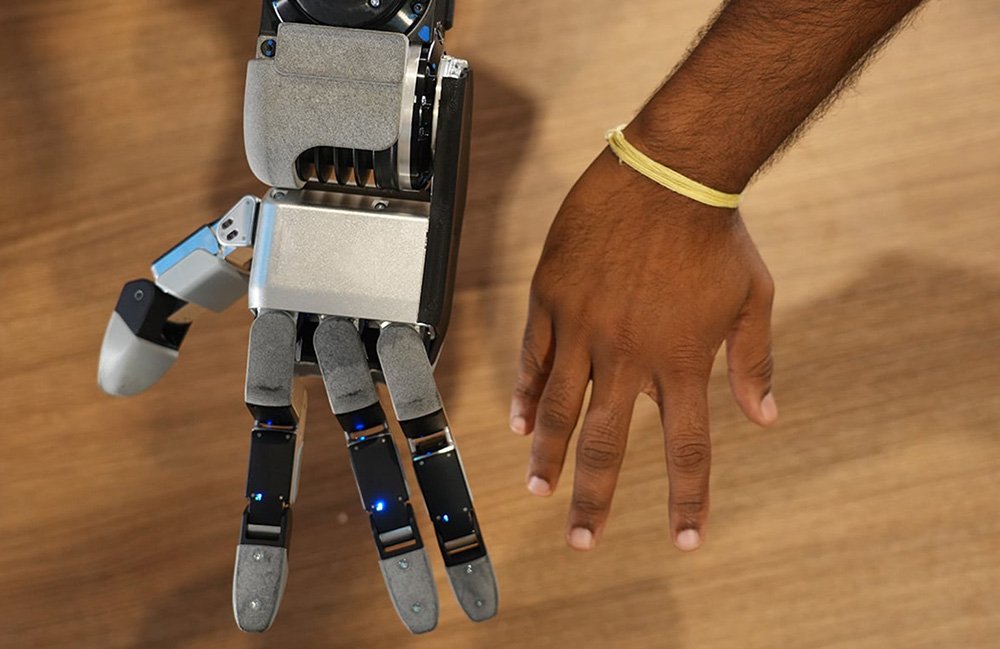
Boston Dynamics has introduced a redesigned humanoid robot hand that reflects years of iterative development and a deliberate shift toward manufacturing at scale. The new gripper, which features four fingers and 13 degrees of freedom, is directly actuated and engineered to be both rugged and precise. It retains the ability to handle objects weighing over 100 pounds while incorporating a more compact form factor than its predecessors.
The hand represents a significant evolution in how the company approaches robot design — prioritizing reliability, simulation fidelity, and compatibility with reinforcement learning pipelines. Alberto Rodriguez, who leads robot behavior for the company’s Atlas platform, provided detailed insight into the decisions and tradeoffs that shaped the latest iteration.
—
## A Design Philosophy Rooted in Lessons Learned
Boston Dynamics drew extensively on its experience building and deploying the Atlas humanoid platform over the years. Rodriguez explained that having a long-term product roadmap allowed engineers to make informed decisions about how much complexity to embed into the hand without sacrificing durability or driving up costs.
“We have learned things from the design of Atlas’ body,” Rodriguez said. “There are things like simplicity, modularity, and actuator maturity that make sense in theory, but over time, you start appreciating the huge impact they have in the velocity you can move.”
The new hand is constructed from 13 identical actuators that are completely self-contained. Unlike earlier iterations, no fragile cables pass through the joints, a change that has already proven beneficial in early testing. The modular approach allows teams to focus their efforts on refining a smaller set of critical components rather than grappling with a sprawling, overly complex system.
Rodriguez also noted that previous hands demonstrated more than enough strength for heavy lifting, so the team was free to reduce force requirements slightly in order to improve actuation transparency — a quality that makes the hand feel more responsive and natural during controlled manipulation.
—
## Why Build In-House?
When asked whether the team considered using commercially available end effectors, Rodriguez emphasized that hands are too central to the value proposition of a humanoid robot to outsource. “Hands are a key piece of technology that are so integral to the value proposition of humanoids that it would be very difficult for us to approach it in any other way than in-house,” he said.
Every hand design involves a set of consequential tradeoffs, and the team’s product roadmap serves as the guiding framework for determining which capabilities are non-negotiable and which can be deprioritized.
—
## The Four-Finger Decision: No Pinky, No Extra Thumb
One of the most visually striking differences in the new hand is the absence of a pinky finger. The team also slimmed down the overall gripper profile. The decision to go with four fingers was informed by a careful analysis of the motions most critical to the hand’s intended tasks.
Key manipulative motions that drove the design include:
– Sliding the fingertip of the thumb along the full length of the other fingers
– Moving the thumb fingertip across the other fingers for lateral manipulation
– Executing a dexterous pinch grasp by rocking the thumb against the index finger
– Applying power grasps on triggered tool handles for industrial use
The team also seriously explored a design featuring two thumbs — one on each side — which would have eliminated the need for separate left and right hands on a single assembly line. Ultimately, the additional actuation complexity, extra degrees of freedom, and increased cost led them to abandon the concept in favor of the current four-finger layout.
—
## Built for Simulation and Reinforcement Learning
Perhaps the most forward-looking aspect of the new hand is its design for high-fidelity simulation. Rodriguez explained that the actuation and transmission systems were developed with backdrivability and transparency as primary objectives. The team also created control-level techniques to compensate for residual non-idealities, such as varying friction profiles in the joints.
This attention to simulation accuracy is critical for the company’s strategy of using sim-to-real reinforcement learning. By training policies in simulated environments where the physics closely mirror real-world behavior, Boston Dynamics can develop sophisticated manipulation skills that transfer directly to hardware.
“This is the exact same recipe that has succeeded for agile humanoid behavior in the past few years,” Rodriguez said. “Build actuators that simulate well, and then rely on RL at scale.”
He expressed confidence that reinforcement learning will unlock the next generation of dexterous manipulation — tasks far more complex than simple pick-and-place operations. Many of these skills involve rapid, subtle shifts in contact and pressure distribution that are extremely difficult to replicate through teleoperation or direct demonstration.
—
## Tasks and Testing
Boston Dynamics has put the new hands through an extensive range of evaluations. The test suite includes common industrial activities such as operating handheld power tools, routing cables, and retrieving screws from bins. The team has also used the hands for benchmarking exercises against older gripper designs and for exploratory tasks that push the boundaries of what the mechanism can achieve.
On the lighter side, Rodriguez mentioned that the team has experimented with various juggling patterns and speed-based hand games — tasks inspired by human athletic feats like parkour and gymnastics. These activities serve double duty: they are engaging demonstrations and also rigorous stress tests for dexterity and coordination.
—
## Durability and the Road to Deployment
Ensuring that the gripper can withstand continuous operation across multiple shifts is a top priority. Rodriguez described a rigorous development process that involves early prototyping, cross-team collaboration between hardware and behavior engineers, and exhaustive validation and verification testing.
While this methodical approach may initially slow down the pace of hardware updates, it ultimately accelerates deployment by catching and resolving issues before they reach the field. The new hands have been used extensively at Boston Dynamics’ headquarters but have not yet been rolled out to the full Atlas robot fleet. That transition requires careful coordination to avoid disrupting ongoing data collection and application work.
—
## FAQ: Boston Dynamics’ New Humanoid Robot Hand
**Q: What are the key specifications of Boston Dynamics’ new robot hand?**
A: The hand features four fingers, 13 degrees of freedom, and is directly actuated. It is capable of handling objects exceeding 100 pounds and was designed with mass manufacturing in mind.
**Q: How is this hand different from previous versions?**
A: The new hand drops the pinky finger, features a smaller gripper, uses 13 identical fully encapsulated actuators with no cables passing through joints, and is optimized for high-fidelity simulation and reinforcement learning.
**Q: What manufacturing considerations went into the design?**
A: The team focused on simplicity, modularity, and actuator maturity to enable faster development cycles and lower production costs. The decision to use four fingers rather than five, and to avoid a dual-thumb configuration, was driven by a need to balance capability with cost and reliability at scale.
**Q: Why is simulation important for this hand?**
A: The hand’s actuators and transmissions are designed to behave accurately in simulated environments, which is essential for training manipulation policies using reinforcement learning. Policies trained in simulation can transfer effectively to real hardware, enabling capabilities that are difficult to achieve through manual programming or teleoperation.
**Q: Has the new hand been deployed on the full Atlas robot fleet yet?**
A: No. The hands have been tested extensively in-house but have not yet been deployed across the entire fleet. The company is taking a careful, coordinated approach to integration to avoid disrupting existing operations.
**Q: What kinds of tasks has the hand been tested on?**
A: Testing includes industrial tasks such as using power tools, handling cables, and retrieving screws, as well as dexterity-focused activities like juggling and speed hand games.
**Q: What role does reinforcement learning play in the hand’s development?**
A: Reinforcement learning is central to the hand’s long-term strategy. By training in high-fidelity simulations, the team aims to develop advanced manipulation policies that handle complex, contact-rich tasks beyond simple pick-and-place operations.
—
## Conclusion
Boston Dynamics’ redesigned robot hand is more than an incremental hardware update — it represents a convergence of manufacturing pragmatism, AI-driven learning, and years of hard-won engineering insight. By stripping away unnecessary complexity, prioritizing simulation fidelity, and leaning on reinforcement learning as a core development tool, the company is positioning its humanoid platform for a future where dexterous manipulation can scale beyond laboratory demos and into real-world industrial settings. The decisions made about finger count, actuation architecture, and testing methodology all point to a singular goal: building a robot hand that is not only capable but also producible, maintainable, and continuously improvable through data-driven learning.
Thank you for reading
