



# Fastening Technology: A Comprehensive Guide to Modern Assembly Tools
## The Foundation of Product Assembly
Fastening remains the backbone of modern product assembly across virtually every industry. From automotive manufacturing to aerospace engineering, threaded fasteners provide a reliable, versatile, and efficient method for joining components. Whether installing screws, nuts, rivets, or lock-bolts, modern assembly operations demand tools that deliver precision, consistency, and speed.
Today’s fastening technology spans a remarkable range of equipment. Manufacturers can choose from cordless nutrunners, pneumatic screwdrivers, screwfeeders, digital torque wrenches, blind rivet tools, hydropneumatic riveters, and much more. These tools can be operated manually, powered by compressed air, driven by batteries, or integrated into robotic systems for fully automated assembly lines. The key is selecting the right tool for the specific application, ensuring that every fastener is installed to exact specifications.
## Cordless Tools: Power Meets Precision
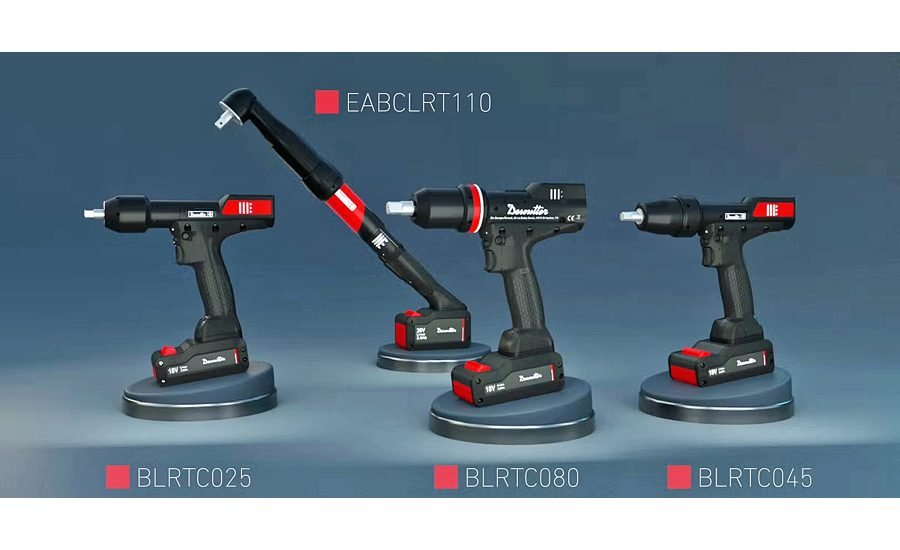
One of the most significant trends in fastening technology is the development of high-performance cordless tools. The BLRTC080 cordless pulse tool from Desoutter Industrial Tools exemplifies this evolution. This pistol-grip tool combines the raw power of an impact tool with the precision of electronic control, delivering a torque range of 40 to 80 newton-meters at speeds up to 4,000 rpm.
What sets modern cordless pulse tools apart is their ergonomic design and advanced technology. The ErgoShield gearbox reduces pulse duration by up to five times compared with conventional pulse tools, while remaining oil-free to minimize maintenance. Progressive Pulse technology allows the tool to handle softer joints without overshooting torque targets, making it suitable for a wider range of applications with consistent results. The reduced amplitude level from the first pulse also lowers torque reaction, significantly improving the operator experience during extended shifts.
HST USA Inc. offers the TBII series of cordless tools featuring a high-precision clutch that shuts off the tool at the exact right moment. Powered by a 12-volt battery, these tools cover a torque range of 0.5 to 12 newton-meters and can be managed through an on-board web-based user interface. With angle-head nutrunners planned for 2027, the line is expanding to meet diverse assembly needs.
## Precision Torque Control
Accurate torque application is critical in any fastening operation. Under-tightening can lead to joint failure, while over-tightening can strip threads or damage components. Digital torque wrenches and transducerized screwdrivers address these challenges head-on.
The LightStar torque wrench from Datamyte is purpose-built for auditing applications. Its angle restart algorithm measures torque the instant a fastener starts retightening after overcoming static friction, giving operators immediate feedback on residual torque in the joint. With multiple measurement algorithms including breakaway, loosening, angle breakaway, and peak recording, this tool provides comprehensive data for quality assurance. The LightStar is also insensitive to the point of load, ensuring consistent readings regardless of how the tool is positioned.
Delta Regis Tools’ ESP-XTA series of transducerized pistol-grip screwdrivers offers real-time torque monitoring and closed-loop control for precision fastening on every cycle. With a torque range of 0.1 to 3 newton-meters, these tools excel in light-duty, high-precision assembly applications. When paired with the BCS-Connect controller, engineers gain complete programming capabilities, real-time feedback, and seamless data collection. The tool also detects cross-threading, stripped threads, and missed fastenings, preventing defective assemblies from moving to the next stage of production.
Nitto Kohki’s Delvo S series electric screwdriver provides programmable three-stage speed control that eliminates common problems like stripped screws, cross-threading, and damaged threads. The soft start feature ensures smooth insertion, while high-speed driving boosts productivity. A built-in screw counter tracks valid fastenings per batch, and the tool provides audible feedback on run-down quality. Settings can be configured for multiple tools simultaneously via a remote controller, and the tool can store eight fastening programs for quick changeovers.
## Riveting Solutions
Riveting remains essential in industries where welding or threading is impractical. The iBird Pro from SFS Group USA is a networked, battery-powered blind rivet tool that can be connected and operated via a smartphone or tablet app. With simple QR code connectivity, the app can manage up to three riveters simultaneously, displaying operating status, battery life, fill levels, and detailed riveting statistics at a glance. An andon ring on the tool provides visual signals during the riveting process, and fault detection triggers both app notifications and colored light alerts. The tool installs rivets from 2.4 to 6 millimeters in diameter with a maximum setting force of 20,000 newtons.
For heavy-duty applications, RivetKing’s RK-986 and RK-987N hydropneumatic tools deliver the force needed for larger fasteners. The RK-986 installs blind rivets and lock-bolts from 3/16 to 1/2 inch in diameter, while the RK-987N is specifically designed for rivet-nut installation up to 3/4 inch in diameter. By separating the hydraulic power unit from the handheld tool and housing it in a wheeled enclosure, these systems reduce operator fatigue while maintaining the power required for demanding applications.
## Specialized Fastening Accessories
Accessories play a vital role in optimizing fastening operations. Luebbering Corp. offers an attachment that boosts the torque output of a cordless tool from 13.5 newton-meters up to 150 newton-meters. The attachment can be configured as reaction-free or with a custom-designed reaction arm, and interfaces are available for tools from all major manufacturers.
Gage Bilt Inc. addresses the challenge of collar placement for lock-bolts with the GB5500 collar feeder. This ergonomic and lightweight device automatically feeds the next collar into position, reducing installation times and eliminating concerns about foreign object damage in sensitive applications like aerospace assembly. Cartridges are quickly refilled using an automatic bowl feeder and cartridge adapter.
Wera Tools’ Zyklop ratchet wrenches combine ergonomics with precision. The ¼-inch Zyklop Comfort features an 80-tooth ratchet with a return angle of only 4.5 degrees, delivering precision tightening in tight spaces. The slip-proof plastic sleeve provides comfort across temperature extremes, and the push-button socket locking ensures a secure fit. The Zyklop VDE 8007 variant is rated for electrical applications up to 1,000 volts.
Cementex Products Inc. offers torque wrenches in ¼, 3/8, and ½-inch square drives with dual-scale readings and calibration adjustments for easy, precise settings. These tools meet or exceed ASME and ISO standards and feature insulation coating for protection against 1,000 volts.
## Choosing the Right Fastening Solution
Selecting the appropriate fastening tool depends on several factors, including the type of fastener, material being joined, required torque specifications, production volume, and the working environment. For high-volume production lines, pneumatic pulse tools and automated nutrunners offer speed and repeatability. For applications requiring traceability and data logging, transducerized screwdrivers with digital controllers are the better choice. In overhead or hard-to-reach positions, cordless tools and specialized feeders like the GB5500 collar feeder improve ergonomics and efficiency.
The diversity of fastening technology available today ensures that manufacturers can find solutions for every application, from delicate electronic assembly to heavy industrial construction.
—
## Frequently Asked Questions (FAQ)
**Q: What are the main types of fastening tools available?**
A: The main types include cordless pulse tools, pneumatic pulse tools, electric screwdrivers, digital torque wrenches, transducerized screwdrivers, hydropneumatic riveters, blind rivet tools, and manual ratchet wrenches. Each type is designed for specific applications, torque ranges, and production environments.
**Q: How do I choose between cordless and pneumatic fastening tools?**
A: Cordless tools offer greater mobility and flexibility without requiring compressed air infrastructure, making them ideal for mobile assembly or areas where hoses are impractical. Pneumatic tools generally deliver higher torque and are better suited for high-volume, stationary production lines with existing air supply systems.
**Q: Why is torque accuracy so important in fastening?**
A: Incorrect torque can lead to joint failure (too little torque) or component damage such as stripped threads, cracked materials, or deformed parts (too much torque). Precise torque control ensures consistent joint quality, product reliability, and safety.
**Q: What should I look for in a fastening tool for an assembly line?**
A: Key factors include the required torque range, speed, ergonomics for the operator, data collection and traceability capabilities, ease of tool changeover, maintenance requirements, and compatibility with your existing production systems.
**Q: Can fastening tools be integrated into automated or robotic systems?**
A: Yes, many modern fastening tools are designed for robotic integration. Features like digital controllers, programmable sequences, and communication interfaces (such as I/O terminals) make them suitable for automated assembly lines, including robotic bolt installation.
**Q: How do blind rivet tools work?**
A: Blind rivet tools install rivets from one side of a joint, using a mandrel that is pulled to expand the rivet body against the backside of the material. Once the rivet is set, the mandrel breaks off, leaving a secure, flush joint. This makes them ideal for applications where access to both sides of the joint is not possible.
**Q: What are collar feeders used for?**
A: Collar feeders automatically place lock-bolt collars onto fasteners, streamlining the installation process and reducing the risk of dropping or fumbling collars, especially in overhead or challenging positions. They improve efficiency and help prevent foreign object contamination in critical assemblies.
—
## Conclusion
Fastening technology has evolved dramatically, offering assembly professionals an unprecedented range of tools to meet the demands of modern manufacturing. From lightweight cordless pulse tools that minimize operator fatigue to hydropneumatic riveters capable of installing large lock-bolts, today’s fastening solutions deliver a combination of precision, power, and intelligence that was unimaginable just a generation ago.
The integration of digital controls, real-time monitoring, and app-based connectivity has transformed fastening from a simple mechanical task into a data-driven process. These advances enable manufacturers to achieve higher quality standards, reduce waste, and maintain detailed traceability records for every fastener installed.
As industries continue to evolve and new materials and assembly methods emerge, fastening technology will continue to advance, providing even more sophisticated solutions for joining components reliably and efficiently.
Thank you for reading
