



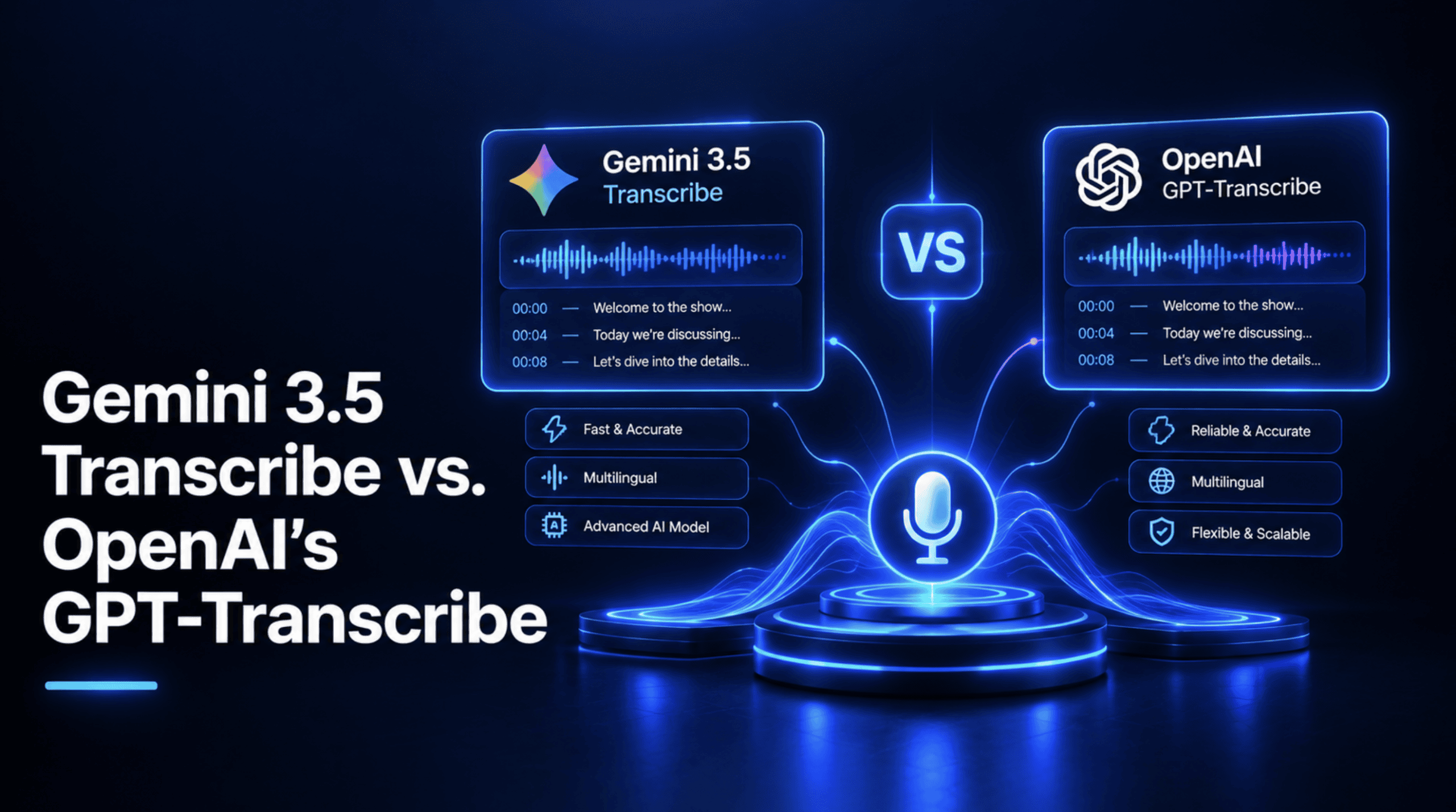
The landscape of automatic speech recognition shifted significantly in the summer of 2026 when two major AI laboratories released their newest transcription engines. Google introduced its latest offering at the end of August, followed closely by OpenAI’s mid-July launch. Because these models arrived within weeks of each other, evaluating them side-by-side provides genuinely relevant insights for developers choosing a transcription pipeline today. Both companies adopted a dual-path strategy: a low-latency model for continuous, real-time audio, and a high-accuracy model for pre-recorded files.
### Google’s Latest Transcription Engine
Google’s newest transcription model represents a major leap over its previous generation, emphasizing processing speed—a seventy percent reduction in the time it takes to finalize a transcript. It is offered under two distinct identifiers for developers. The streaming variant delivers sub-second latency for continuous audio, while the offline variant excels at processing meetings and call recordings.
Benchmarks indicate a general word error rate of 4.0% for live streams and 2.6% for static files. On multilingual tests, the error rate sits around five percent. What truly sets this model apart is its native multi-speaker identification, which reliably tracks up to three distinct voices out of the box, along with precise word-level timestamps. It also supports over eighty-five languages, allows developers to inject custom terminology, and features an extensible architecture capable of triggering follow-up tasks like image generation through agentic function calling.
### OpenAI’s Latest Transcription Model
OpenAI’s entry continues the evolution of its speech-to-text architecture, dramatically outperforming its predecessors on benchmark datasets by cutting error rates in half compared to older versions. Priced at half a cent per minute for file uploads and roughly two cents per minute for live sessions, it is a highly cost-effective choice for high-volume processing.
The model accepts keyword and language hints, making it adaptable for domain-specific jargon and code-switching, and it can report which language it detected in the audio. However, the base streaming and file models lack built-in speaker separation and word-level timestamps; achieving those features requires relying on older or separate systems.
### Practical Scenarios
When a team needs to transcribe a recorded discussion among three colleagues and requires an immediate breakdown of who spoke when, the Google model’s built-in attribution provides a seamless workflow, eliminating the need for a secondary diarization step. The output can be fed directly into an analytics pipeline with speaker labels and timestamps intact.
Conversely, for a live event requiring on-screen text captions with minimal delay and minimal per-minute cost, the OpenAI model shines. Its continuous streaming approach feeds partial text to the display continuously as the speaker talks, ensuring captions stay perfectly in sync without waiting for the audio file to finish.
### Feature Comparison at a Glance
* **Release Dates:** Google’s model launched on August 26, 2026; OpenAI’s launched on July 28, 2026.
* **Real-Time Error Rate:** Google achieves a 4.0% word error rate in streaming mode; OpenAI demonstrates a roughly 19% word error rate on its primary multilingual benchmarks.
* **Speaker Separation:** Native in Google’s pre-recorded model (up to three speakers); absent in OpenAI’s current base model.
* **Timestamps:** Native word-level timestamps available in Google’s model; unavailable in OpenAI’s current base offering.
* **Language Coverage:** Google supports over eighty-five languages; OpenAI supports two dozen-plus languages with flexible hinting capabilities.
* **Pricing:** OpenAI publishes its rates at $0.0045 per minute for files and $0.017 per minute for streaming. Google has not yet published per-minute pricing for either its streaming or file models.
### Frequently Asked Questions
**1. Which model is better for transcribing multi-person meetings?**
Google’s offering is the clear winner for meetings. Its built-in speaker attribution and native word-level timestamps provide a complete, structured transcript in a single step, whereas the OpenAI model requires separate, additional processing to achieve the same result.
**2. Does OpenAI’s transcription model support custom vocabulary?**
Yes. While OpenAI does not offer a dedicated custom vocabulary dictionary, it accepts keyword and language hints that help the model recognize domain-specific terms and handle instances where speakers switch languages mid-sentence.
**3. Is Google’s streaming transcription more expensive than OpenAI’s?**
As of the latest available data, Google has not publicly disclosed per-minute pricing for its transcription models, either for streaming or pre-recorded files. OpenAI’s streaming model is priced at $0.017 per minute, providing a known, cost-effective baseline for high-volume live captioning.
**4. Can I use OpenAI’s model to get timestamps?**
Not natively in the current base transcription model. The OpenAI base model returns continuous text without word-level timing information. To get timestamps or speaker separation, developers currently need to route audio through older or separate models within the OpenAI ecosystem.
**5. How do I choose between a streaming and a pre-recorded model?**
Choose a streaming model if you are building live captioning, real-time translation, or interactive voice applications where latency matters more than perfect final accuracy. Choose a pre-recorded model if you are processing meetings, podcasts, or call logs where accuracy, speaker identification, and precise timestamps are the top priorities.
### Conclusion
The choice between these two transcription engines ultimately depends on the complexity of the audio and the requirements of the downstream application. If the goal is to analyze multi-voice conversations with detailed attribution and timing in a single, integrated step, Google’s latest model offers a compelling, all-in-one solution. For straightforward single-speaker dictation or live captioning where budget and integration speed are top priorities, OpenAI’s model offers a lean, cost-effective alternative. Thank you for reading
