



# Sarvam AI’s Saaras V4: A New Era for Multilingual Speech Recognition Across India
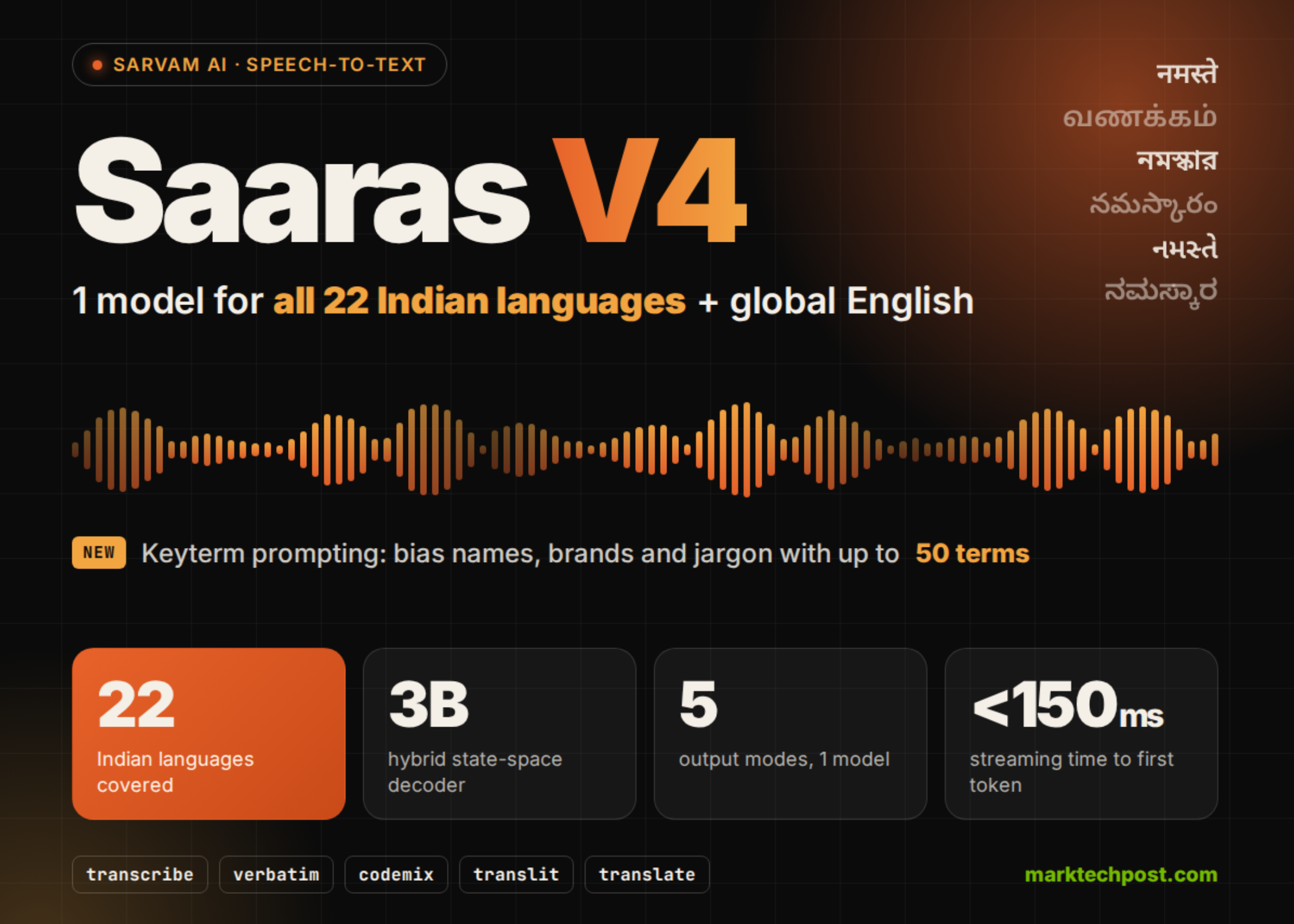
The landscape of automatic speech recognition (ASR) is undergoing a significant shift as companies race to serve India’s extraordinarily diverse linguistic ecosystem. Sarvam AI has entered the conversation with Saaras V4, the fourth iteration of its speech recognition model, which now covers all 22 scheduled Indian languages along with English in multiple accent variations.
This article takes a detailed look at what makes Saaras V4 stand out, how it works under the hood, what benchmarks it claims to meet, and what developers and enterprises need to know about deploying it in real-world applications.
—
## What Is Saaras V4?
Saaras V4 is the latest generation of Sarvam AI’s speech-to-text model. It is designed to handle speech input across all 22 scheduled languages of India — including Hindi, Tamil, Telugu, Bengali, Marathi, Gujarati, Kannada, Malayalam, Odia, Punjabi, Assamese, Maithili, Urdu, and others — alongside English. A notable addition in this version is support for global English accents, expanding beyond Indian English to capture a wider range of pronunciation patterns.
According to the company, Saaras V4 achieves state-of-the-art accuracy across all 22 languages, making it one of the most comprehensive multilingual ASR models available today.
## How Saaras V4 Works: Architecture Deep Dive
At its core, Saaras V4 follows an encoder-decoder design that is both modular and efficient.
### Audio Encoder
The first stage of the pipeline is an audio encoder that takes raw waveform input and converts it into rich, high-dimensional embeddings. These embeddings capture the phonetic and acoustic details of the spoken language — the subtle tones, consonants, vowel lengths, and prosodic features that differentiate one language or dialect from another.
### Temporal-Downsampling Adapter
Once the encoder produces its output, a temporal-downsampling adapter compresses the sequence along the time axis. This compression serves a critical purpose: it shrinks the length of the embedding sequence so that it can fit comfortably within the context window of the language model. Without this step, longer audio recordings — such as a 30-minute meeting or podcast episode — would exceed the model’s processing capacity.
### Sarvam-3B Decoder
The compressed embeddings are then fed into the decoder, which is Sarvam-3B, a 3-billion-parameter hybrid state-space language model. This model was trained from scratch in-house by Sarvam AI, meaning its architecture and training pipeline were designed specifically for this task rather than being adapted from a general-purpose language model.
Sarvam-3B reads the audio embeddings alongside a text prompt (such as a system instruction or context hint) and generates the transcript autoregressively — that is, it predicts one token at a time, with each predicted token being fed back into the model as input for the next prediction step. This autoregressive approach allows the model to produce fluent, contextually coherent transcriptions.
## Five Output Modes From a Single Model
One of the most practical features of Saaras V4 is its support for five distinct output modes, all accessible through a single `mode` parameter in the API request:
| Mode | Description | Best Use Case |
|——|————-|—————|
| **Transcribe** | Default mode; outputs native script with numbers and dates normalized into standard formats | General transcription, documentation |
| **Verbatim** | Captures every word exactly as spoken, including fillers and spoken numbers without normalization | Legal proceedings, media subtitles |
| **Codemix** | Native script output where English words remain in English rather than being transliterated | Hinglish or Tanglish content, social media |
| **Translit** | Full utterance rendered in Latin (Roman) script | International audiences, analytics pipelines |
| **Translate** | English translation with numbers normalized | Cross-language content workflows |
The rationale behind embedding all five modes inside the model is straightforward: it eliminates the need for separate post-processing pipelines that can introduce cascading errors. By handling normalization, transliteration, and translation within a single model pass, Sarvam claims greater consistency and fewer mistakes compared to chaining multiple tools together.
## Keyterm Prompting
A new feature introduced with V4 is keyterm prompting. This allows developers to pass a JSON list of important terms — up to 50 terms, each up to 64 characters — via the `keyterms` parameter. The model then biases its recognition toward these terms, increasing the likelihood that domain-specific names, brands, or jargon are transcribed correctly.
It is important to note that keyterm prompting biases recognition rather than guaranteeing accuracy. The model will prioritize the provided terms where possible, but it does not override the acoustic evidence entirely. For brand names that must remain in Latin script, developers are advised to use the `codemix` output mode.
On the IndicContextEval benchmark (presented at Interspeech 2026), Saaras V4 achieved a Word Error Rate (WER) of 16.03% in the L5 keyword-prompting configuration, which Sarvam reports as the lowest score on that benchmark.
## Benchmark Results
Sarvam has published a range of benchmark results for Saaras V4 across several evaluation suites. It is worth noting that all numbers below are vendor-reported, and independent third-party reproduction has not yet been published.
### English Performance
The company evaluated Saaras V4 against seven English-language datasets. Six of these — AMI, GigaSpeech, LibriSpeech clean, LibriSpeech other, SPGISpeech, and VoxPopuli — come from Hugging Face’s Open ASR Leaderboard. The seventh is AI4Bharat’s Svarah dataset, which tests recognition of Indian-accented English. Using the normalization code from the Open ASR Leaderboard, Saaras V4 achieved the lowest average Word Error Rate among the models that Sarvam benchmarked against.
### Indic Language Performance
For Indian languages, Sarvam used Vistaar as the evaluation suite, testing across 10 languages. Two metrics were reported: standard WER and LLM-WER. The latter introduces a semantic layer by using a large language model to verify whether errors in the transcription actually change the meaning of the sentence. This approach helps distinguish between genuine comprehension errors and harmless spelling or formatting variants that are common across Indic scripts.
### Noisy Audio Performance
On the Kathbath Noisy dataset, which includes compressed, clipped, and background-heavy recordings, Saaras V4 demonstrated strong noise resilience. Measured with LLM-WER, the model’s error rate was reported as less than half that of Deepgram Nova-3 and GPT-4o Transcribe on the same benchmark set.
### Language Identification
Saaras V4 also includes a built-in language identification component. On verified IndicVoices utterances, the error rate for identifying the correct language is 2.9% across the top 10 Indian languages and 5.22% across all 22 languages covered by the model.
## Streaming, Long Audio, and API Capabilities
Saaras V4 supports three operational modes suited to different use cases:
– **Streaming via WebSocket**: Delivers partial transcription results in real time with time-to-first-token latency below 150 milliseconds. This makes it well-suited for voice assistants and interactive applications where low latency is critical.
– **REST API (Synchronous)**: Handles shorter audio clips up to 30 seconds. This is ideal for quick, one-off transcription tasks.
– **Batch Processing (Asynchronous)**: Supports files up to 2 hours in length, with optional speaker diarization that identifies and labels different speakers within the audio.
### SDKs and Integrations
Sarvam provides Software Development Kits for Python (version 3.9 and above) and Node.js (version 18 and above). Additionally, the model integrates with popular agent-building and voice infrastructure platforms including LiveKit Agents, Pipecat, and the Vercel AI SDK, making it easier to embed transcription capabilities into existing technology stacks.
## Pricing
Sarvam’s pricing structure for speech-to-text is transparent and tiered:
– **₹30 per hour** for standard transcription via real-time streaming, REST, and batch APIs.
– **₹45 per hour** for batch transcription with speaker diarization enabled.
For context, switching from Saaras V3 to V4 is a minimal effort — the API request shape is identical, requiring only a one-line change to update the model identifier to `model=”saaras:v4″`.
## Is It Deployable Today?
Yes. Saaras V4 is available through Sarvam’s API today. Developers can access it by specifying `model=”saaras:v4″` in their requests. However, it is important to note that the model weights are not publicly available. Sarvam’s self-hosting documentation via SageMaker currently covers Saaras V3, and V4 is accessed exclusively through the cloud API at this time.
—
## Frequently Asked Questions (FAQ)
**Q: What languages does Saaras V4 support?**
A: Saaras V4 covers all 22 scheduled Indian languages plus English, including both Indian English and global English accents.
**Q: Is Saaras V4 available as open-source weights?**
A: No. The model weights are not publicly released. Access is provided through Sarvam’s API and its managed infrastructure.
**Q: Can I use Saaras V4 for real-time streaming applications?**
A: Yes. It supports WebSocket streaming with time-to-first-token latency below 150 milliseconds, making it suitable for voice agents and interactive use cases.
**Q: What is the maximum file length I can transcribe?**
A: The REST API handles clips up to 30 seconds. The batch API supports files up to 2 hours per file, with an optional speaker diarization feature.
**Q: How much does Saaras V4 cost?**
A: Standard transcription is priced at ₹30 per hour. With speaker diarization enabled, the cost is ₹45 per hour.
**Q: What are the five output modes and when should I use each?**
A: The five modes are transcribe (general purpose), verbatim (exact speech capture), codemix (native script with English words preserved), translit (Latin script output), and translate (English translation). Choose based on whether you need normalized text, raw speech, code-mixed content, romanized text, or an English translation.
**Q: Does keyterm prompting guarantee that specific words will be transcribed correctly?**
A: No. Keyterm prompting biases the model toward specified terms but does not override acoustic evidence. It increases the probability of correct recognition for listed terms but does not guarantee it.
**Q: Can I upgrade from Saaras V3 to V4 easily?**
A: Yes. The API request shape is identical between V3 and V4, so switching requires only changing the model identifier from `saaras:v3` to `saaras:v4`.
**Q: What benchmarks has Saaras V4 been evaluated on?**
A: Sarvam reports results on the Open ASR Leaderboard (English datasets), Vistaar (Indic languages), Kathbath Noisy (noisy audio), IndicContextEval (keyword prompting), and IndicVoices (language identification). Independent reproduction of these benchmarks has not yet been published.
**Q: Does Saaras V4 support speaker diarization?**
A: Yes, but only through the batch API as an optional feature. It is not available in streaming or REST modes.
—
## Conclusion
Sarvam AI’s Saaras V4 represents a significant step forward in multilingual speech recognition, particularly for the Indian subcontinent. By covering all 22 scheduled Indian languages alongside English — including global English accents — and delivering five distinct output modes from a single model, it offers developers a versatile and unified solution for a wide range of transcription needs.
The encoder-decoder architecture, built around a purpose-built 3-billion-parameter hybrid state-space model, provides a compelling balance of efficiency and accuracy. Features like keyterm prompting, low-latency streaming, and support for long-form batch processing with diarization further strengthen its appeal for enterprise and consumer applications alike.
While the vendor-reported nature of the benchmarks calls for independent validation, the breadth of language coverage, the thoughtful design of output modes, and the competitive pricing position Saaras V4 as a noteworthy contender in the crowded ASR landscape. For developers building voice-driven applications in or involving Indian languages, it is certainly a model worth exploring.
Thank you for reading
