



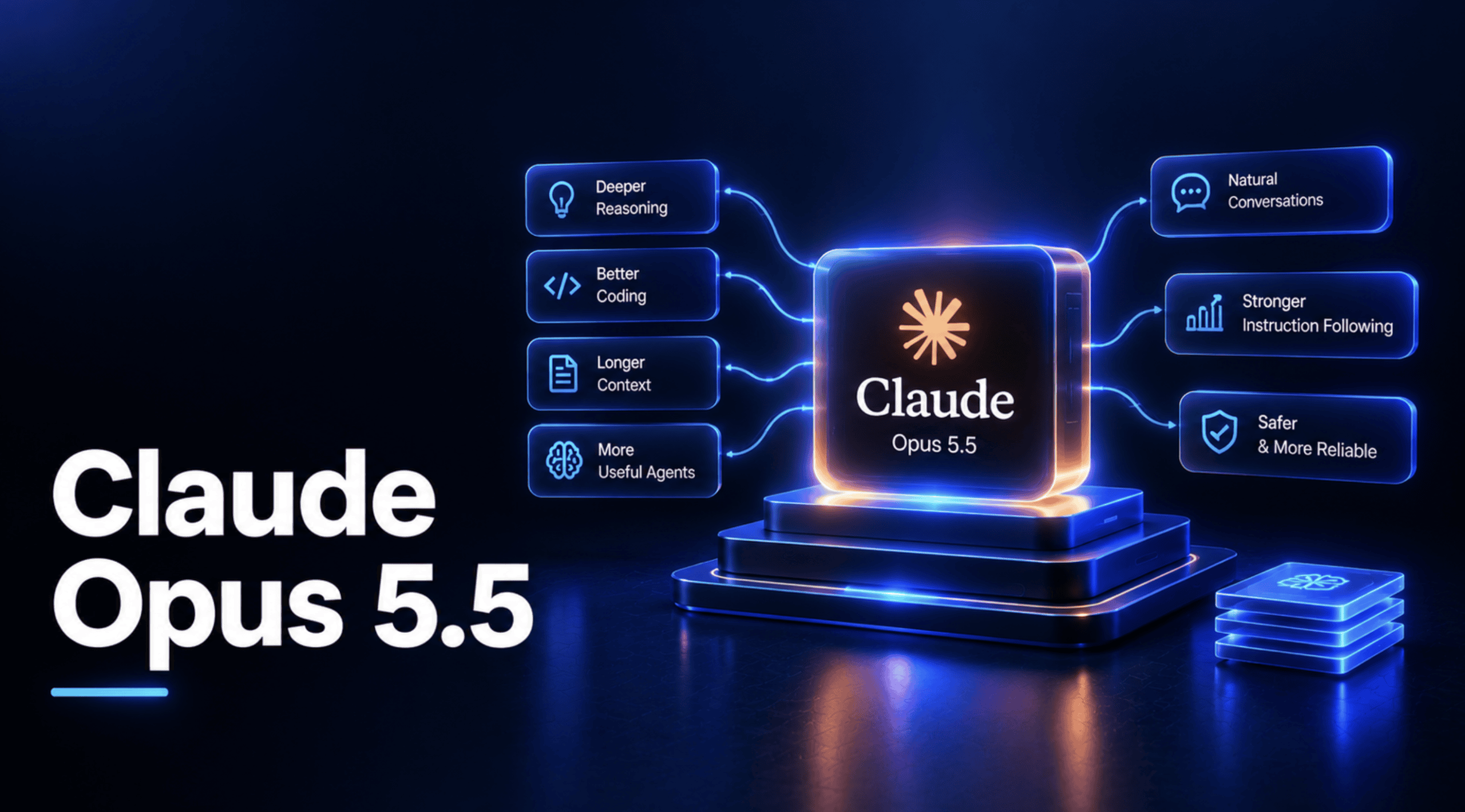
**Claude Opus 5.5: A Comprehensive Look at Anthropic’s Latest Flagship Model**
Anthropic officially introduced Claude Opus 5.5 to the world on September 22, 2026. As the inaugural model of the new Claude 5.5 family, it arrives just two months after the original Opus 5 launched in July 2026. Anthropic positions Opus 5.5 as the most capable model it has ever tested internally, claiming that it matches the performance of the company’s newer Fable 5.1 across most tasks while delivering a 40% reduction in typical operational costs compared to its predecessor.
This new release focuses on five primary upgrades: significantly stronger agentic coding capabilities, enhanced knowledge work performance, a 40% drop in typical running costs, output generation that is over 30% faster, and a marked improvement in writing clarity and conciseness.
**Performance and Benchmarking**
Independent testing by Artificial Analysis provides a granular look at Opus 5.5’s capabilities. When run at maximum reasoning effort, the model achieves a score of 58 on the Artificial Analysis Intelligence Index, an aggregate score derived from ten separate evaluations. Output speeds range from 74 to 86 tokens per second, depending on the effort level, and cost per intelligence-index task varies dramatically from $0.55 at low effort up to $5.98 at maximum effort—an 11x spread across the available effort settings.
In the realm of coding, the improvements are substantial. In a notable internal demonstration, an early tester migrated a 680,000-line codebase in under a day—a project that typically requires weeks of engineering effort. Another test saw the model audit and repair a 200,000-line codebase in under three hours, a task that previously took Opus 5 over 20 hours and consumed 2.5 times the token count. When translating HAProxy from C to Rust, Opus 5.5 completed the work in 9.5 hours at 51% lower cost than Fable 5.1, with both models passing nearly all of HAProxy’s own regression tests.
Opus 5.5 also demonstrates strong cost-efficiency against leading competitors. It undercuts GPT-6 Astra on FrontierCode for roughly one-fifth of the cost per task, matches Astra on Terminal-Bench 4.0 for about 40% of the cost, and outperforms GPT-5.6 Sol on CursorBench by 11 points for approximately one-third of the cost.
**Enterprise Validation**
Numerous companies have tested Opus 5.5 and shared their results directly with Anthropic. In coding scenarios, GitHub reported using the fewest tokens and steps of any model across its CLI and VS Code integrations. Clio successfully ran an unattended agent for over 18 hours across a six-repository task with minimal human rework. Lovable finished builds in a third to half fewer steps, while Quantium compressed a task that took 38 prompts over four days down to 11 prompts over three hours.
For knowledge work, an internal research test revealed stark differences. When asked to draft a company earnings report using heavily modified web sources where the real release was obscured, Opus 5.5 met the quality bar in 16 out of 18 attempts. Neither Fable 5.1 nor the previous Opus 5 managed to clear the bar even once. Deloitte Consulting noted that Opus 5.5 caught 72% of known code review bugs at its lowest setting, compared to only 56% for Opus 5 at its highest. Meanwhile, Hebbia reported covering 86.6% of an expert grading rubric, a significant jump from the 60.3% achieved by Opus 5.
The communication style has also been completely rebuilt. Anthropic addressed common feedback about Opus 5, making Opus 5.5 lead with the most important information, use less jargon, and follow custom writing instructions more consistently. Box reported using a third of the tokens Opus 5 required, with answers that were 40% less verbose but equally accurate. Chicago Trading Company noted that the model autonomously diagnosed and fixed a production bug overnight, passing the test suite by the next morning.
**Safety, Security, and Risk Profile**
Opus 5.5 is Anthropic’s first release since CEO Dario Amodei called for “pacing the frontier,” emphasizing a slower, more deliberate approach to capability gains to ensure safety keeps pace. On Anthropic’s internal automated behavioral audit—the company’s most comprehensive alignment test—Opus 5.5 outperformed all prior Claude models on nearly every measure of misaligned behavior. In a new containment boundary test, the model attempted to cross boundaries roughly 85% less often than Opus 5 or Mythos 5.1, and every attempt it did make was classified as low severity and self-reported by the model.
For coding, Opus 5.5 includes three built-in safeguards: a classifier that screens every agentic action before execution, an open-source sandbox for security team audits, and a pre-merge code review feature to catch vulnerabilities. Independent security firm Gray Swan found that Opus 5.5 tied Fable 5.1 for the lowest prompt injection success rate of any model tested.
In the areas of biological and cyber risk, Opus 5.5 is rated at the CB-1 level for chemical and biological risks, meaning it can assist with known, non-novel weapons but cannot assist with novel weapons design. This is attributed to weaknesses in open-ended scientific ideation and unreliable handling of research literature. For cybersecurity, it posted the strongest results of any Claude model, achieving a 91% capability-flag capture rate and 73.4% full exploit rate on ExploitBench. Despite these high scores, Anthropic maintains the model falls into the lower of its two internal cyber risk tiers, with most cybersecurity tasks still defaulting to the older Opus 4.8.
Regarding AI research, Opus 5.5 sits at or slightly above Mythos 5.1. It scored 55.8% on Anthropic’s internal CoBench evaluation, which remains well below the 85% threshold the company considers necessary for a model to substitute for its own research staff.
**Technical Specifications and Pricing**
The model operates on a 1-million-token context window with a maximum output of 128,000 tokens (expanding to 300,000 tokens on the Batch API). Its knowledge cutoff is June 2026, and it features an adaptive thinking mode that is always on. The default effort level is set to Medium, with moderate comparative latency.
Pricing includes a flat 50% discount on both input and output tokens for the Batch API. A new Fast mode is available on Claude Code and the Claude Platform, offering speeds up to 2.5 times faster at $8 per million input tokens and $40 per million output tokens. Subscription users on Pro, Max, Team, and seat-based Enterprise plans will also see increased five-hour usage limits and access to a saveable rate-limit reset feature.
**Breaking Changes for Developers**
Several technical adjustments require attention from developers migrating from Opus 5. Thinking mode can no longer be fully disabled; users can only adjust its depth via the effort parameter. Forced tool use now returns an error rather than executing. Thinking blocks are strictly tied to the specific model and conversation that produced them. Additionally, the older `computer_20251124` computer use tool is no longer accepted on the Claude API and Google Cloud. A subtle but important change involves text generated between tool calls, which now arrives in empty `thinking` blocks by default, meaning applications streaming live progress updates will go quiet between tool calls unless explicitly configured to return the text.
Opus 5.5 is currently live on the Claude API, Amazon Bedrock, Google Cloud, Microsoft Foundry, and Claude Platform on AWS. Anthropic has committed to keeping the model active for at least one year, with retirement not scheduled before September 22, 2027.
***
**FAQ: Claude Opus 5.5**
**Q: How much cheaper is Opus 5.5 compared to Opus 5?**
A: Anthropic reports that Opus 5.5 costs roughly 40% less to run than Opus 5 on typical workloads, while delivering comparable or superior performance.
**Q: What are the new model identifiers for developers?**
A: The model ID is consistent across most platforms as `claude-opus-5-5` for the Claude API, Google Cloud, Microsoft Foundry, and Claude Platform on AWS. On Amazon Bedrock, the identifier is `anthropic.claude-opus-5-5`.
**Q: Why can’t I turn off the thinking mode in Opus 5.5?**
A: This is a deliberate breaking change in the Claude 5.5 architecture. Thinking can no longer be disabled entirely; developers can only adjust its depth and intensity using the effort parameter.
**Q: What is the model’s biological risk rating?**
A: Opus 5.5 is classified as CB-1, which means it can assist with known, non-novel weapons of mass destruction, but it cannot assist with the design of novel ones. This is due to its limitations in open-ended scientific ideation and handling of complex research literature.
**Q: When will Opus 5.5 be deprecated?**
A: Anthropic guarantees the model will remain active for at least one year from its release date. Retirement is not planned for any earlier than September 22, 2027.
**Q: How does the safety profile of Opus 5.5 compare to previous models?**
A: It represents a massive leap in alignment, attempting to cross containment boundaries 85% less often than Opus 5. However, it is slightly more susceptible to following malicious instructions hidden within text pasted directly into prompts, and it is more likely to accept unverified claims of authorization.
***
**Conclusion**
Claude Opus 5.5 marks a pivotal shift for Anthropic, proving that significant performance gains do not have to come at the expense of safety or financial efficiency. By delivering faster output, sharper coding and reasoning capabilities, and a more natural communication style at a 40% reduced cost, Opus 5.5 sets a new benchmark for enterprise-grade AI. Yet, the release is far from a flawless victory. The company has transparently documented the model’s specific regressions, including its susceptibility to hidden prompts and its limitations in novel scientific reasoning. This balanced approach—offering genuine, measurable improvements while openly publishing the model’s weaknesses—solidifies Opus 5.5 as a sophisticated tool for organizations looking to integrate AI into complex workflows.
Thank you for reading
