



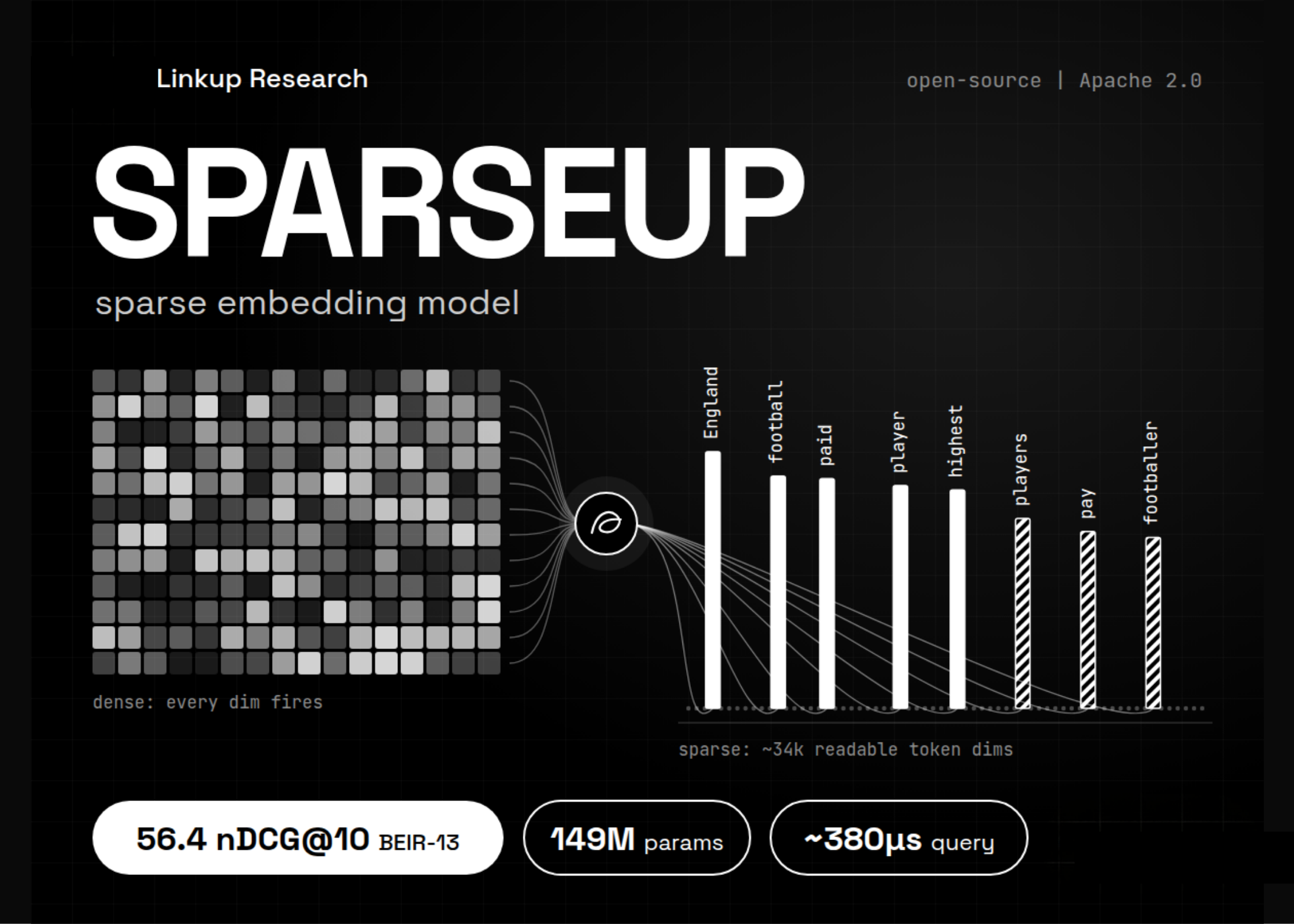
# SPARSEUP: A New Open-Source Sparse Embedding Model That Rivals Dense Retrieval
The landscape of text retrieval has long been dominated by dense encoding models, where each piece of text is compressed into a single dense vector. A newly released sparse embedding approach challenges this paradigm with a vocabulary-based method that is not only more interpretable but also remarkably competitive in benchmark performance.
## What Is SPARSEUP?
SPARSEUP is a 149-million-parameter sparse embedding model built on a ModernBERT backbone. Unlike traditional dense models that produce one vector per text, sparse encoders output a weighted vector over a fixed vocabulary. Each dimension in the resulting vector corresponds to an actual token, meaning the embeddings can be inverted into searchable indexes and inspected by humans — a feature that dense vectors fundamentally lack.
The model has been released under the Apache 2.0 license, with weights available on Hugging Face. It can be loaded using standard libraries like Transformers and Sentence Transformers by setting `trust_remote_code=True` to `True`.
## Why Sparse Models Matter
The question is not simply academic. Sparse encoders have a unique set of advantages that make them compelling for real-world retrieval systems:
– **Interpretability**: Because every dimension maps to a known token, you can inspect exactly which words or subwords contributed most to a match. This is invaluable for debugging and domain-specific applications.
– **Compatibility with inverted indexes**: Sparse vectors naturally fit into classic search infrastructure, enabling fast, scalable retrieval without the need for approximate nearest neighbor libraries that dense models require.
– **Strong rare-word matching**: Vocabulary-based models tend to capture rare and specific terms more effectively than dense encoders, which can smooth over infrequent but critical signals.
## Filling a Gap in the Landscape
The release of SPARSEUP was motivated by a notable gap in the open-source retrieval ecosystem. When a major research group published an open dataset, training recipe, dense model, and late-interaction model using the same ModernBERT family, it created a unique opportunity to compare all major retrieval paradigms side by side. However, the sparse retrieval slot was missing. SPARSEUP fills that gap, allowing practitioners to compare dense, late-interaction, and sparse approaches trained on identical data and backbone architecture.
## How SPARSEUP Is Built
### Training Pipeline
The model starts from an unsupervised late-interaction checkpoint. Since that checkpoint lacked a masked language modeling (MLM) head, the team reattached ModernBERT’s original MLM head before fine-tuning. The training process used contrastive learning exclusively, drawing from a curated fine-tuning mixture.
For each query in a training batch, the model was presented with seven hard negatives sampled from a pool of fifty candidates, in addition to in-batch negatives. No cross-encoder distillation was employed, and the entire training run fits on a single H100 GPU — a remarkably efficient setup for a model of this caliber.
### Solving the “Bag of Stopwords” Problem
A vanilla implementation of sparse encoding on this backbone would produce extremely dense bags dominated by common stopwords. SPARSEUP addresses this with three targeted architectural modifications:
**1. Logit Shifting**
ModernBERT’s MLM logits tend to be large, which causes the sparse encoding function to saturate and produce dense, uninformative vectors. By subtracting a threshold value before applying the log-transformed ReLU activation — specifically `log(1 + ReLU(x − 15))` — the model starts with sparse vectors at initialization and maintains meaningful sparsity throughout training.
**2. Per-Token Top-K Selection**
Instead of allowing each input token to expand across the entire vocabulary, SPARSEUP keeps only the top twelve strongest vocabulary dimensions for each token position before max pooling. This caps per-token expansion without limiting the total vector size, ensuring that each token contributes a focused set of signals rather than scattering weight everywhere.
**3. Case Folding**
The underlying byte-level BPE tokenizer stores multiple surface forms of the same word — such as `heat`, `Heat`, `Ġheat`, and `ĠHeat` — as separate token IDs. SPARSEUP folds these variants onto a single canonical ID after pooling, keeping only the largest weight. This reduces the effective output vocabulary from roughly fifty thousand dimensions to approximately thirty-four thousand, consolidating redundant representations into clean, unified signals.
### Scoring and Evaluation
Queries receive a `[Q]` prefix and documents receive a `[D]` prefix. Both are processed through the same encoder, and scoring between a query and a document is performed via a simple dot product. During evaluation, queries are truncated at 128 tokens and documents at 512 tokens.
## Performance and Benchmarks
SPARSEUP achieves an average nDCG@10 of 56.4 across the BEIR-13 benchmark suite, which the developers report as the strongest public vocabulary-based sparse encoder under 150 million parameters.
Key performance highlights include:
| Metric | Value |
|—|—|
| BEIR-13 avg nDCG@10 | 56.4 |
| Avg non-zeros per query (MS MARCO) | 47 |
| Avg non-zeros per document (MS MARCO) | 190 |
| Recall vs exact search (Seismic) | >97% |
| Per-query latency (single-threaded, MS MARCO) | ~380 microseconds |
For context, SPLADE-v3 on the same backbone produces far denser vectors — roughly 25 non-zeros per query and 170 per document — while SPARSEUP achieves higher precision with more targeted expansion.
## Comparative Results
Against other sparse encoders under 150 million parameters, SPARSEUP leads the pack on BEIR-13 without MS MARCO. Notable competitors include OpenSearch’s doc-v3-gte (54.6), OpenSearch v1 (52.44), and SPLADE-v3 (51.7). The model also holds its own when compared against late-interaction and dense models from the same training setup, with LateOn scoring 58.9 and DenseOn at 57.9 on the same benchmark — a narrow margin that speaks well for the sparse approach.
One distinction worth noting: SPARSEUP uses approximate nearest neighbor search (Seismic) during evaluation, while LateOn and DenseOn use exact search. Despite this difference, the gap is small, suggesting that sparse models with approximate search are highly competitive.
## Deployability and Integration
SPARSEUP is designed for practical deployment. The weights are freely downloadable from Hugging Face, and the model integrates into existing NLP pipelines through standard libraries. The use of Apache 2.0 licensing means there are no restrictions on commercial use, modification, or distribution — making it a strong candidate for production retrieval systems.
## Frequently Asked Questions
**Q: What is the difference between sparse and dense retrieval models?**
A: Dense models compress each text into a single fixed-length vector where every dimension is active and carries continuous values. Sparse models produce a vector where most dimensions are zero, and each non-zero dimension corresponds to a specific token from the vocabulary. This makes sparse vectors interpretable and compatible with traditional search infrastructure.
**Q: Why is case folding important in SPARSEUP?**
A: Byte-level BPE tokenizers treat different capitalizations and whitespace-prefixed variants of the same word as separate tokens. Case folding merges these variants into a single canonical representation after pooling, reducing the effective vocabulary from ~50k to ~34k and eliminating redundant dimensions that would otherwise fragment a single concept across multiple entries.
**Q: Can SPARSEUP be used for languages other than English?**
A: The model is trained with a byte-level BPE tokenizer that supports multilingual text. However, its primary training data and benchmark evaluations focus on English-language retrieval tasks. Fine-tuning on multilingual corpora could extend its capabilities to other languages.
**Q: How does SPARSEUP compare to SPLADE?**
A: Both are vocabulary-based sparse models, but SPARSEUP introduces several refinements including logit shifting, per-position top-k selection, and case folding. These changes produce sparser, more precise vectors compared to vanilla SPLADE, while also achieving higher benchmark scores.
**Q: Is SPARSEUP suitable for production use?**
A: Yes. The model is Apache 2.0 licensed, weights are publicly available, and it can be integrated into existing systems using standard transformer libraries. Its single-threaded query latency of roughly 380 microseconds on MS MARCO makes it viable for low-latency retrieval applications.
**Q: What hardware is needed to train a similar model from scratch?**
A: According to the development team, the fine-tuning process fits on a single H100 GPU, making it accessible for organizations without large-scale multi-GPU training infrastructure.
**Q: How does the model handle out-of-vocabulary or rare terms?**
A: Because SPARSEUP uses a vocabulary-based approach with byte-level BPE, rare or specialized terms are represented by one or more subword tokens, each with its own learned expansion. The per-token top-k mechanism ensures that even rare tokens can contribute meaningful, focused signals to the final vector.
## Conclusion
SPARSEUP represents a significant step forward for open-source sparse retrieval. By combining a carefully designed training pipeline with three targeted architectural innovations — logit shifting, per-position top-k selection, and case folding — the model achieves competitive benchmark performance while maintaining the interpretability and infrastructure compatibility that make sparse encoders uniquely valuable.
The release under Apache 2.0 and its availability on Hugging Face lower the barrier to entry for teams looking to incorporate vocabulary-based sparse retrieval into their applications. As the retrieval landscape continues to evolve, models like SPARSEUP demonstrate that sparse approaches remain highly relevant and can rival their dense counterparts when engineered with precision.
For practitioners, researchers, and engineers working on search and information retrieval, SPARSEUP offers a compelling option worth evaluating — especially for use cases where interpretability, speed, and integration with existing search infrastructure are priorities.
Thank you for reading.
