



# Optimizing Small Language Models for Narrow Automation Through Prompt Prefix Caching
## Introduction
Small language models (SLMs) are increasingly becoming viable candidates for production deployment in constrained, repetitive automation tasks. When a model is tasked with classifying support tickets, extracting structured fields, or routing incoming messages, the prompt itself rarely changes — a fixed set of instructions, category definitions, and a handful of few-shot examples remain constant across every single call. Yet most naive implementations treat each inference request as a fresh, isolated event, recomputing the entire prompt from scratch every time.
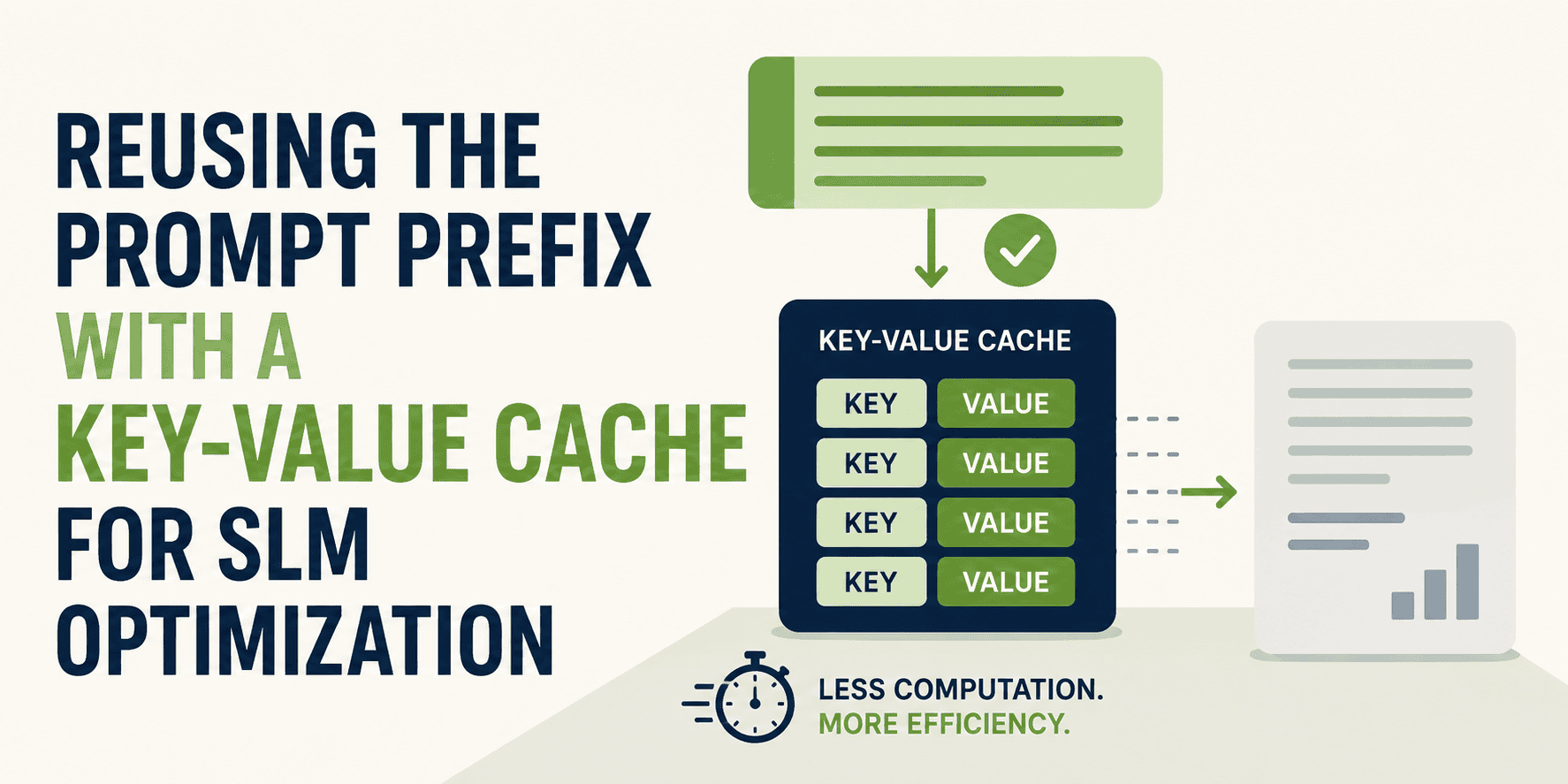
This article explores a powerful optimization strategy: caching the key-value representations of a static prompt prefix so that the model does not waste compute re-processing identical tokens on every invocation. By leveraging this technique, practitioners can achieve dramatic throughput improvements without altering model behavior or accuracy.
—
## Why Caching the Static Prefix Matters
In a typical narrow automation setup, the prompt consists of two parts:
– **A static prefix** — the system instructions, taxonomy definitions, and worked examples.
– **A dynamic suffix** — the specific input item being classified or processed.
For many real-world prompts, the static prefix can account for 80–90% of the total token count. Transformers generate a key vector and a value vector for every token at every attention layer, and these depend solely on the tokens to their left. This means that for any token in the fixed prefix, the computed keys and values will be bit-for-bit identical on every single call. Recomputing them is, by any measure, redundant.
By computing the prefix’s key-value pairs once and retaining them, the per-item forward pass shrinks to processing only the tokens that actually changed. The savings compound rapidly when thousands or millions of items are processed in a batch.
—
## How Key-Value Caching Works Under the Hood
During autoregressive decoding, the transformer maintains a cache of past keys and values across all layers. When new tokens arrive, the model attends to both the new inputs and everything stored in the cache. This is the standard mechanism behind efficient generation — but it can also be applied to pre-fill computation, which is exactly what prefix caching exploits.
The workflow looks like this:
1. **Populate the cache once** by running the static prefix through the model in a single forward pass with `use_cache=True`.
2. **For each subsequent item**, tokenize only the dynamic portion, construct an attention mask spanning both the cached prefix and the new tokens, and specify the correct starting position via `cache_position`.
3. **After inference**, trim the cache back to its original prefix length so it does not accumulate stale entries from previous items.
The result is a dramatic reduction in the number of tokens the model must process per call, translating directly into faster inference and lower energy consumption.
—
## A Practical Implementation
Below is a streamlined implementation using the Hugging Face Transformers library. The example uses a lightweight instruction-tuned model running on modest consumer hardware, demonstrating that these optimizations are accessible without specialized infrastructure.
### Setup
“`bash
pip install torch transformers accelerate
“`
### Step 1: Baseline — Full Re-encoding Per Item
The first pass establishes the baseline by encoding the entire prompt (prefix + suffix) from scratch for every single item. This represents the unoptimized approach most beginners default to.
“`python
import os
import time
import torch
from transformers import AutoTokenizer, AutoModelForCausalLM
MODEL_ID = “Qwen/Qwen2.5-0.5B-Instruct”
torch.set_num_threads(os.cpu_count() or 1)
tokenizer = AutoTokenizer.from_pretrained(MODEL_ID)
model = AutoModelForCausalLM.from_pretrained(MODEL_ID, dtype=torch.float32)
model.eval()
LABELS = [“billing”, “technical”, “account”]
tickets = [
“My card was charged twice for the same invoice.”,
“The mobile app crashes whenever I open the settings page.”,
“I need to change the email address on my profile.”,
] * 200
label_first_ids = [tokenizer.encode(label, add_special_tokens=False)[0] for label in LABELS]
assert len(set(label_first_ids)) == len(LABELS), (
“Labels share a first token; score full label sequences instead.”
)
label_first_ids = torch.tensor(label_first_ids, device=model.device)
SYSTEM_PROMPT = “””You classify customer support tickets into exactly one category.
Categories:
– billing: payments, invoices, refunds, charges, subscription costs
– technical: crashes, errors, performance problems, broken features
– account: profile changes, login access, permissions, account deletion
Examples:
Ticket: I was billed twice in March.
Category: billing
Ticket: The dashboard never finishes loading.
Category: technical
Ticket: Please remove my old phone number from my profile.
Category: account
Ticket: My promo code was rejected at checkout.
Category: billing
Ticket: Exporting to CSV throws a 500 error.
Category: technical
Ticket: I cannot reset my password.
Category: account
“””
prefix_text = f”<|im_start|>systemn{SYSTEM_PROMPT}<|im_end|>n”
def suffix_text(ticket):
return (
f”<|im_start|>usernTicket: {ticket}nCategory:<|im_end|>n”
f”<|im_start|>assistantn”
)
def encode(text):
return tokenizer(text, add_special_tokens=False)[“input_ids”]
_probe = suffix_text(tickets[0])
assert encode(prefix_text) + encode(_probe) == encode(prefix_text + _probe), (
“Prefix/suffix split is not token-clean; move the boundary.”
)
prefix_len = len(encode(prefix_text))
full_len = prefix_len + len(encode(_probe))
print(f”Static prefix length: {prefix_len} tokens”)
print(f”Full prompt length: {full_len} tokens ({100 * prefix_len / full_len:.0f}% of it static)”)
baseline_predictions = []
start = time.time()
for n, ticket in enumerate(tickets, start=1):
if n % 100 == 0:
print(f” {n}/{len(tickets)} tickets ({(time.time() – start) / n:.2f}s each)”, flush=True)
full = tokenizer(
prefix_text + suffix_text(ticket), add_special_tokens=False, return_tensors=”pt”
).to(model.device)
with torch.no_grad():
logits = model(**full).logits[0, -1, :]
baseline_predictions.append(LABELS[int(logits[label_first_ids].argmax())])
duration_full = time.time() – start
print(f”Recomputing the full prompt every time: {duration_full:.2f} seconds”)
print(f” ({1000 * duration_full / len(tickets):.1f} ms per ticket)”)
“`
On the hardware used for testing, this approach produced a runtime of approximately 185 seconds, or roughly 308 milliseconds per ticket.
### Step 2: Prefix-Cached Inference
The second pass reuses the cached key-value tensors from the static prefix, processing only the dynamic suffix on each iteration.
“`python
from transformers import DynamicCache
prefix = tokenizer(prefix_text, add_special_tokens=False, return_tensors=”pt”).to(model.device)
prefix_ids = prefix[“input_ids”]
prefix_len = prefix_ids.shape[1]
full_len = prefix_len + len(encode(_probe))
prefix_cache = DynamicCache()
with torch.no_grad():
model(
input_ids=prefix_ids,
attention_mask=torch.ones_like(prefix_ids),
past_key_values=prefix_cache,
use_cache=True,
)
def classify_cached(ticket):
suffix = tokenizer(
suffix_text(ticket), add_special_tokens=False, return_tensors=”pt”
).to(model.device)
suffix_ids = suffix[“input_ids”]
suffix_len = suffix_ids.shape[1]
attention_mask = torch.ones((1, prefix_len + suffix_len), device=model.device, dtype=torch.long)
cache_position = torch.arange(prefix_len, prefix_len + suffix_len, device=model.device)
with torch.no_grad():
out = model(
input_ids=suffix_ids,
attention_mask=attention_mask,
past_key_values=prefix_cache,
cache_position=cache_position,
use_cache=True,
)
logits = out.logits[0, -1, :]
label = LABELS[int(logits[label_first_ids].argmax())]
prefix_cache.crop(prefix_len)
return label
def classify_full(ticket):
full = tokenizer(
prefix_text + suffix_text(ticket), add_special_tokens=False, return_tensors=”pt”
).to(model.device)
with torch.no_grad():
logits = model(**full).logits[0, -1, :]
return LABELS[int(logits[label_first_ids].argmax())]
mismatches = [t for t in dict.fromkeys(tickets) if classify_cached(t) != classify_full(t)]
assert not mismatches, f”Cached path disagrees with full re-encoding on: {mismatches}”
print(f”Cache verified against full re-encoding on {len(set(tickets))} distinct tickets”)
predictions = []
start = time.time()
for n, ticket in enumerate(tickets, start=1):
if n % 100 == 0:
print(f” {n}/{len(tickets)} tickets ({(time.time() – start) / n:.2f}s each)”, flush=True)
predictions.append(classify_cached(ticket))
duration_cached = time.time() – start
print(f”Reusing the cached prefix: {duration_cached:.2f} seconds”)
print(f” ({1000 * duration_cached / len(tickets):.1f} ms per ticket)”)
“`
The cached approach completed in roughly 80 seconds, averaging about 133 milliseconds per ticket — a runtime reduction of approximately 57%.
—
## Key Implementation Notes
Several details in the code above deserve attention, as they are easy to get wrong and can silently produce incorrect results.
**Token-clean splitting**: The prompt must be split at a boundary that aligns with the tokenizer’s vocabulary. If you tokenize two halves separately, the resulting ID sequence might differ from tokenizing the full concatenation, especially if the split lands mid-word. The assertion in the baseline script validates this directly.
**Attention mask width**: The mask must be wide enough to cover both the cached prefix and the incoming suffix, even though only the suffix IDs are being fed into the model. This ensures the model attends correctly to both regions.
**Cache position tracking**: The new tokens must be told where they begin in the sequence. Passing `cache_position` explicitly ensures that rotary positional embeddings are computed relative to the correct offset, matching what the full prompt would have produced.
**Cache cropping**: After each forward pass, the suffix keys and values get appended to the cache. Without explicitly trimming it back to the prefix length, the cache would grow indefinitely and the second item would attend to the first item’s suffix — a clear correctness bug.
**torch.no_grad() vs torch.inference_mode()**: Using `no_grad()` rather than `inference_mode()` is recommended here because tensors created under `inference_mode` carry internal flags that make them awkward to manipulate after the fact. The `crop()` operation on the cache relies on straightforward tensor slicing, which works reliably under `no_grad()`.
—
## Performance Takeaways
| Metric | Full Re-encoding | Prefix Caching | Improvement |
|—|—|—|—|
| Total runtime (600 items) | ~185 seconds | ~80 seconds | ~57% faster |
| Per-item latency | ~308 ms | ~134 ms | ~56% reduction |
| Prediction accuracy | Identical | Identical | No change |
The gains scale directly with the proportion of static content in the prompt. Prompts with longer instruction blocks, more examples, and richer taxonomies stand to benefit the most, since a larger share of the computation is redundant across calls.
—
## FAQ
**Q: Does prefix caching change the model’s predictions in any way?**
A: No. This is purely a compute optimization. The same attention computations occur — the model simply does not recompute the key and value vectors for tokens it has already processed. The output logits, and therefore the predictions, are identical.
**Q: What hardware is needed to benefit from prefix caching?**
A: The technique is hardware-agnostic. It can be applied on consumer-grade GPUs, Apple Silicon with Neural Engine, or even CPU-only setups. The only requirement is sufficient memory to hold the key-value cache tensors, which for small models and modest prefix lengths is rarely a constraint.
**Q: Is this the same technique used in large-scale LLM serving (like vLLM or TGI)?**
A: The underlying principle is identical. Production serving engines use prefix caching to handle concurrent requests that share a common prompt template. The approach described here simply applies the same concept to a custom inference loop rather than a high-throughput serving infrastructure.
**Q: Can prefix caching be combined with other optimization techniques?**
A: Absolutely. Prefix caching complements methods like quantization (e.g., float16 or int8), constrained output scoring, and batching. In fact, combining prefix caching with quantization can yield compounding speedups — one article in this series focused on constrained scoring as a complementary technique.
**Q: Does the DynamicCache approach work with all transformer models?**
A: DynamicCache is supported in recent versions of Hugging Face Transformers for most causal language models. For older model architectures or custom implementations, a manual key-value cache using dictionaries or tensors may be required. Always verify compatibility with the specific model and library version you are using.
**Q: What happens if I forget to crop the cache between calls?**
A: The cache will accumulate the keys and values from every processed suffix. This leads to two problems: the attention mask and cache positions will become misaligned with subsequent calls, and the cache will consume ever-increasing memory. Both issues will produce incorrect results or eventual out-of-memory errors.
—
## Conclusion
Optimizing small language models for production use requires looking beyond the model itself and focusing on the surrounding inference infrastructure. Prefix caching is one of the most impactful yet straightforward techniques available: it leverages the inherent redundancy in static prompts to eliminate wasted computation, often cutting per-item latency in half or more.
For narrow automation tasks — classification, extraction, routing — the prompt is overwhelmingly static. Once the inference loop recognizes this and caches accordingly, the small model stops being a compromise and becomes the obvious choice. The longer and more detailed the instruction block, the more valuable the optimization becomes.
Adopting this technique does not require specialized hardware, exotic libraries, or changes to model weights. It is a software-level optimization that any practitioner can implement with the Hugging Face ecosystem and a few lines of additional code. When combined with other strategies from the same optimization family, it can transform a prototype-level SLM pipeline into something genuinely production-ready.
Thank you for reading
